
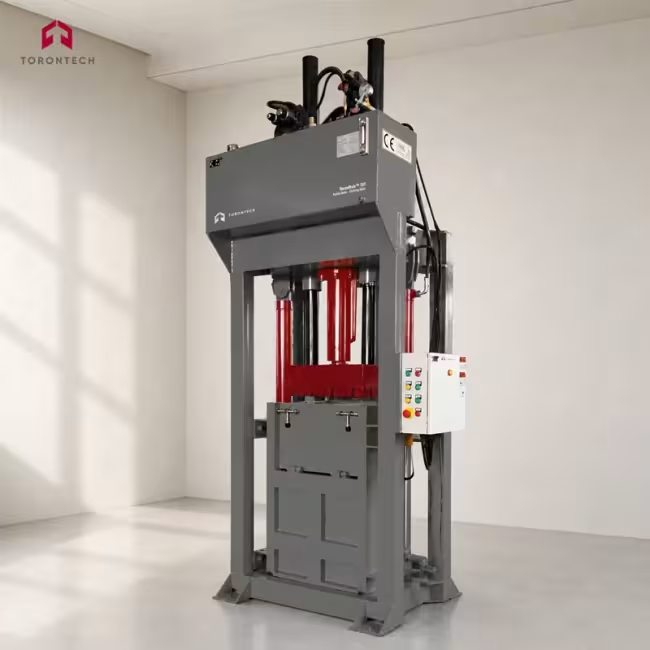
Textile Baler - Clothing Baler - ToronBale™ TXT
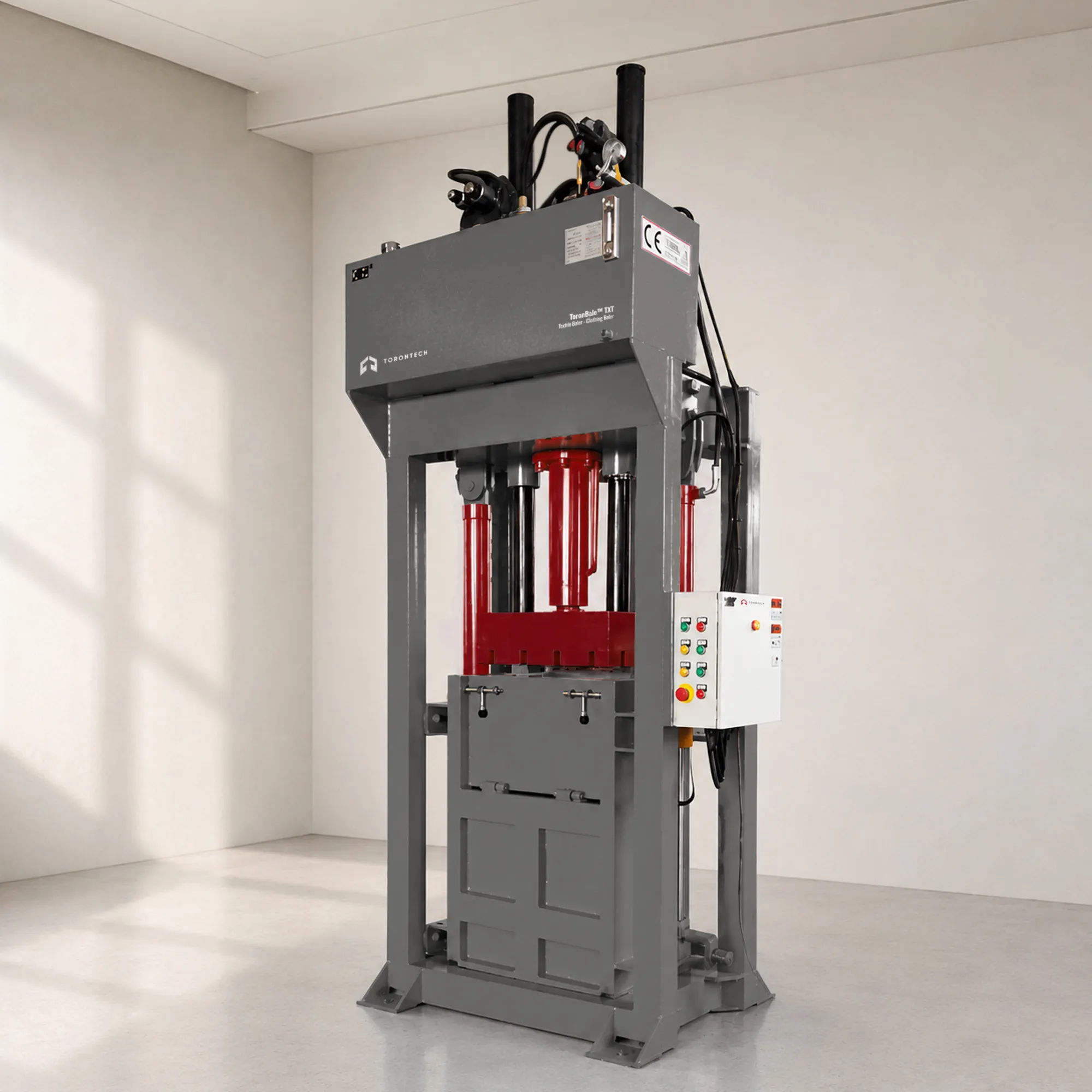
textile baler compresses used clothing, wool, cotton, and fabric waste into dense bales for storage, sale, or export. Torontech supplies the ToronBale™ TXT in five configurations spanning 30 to 150 tons of press force, with bale weights from 40 kg to 400 kg. Soft materials need far more pressure than their weight suggests, which is why the larger models reach tonnages normally associated with scrap metal presses. Machine weights run from 1,800 kg to 6,000 kg.
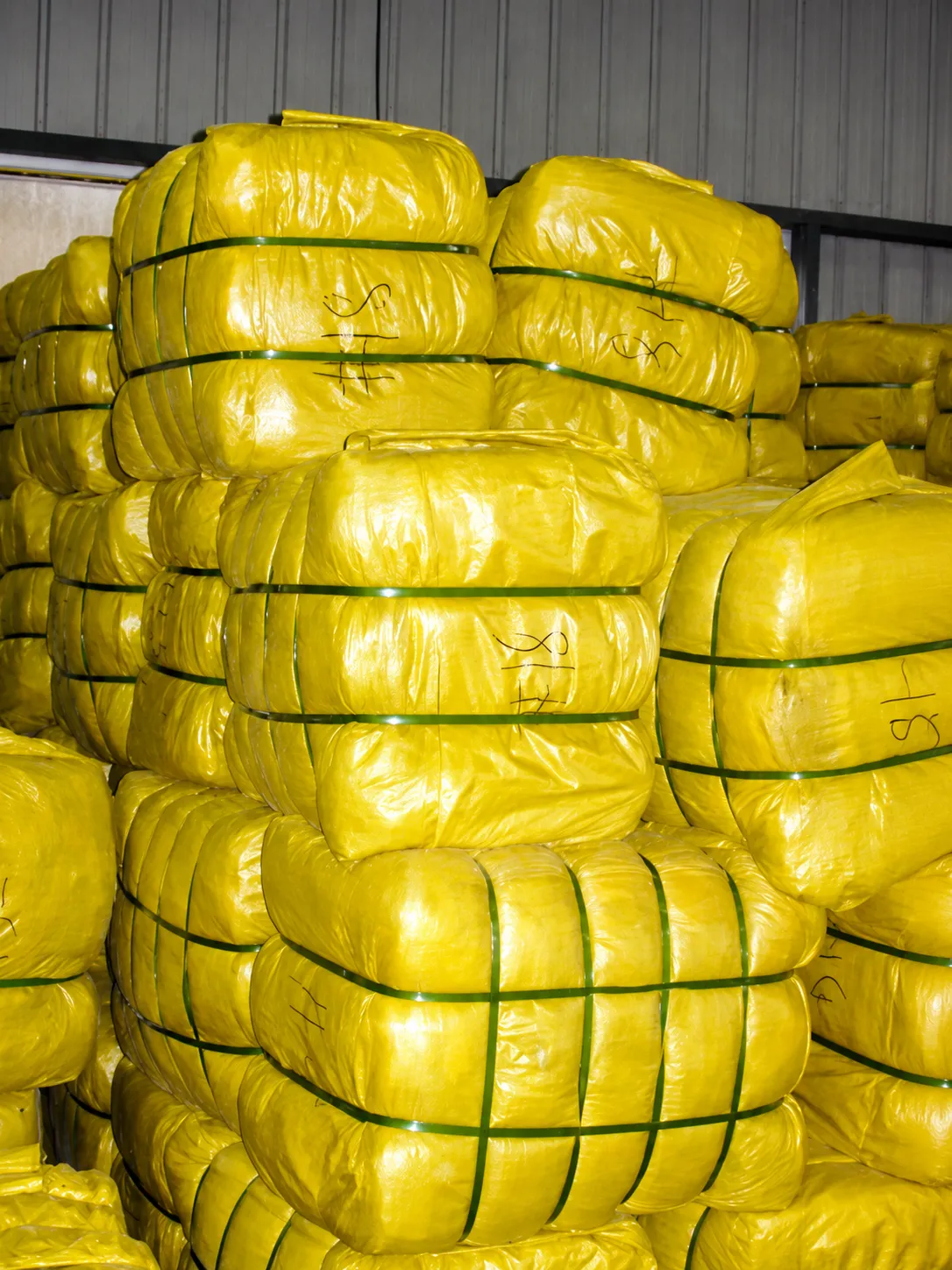
A hydraulic lifting chamber separates this machine from general-purpose balers. The chamber rises clear of the finished bale rather than opening a single door, exposing all four sides at once. Operators then pass straps around the bale in a cross pattern and slip a bag over it before the material relaxes. Textile bales bulge in every direction, so tying from one face alone rarely holds them.
Model choice depends on bale density rather than volume. The 120 ton unit produces a smaller 800 by 450 mm bale at high pressure, suited to export shipments priced by container space. The 150 ton unit makes larger bales up to 400 kg for operations handling volume. Second-hand clothing plants, wool handlers, and textile recyclers use the ToronBale™ TXT across all five sizes.
Textile Baler - Clothing Baler - ToronBale™ TXT Applications
The ToronBale™ TXT serves operations that collect, sort, or process soft textile material in commercial quantities.
- Second-Hand Clothing Export: compresses sorted garments into dense, bagged bales sized for container shipment to overseas markets
- Charity and Thrift Store Operations: bales unsold donations and surplus stock for sale to graders and recyclers
- Textile Recycling Plants: densifies mixed fabric waste, cutting the storage volume that loose textile occupies
- Wool Handling and Scouring: presses greasy or scoured wool into bales for transport to processors
- Cotton Ginning and Processing: compacts cotton lint and comber waste for onward sale
- Garment Manufacturing: bales cutting-room offcuts and rejected stock generated during production runs
- Wiper and Rag Producers: compresses graded rag stock into uniform units for distribution
- Commercial Laundry and Linen Services: bales retired linen, towels, and uniforms at end of service life
- Bedding and Comforter Manufacturing: handles filling waste, quilt offcuts, and returned soft goods
Standards
Torontech has no published standards compliance for the ToronBale™ TXT at this time. The design includes a feed-gate interlock that halts downward platen travel when the loading gate opens, along with an independent emergency stop mounted separately from the main controls. Buyers who require specific safety certification, marking, or documentation for their jurisdiction should raise this with Torontech before ordering, since available documentation varies by destination market and configuration.
Textile Baler - Clothing Baler - ToronBale™ TXT Key Features
The ToronBale™ TXT is built around the two problems that define textile baling, high compression force and controlled restraint of a bale that wants to expand.
- Hydraulic Lifting Chamber: the chamber rises clear of the finished bale instead of opening one door, exposing all four faces for cross-tying and bagging while the material stays compressed
- Cross-Tying Access: full-perimeter access lets operators strap along both axes, which holds a bale that would burst single-axis strapping
- Bale Bagging Capability: the open chamber lets a protective bag go over the bale during the same operation, keeping export stock clean and dry in transit
- Press Force from 30 to 150 Tons: five ratings cover thrift store volumes through high-density export production without over-specifying
- High-Density Configuration: the 120 ton model applies its force to a smaller 800 by 450 mm bale face, producing the dense bales that container-based shipping economics reward
- Feed Gate Ram Interlock: stops downward platen travel the moment the loading gate opens, keeping hands clear of the compaction zone
- Independent Emergency Stop: a dedicated, prominently mounted circuit cuts hydraulic function apart from the main control system
- Reinforced Ram Guides: maintain a square platen face when soft material piles unevenly, protecting cylinder seals from side loading
- Automatic Load-Balancing Design: distributes compaction force across the platen so off-center charges do not produce sudden shifts mid-stroke
- Direct-Coupled Motor and Pump: a cross-connected direct drive holds full concentricity between motor and pump, replacing conventional couplings and extending pump service life
- NOK Hydraulic Seals: Japanese-sourced sealing components extend service intervals and reduce seal replacement downtime
- A.M.C. Oil Pipe Joints: Japanese-made fittings hold hydraulic connections leak-free across thermal cycling and vibration
- Adjustable Bale Height: bale height adjusts on every model, letting operators match bale size to buyer specification or container loading pattern
Theory and Method
Fiber masses resist compression steeply rather than evenly. Loose textile is mostly air, and early platen travel costs little because fibers rearrange and air escapes. Once fibers touch on all sides, further volume reduction forces them to bend against one another, and required pressure climbs roughly with the cube of packing density. That is why the largest models carry 120 and 150 ton ratings while producing bales lighter than a metal baler makes at 30 tons.
Nothing holds that compression except friction. Fibers store the bending energy elastically, so a textile bale pushes outward with real force the moment platen pressure drops. Inter-fiber friction resists that recovery, but only partially, and a bale left untied expands within seconds. The material has no yield point that locks it in place the way crushed aluminum stays crushed.
Bale restraint therefore has to happen under load, which drives the chamber design. Raising the whole chamber rather than swinging one door gives access to every face while the platen still holds the charge down. Straps go on in a cross pattern, resisting outward pressure along both axes, and a bag can be fitted at the same moment. Ram guides hold the platen square throughout, since textile piles unevenly and side loading would otherwise reach the cylinder seals.
Textile Baler - Clothing Baler - ToronBale™ TXT Technical Specifications
| Parameter | ToronBale™ TXT-30A | ToronBale™ TXT-30B | ToronBale™ TXT-50 | ToronBale™ TXT-120 | ToronBale™ TXT-150 |
|---|---|---|---|---|---|
| Press Force | 30 tons (approx. 294 kN) | 30 tons (approx. 294 kN) | 50 tons (approx. 490 kN) | 120 tons (approx. 1,177 kN) | 150 tons (approx. 1,472 kN) |
| Feed Opening Size (L × H) | 600 × 400 mm | 700 × 400 mm | 750 × 350 mm | 750 × 450 mm | 1,100 × 600 mm |
| Baling Chamber Height | 1,250 mm | 1,200 mm | 1,850 mm | 1,700 mm | 1,850 mm |
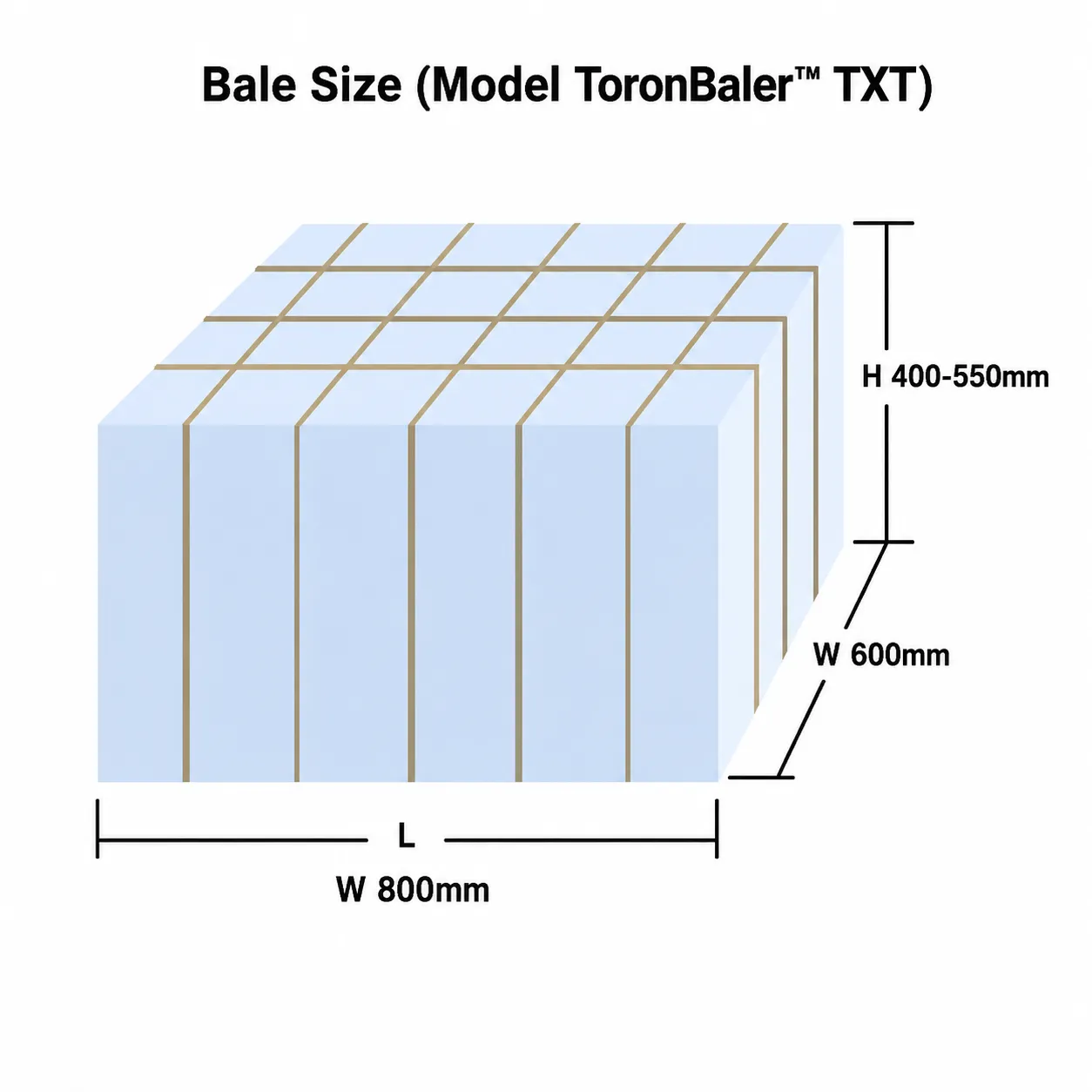
| Bale Size (L × W × H, H adjustable) | 630 × 430 × (400 to 600) mm | 730 × 430 × (250 to 600) mm | 800 × 600 × (400 to 550) mm | 800 × 450 × (350 to 500) mm | 1,100 × 850 × (500 to 900) mm |
| Bale Weight | 40 to 60 kg | 40 to 60 kg | 80 to 120 kg | 90 to 150 kg | 300 to 400 kg |
| Motor Power | 7.5 kW | 7.5 kW | 11 kW | 18.5 kW | 18.5 kW |
| Machine Weight | 1,800 kg | 1,800 kg | 2,800 kg | 3,800 kg | 6,000 kg |
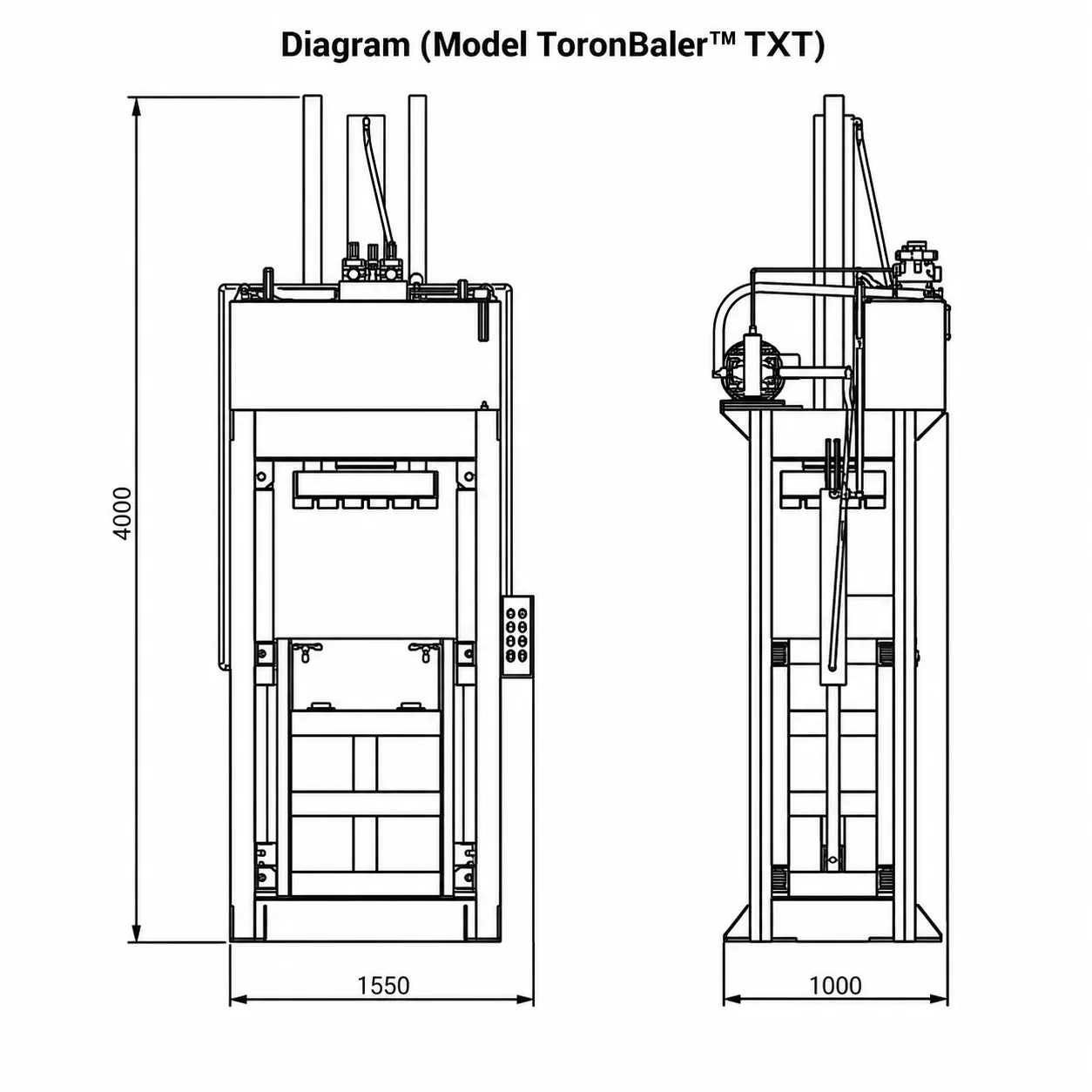
| Overall Dimensions (L × W × H) | 1,250 × 800 × 3,700 mm | 1,200 × 700 × 3,500 mm | 1,550 × 1,000 × 4,200 mm | 1,600 × 1,000 × 4,550 mm | 2,000 × 1,450 × 4,300 mm |
| Chamber Access | Hydraulic lifting chamber | Hydraulic lifting chamber | Hydraulic lifting chamber | Hydraulic lifting chamber | Hydraulic lifting chamber |
| Materials Handled | Used clothing, comforters, shoes, wool, cotton | Used clothing, comforters, shoes, wool, cotton | Used clothing, comforters, shoes, wool, cotton | Used clothing, comforters, shoes, wool, cotton | Used clothing, comforters, shoes, wool, cotton |