
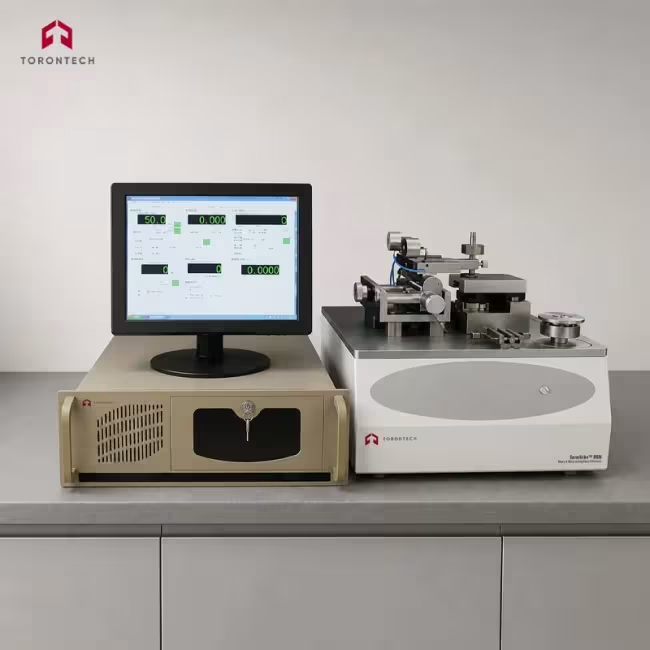
Rotary & Reciprocating Micro Tribometer
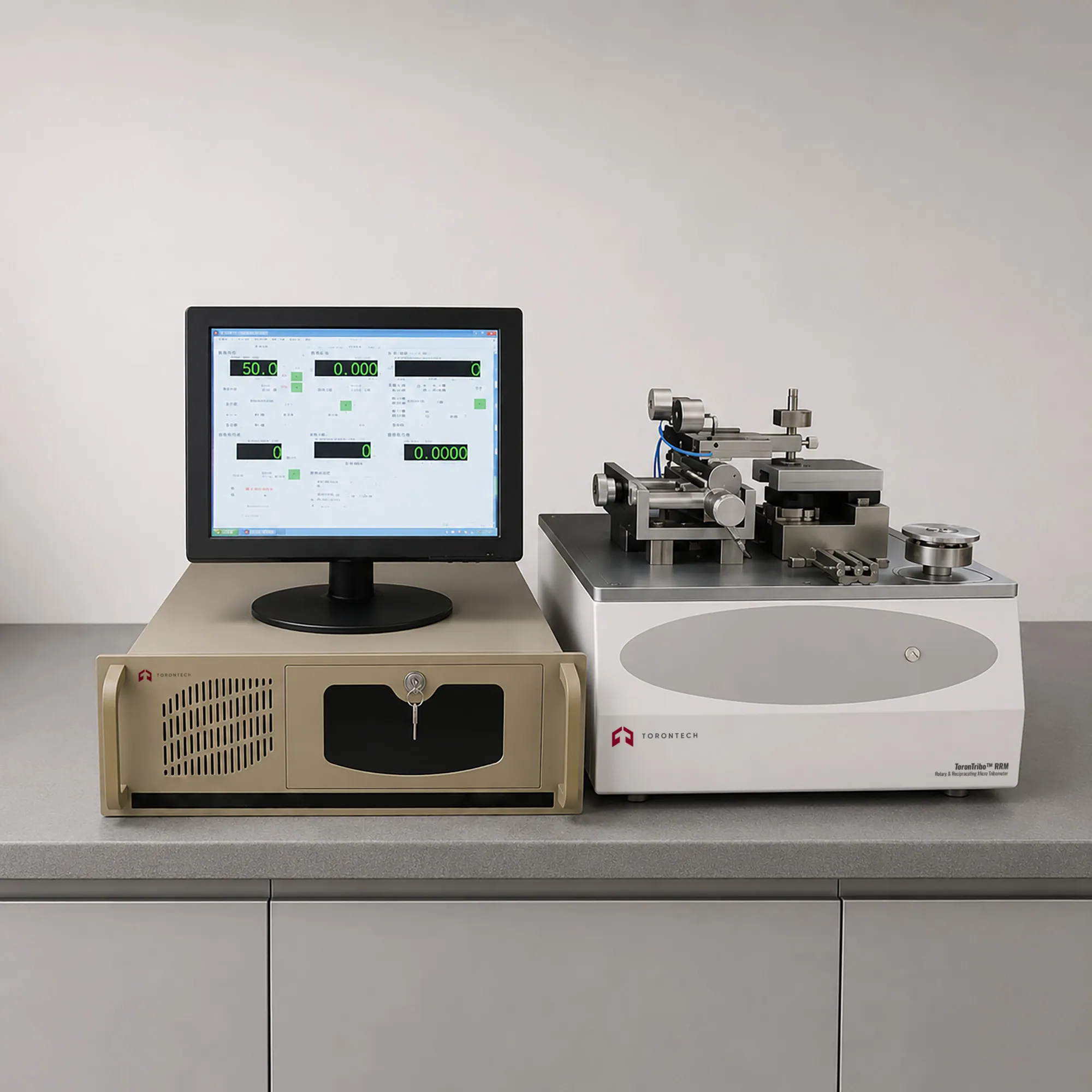
Rotary & Reciprocating Micro Tribometer - ToronTribo™ RRM
Micro-Load Rotary Reciprocating Friction and Wear Tester
Rotary reciprocating micro tribometer gives materials engineers and coating developers a single benchtop platform for evaluating low-load friction and wear performance. It operates under normal forces from 0.1 N to 20 N. The instrument reproduces both rotational sliding and linear reciprocating contact within one test rig. Qualitest offers the ToronTribo™ RRM for laboratories that need repeatable, small-scale tribology data. It replaces the need to switch between separate machines for each motion type.
The system dynamically records friction force and specimen temperature throughout every test. Each parameter plots as a live curve for immediate review during the run. Interchangeable ball-on-disk and pin-on-disk configurations let operators match the friction pair geometry to the material or coating under evaluation. A temperature chamber spanning room temperature to 600°C extends testing into high-temperature wear regimes. This range supports coatings, ceramics, and heat-resistant alloys used in demanding service conditions.
Rotary & Reciprocating Micro Tribometer - ToronTribo™ RRM Applications
The rotary reciprocating micro tribometer supports friction and wear evaluation wherever low-load, small-scale contact conditions need to be reproduced under laboratory control. Typical use spans materials research, coating qualification, and precision component development.
- Thin Film and Coating Development: evaluates friction and wear resistance of thin films, hard coatings, and surface treatments under controlled low-load sliding
- Biomedical Device and Implant Testing: assesses wear behavior of small-scale medical components, including catheter coatings and implant surfaces, at loads that approximate physiological contact
- Electronics and Micro-Component Testing: characterizes friction and wear of connectors, micro-switches, and precision electronic contacts subject to repeated low-force actuation
- Optical and Precision Component Testing: measures surface durability of lenses, mirrors, and touchscreens exposed to repeated light-contact wear
- Automotive Coating and Lubricant Screening: supports material and lubricant selection for low-load automotive components such as valve trains and small bearings
- Jewelry and Consumer Product Finishing: evaluates wear resistance of plated, polished, or coated decorative surfaces
- Materials Research and Academic Studies: provides a benchtop platform for fundamental tribology research across rotating and reciprocating contact regimes at variable temperature
Standards
The rotary reciprocating micro tribometer performs testing in line with internationally recognized tribology test methods. These standards define the apparatus geometry, loading conditions, and reporting requirements the instrument follows for pin-on-disk, ball-on-disk, and reciprocating sliding tests.
- ASTM G99-23 - Standard Test Method for Wear and Friction Testing with a Pin-on-Disk or Ball-on-Disk Apparatus
- ASTM G133-05 - Standard Test Method for Linearly Reciprocating Ball-on-Flat Sliding Wear
- ASTM B611-13 - Standard Test Method for Determining the High Stress Abrasion Resistance of Hard Materials
- DIN 50324:1992-07 - Tribology; Testing of Friction and Wear, Model Test for Sliding Friction of Solids (Ball-on-Disc System)
Rotary & Reciprocating Micro Tribometer - ToronTribo™ RRM Key Features
The ToronTribo™ RRM combines multiple test modes and a wide operating envelope in a single benchtop system.
- Dual Motion Testing: performs both rotational and linear reciprocating wear tests on one drive system, removing the need for separate machines
- Real-Time Friction and Temperature Monitoring: records friction force and specimen temperature continuously and plots each parameter as a live curve during the test
- Low-Load Precision: applies normal forces from 0.1 N to 20 N for accurate characterization of thin films, coatings, and delicate small-scale specimens
- Interchangeable Friction Pairs: supports ball-on-disk and pin-on-disk configurations to match the contact geometry to the material or component under evaluation
- Wide Temperature Range: tests from room temperature to 600°C to evaluate how heat affects friction and wear behavior
- Dry and Lubricated Test Modes: switches between dry friction and oil-lubrication conditions to compare unlubricated wear resistance against lubricant performance
Theory and Method
Rotational wear testing works by pressing a stationary pin or ball against a rotating disk under a fixed normal force. As the disk turns, the contact point traces a circular wear track and the sliding motion generates friction at the interface. A force sensor measures the tangential resistance continuously, and the instrument calculates the coefficient of friction from the ratio of friction force to applied load. Repeated passes remove material from the pin, disk, or both, and the resulting wear volume indicates how well the material resists abrasive and adhesive wear mechanisms.
Reciprocating wear testing reverses the sliding direction in a periodic back-and-forth motion instead of continuous rotation. A ball presses down on a flat specimen while the sample stage drives it linearly across a fixed stroke length. Because the direction reverses at each stroke end, the test reproduces contact conditions found in components such as pistons, valve trains, and seals that experience repeated directional changes rather than one-way sliding. The instrument tracks friction force through the full stroke and calculates wear volume on both the ball and flat specimen at the end of the test.
The ToronTribo™ RRM combines both test geometries in one drive system, so operators switch between rotational and reciprocating motion without reconfiguring the load frame. Dry-friction and oil-lubrication modes let the same setup evaluate unlubricated wear resistance and lubricant film performance side by side. The integrated heating stage raises specimen temperature up to 600°C, which lets engineers separate temperature-driven changes in friction and wear from the baseline behavior measured at room temperature.
Rotary & Reciprocating Micro Tribometer - ToronTribo™ RRM Technical Specifications
| Parameter | Specification |
|---|---|
| Normal Force Range | 0.1 N to 20 N |
| Maximum Rotational Speed | 2,000 rpm |
| Maximum Oscillation Frequency | 20 Hz |
| Friction Force Range | 0.05 N to 10 N |
| Maximum Rotation Radius | 30 mm |
| Maximum Reciprocating Stroke | 30 mm |
| Reciprocating Friction Pair | Ball-on-disk, pin-on-disk |
| Rotating Friction Pair | Ball-on-disk, pin-on-disk |
| Temperature Range | Room temperature to 600°C |
| Friction Medium | Dry friction, oil lubrication |