
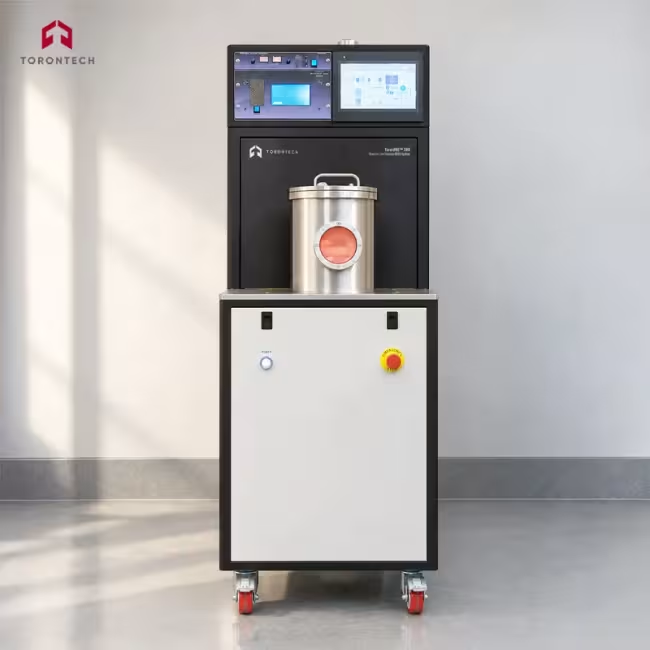
Reactive Ion Etching (RIE) System
Reactive Ion Etching (RIE) System - ToronRIE™ 300
Reactive Ion Etching (RIE) System is a parallel-plate plasma dry etching platform for semiconductor and MEMS device fabrication, processing substrates up to 3 inches in a stainless steel cylindrical chamber. A 300 W RF power supply with fully automatic impedance matching drives plasma between the parallel electrodes, producing reactive ions that etch materials with high selectivity and uniformity. DC bias voltage readout gives real-time process monitoring. The PLC-controlled system with graphical HMI interface supports both manual and fully automatic etching modes.
A water-chilled sample holder with mechanical clamping maintains substrate temperature and position stability during the etch process. The adjustable sample-to-electrode distance enables optimization of etch parameters for different process chemistries and substrate configurations. Process pressure control operates independently from gas flow, and automatic fast-acting pressure regulation responds to changing process conditions without interrupting the etch. The 5×10⁻² mbar base pressure achieved with the standard pump configuration supports the vacuum requirements for reactive ion etching processes.
The system etches Si, SiO₂, Si₃N₄, poly-Si, and selected metals, and supports organic processes including photoresist descumming, stripping, and polymeric film patterning. High etch rate uniformity across the substrate is produced by the optimized reaction chamber and electrode geometry. The W60×D95 cm footprint and clean-room-compatible design enable installation in semiconductor laboratory and MEMS fabrication environments. A dry pump option is available for oil-free vacuum system configurations.
Reactive Ion Etching (RIE) System - ToronRIE™ 300 Applications
The Reactive Ion Etching (RIE) System serves semiconductor device fabrication, MEMS research, and academic thin film laboratories requiring plasma dry etching with anisotropic etch profiles and high material selectivity. Its clean-room-compatible design and PLC automation make it suited to both research programs and small-volume production environments.
- Semiconductor Device Fabrication: dry etching of Si, SiO₂, Si₃N₄, and poly-Si layers for transistor gate patterning, via formation, and trench definition in semiconductor research and prototyping
- MEMS Device Fabrication: anisotropic etching of silicon and oxide layers for suspended structures, sensor membranes, and actuator elements in microelectromechanical device research
- Photoresist Descumming and Stripping: oxygen plasma removal of photoresist residues, scum layers, and post-etch organic contamination without wet chemical processing
- Polymeric Thin Film Etching and Patterning: plasma etching of polymer films, organic device layers, and coatings for printed electronics, biosensor, and flexible device applications
- Surface Activation and Wettability Modification: plasma treatment of substrate surfaces to improve adhesion, wettability, or surface energy before subsequent coating or bonding steps
- Academic and University Cleanroom Research: compact RIE platform for thin film materials research, device prototyping, and cleanroom teaching environments
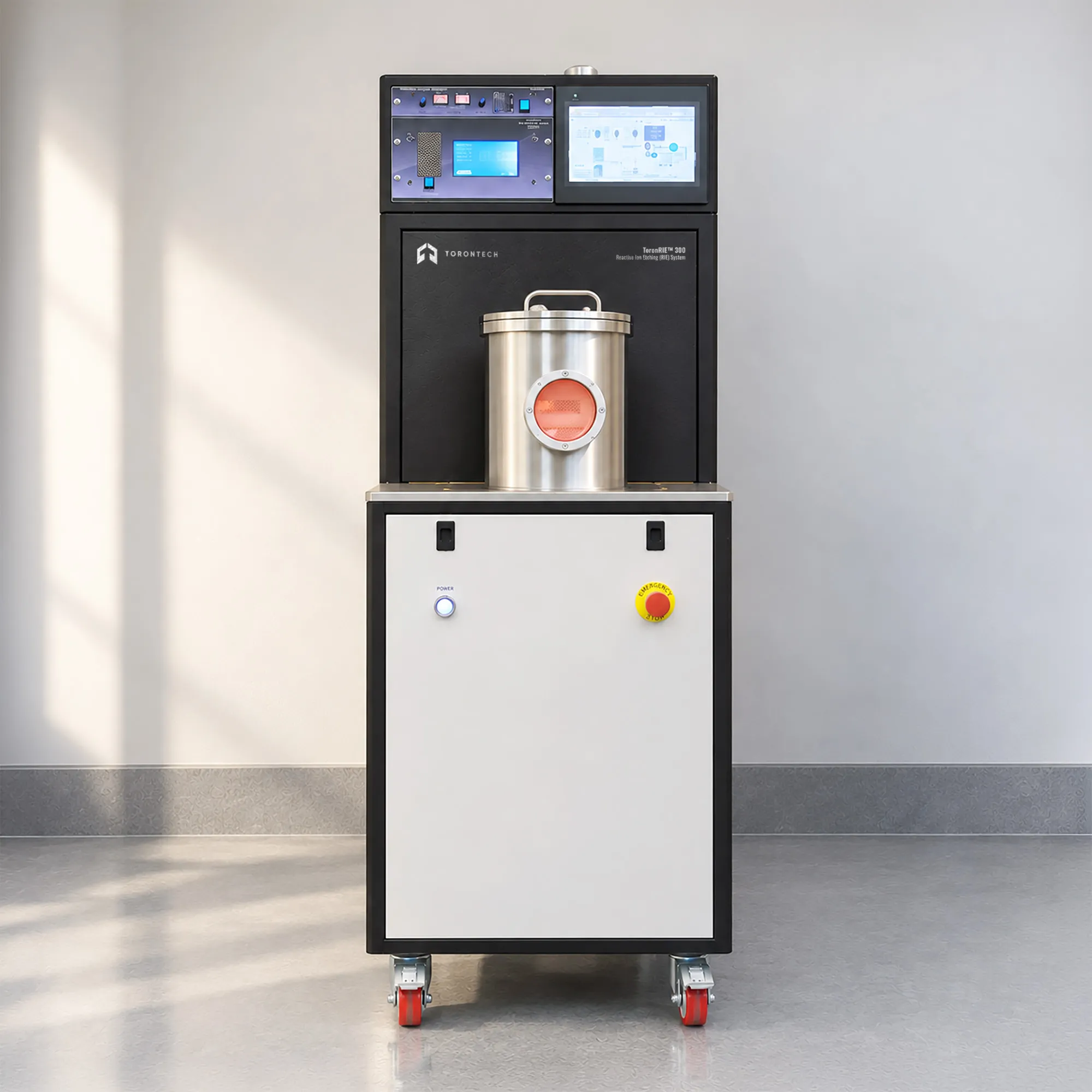
Reactive Ion Etching (RIE) System - ToronRIE™ 300 Key Features
The Reactive Ion Etching (RIE) System integrates a 300 W RF plasma source, water-chilled electrode, automatic impedance matching, independent pressure control, and PLC automation in a compact, clean-room-compatible dry etch platform for semiconductor and MEMS research.
- Up to 3-Inch Wafer and Substrate Processing: accommodates wafers and substrate pieces up to 3 inches, covering standard research wafer sizes for semiconductor and MEMS applications
- 300 W RF Power Supply: high-power RF source covers the full range of etch rates and plasma conditions for the system's supported process chemistries
- Fully Automatic Impedance Matching: automatic matching network optimizes power transfer between the RF generator and plasma load, maintaining stable conditions across changing pressures and gas chemistries
- DC Bias Voltage Readout: real-time display of self-bias voltage provides a continuous indicator of ion energy at the substrate surface throughout the etch process
- Water-Chilled Sample Holder: active electrode cooling removes ion-bombardment heat, preventing thermal damage to photoresist masks and temperature-sensitive samples during extended etch cycles
- Mechanical Sample Clamping: positive mechanical clamping secures wafers and substrate pieces, maintaining stable position and thermal contact with the chilled electrode surface
- Adjustable Sample-to-Electrode Distance: variable electrode gap enables optimization of etch rate, uniformity, and ion energy distribution for different process chemistries and substrate geometries
- Automatic Fast-Acting Pressure Control: fast-response pressure regulation maintains stable etch conditions during gas consumption changes and process transitions
- Process Pressure Control Independent from Gas Flow: decoupled pressure and flow control allows independent adjustment of both parameters, expanding the accessible process parameter space
- 5×10⁻² mbar Base Pressure: achievable base pressure supports the vacuum requirements for RIE plasma generation and limits substrate surface contamination before the etch
- High Etch Rate Uniformity: optimized reaction chamber and electrode geometry produce uniform etch rates across the substrate area as confirmed by etch uniformity mapping data
- High Selectivity Between Materials: plasma chemistry and RF parameters are tunable to achieve high etch selectivity between the target material and mask or underlying layers
- Stainless Steel Cylindrical Chamber: SS construction provides a durable, corrosion-resistant process environment compatible with oxygen and other non-corrosive plasma chemistries
- PLC Control with Graphical HMI Interface: PLC-based automation with an intuitive graphical HMI enables both manual and fully automatic etching operations
- Fast Process Cycles: rapid pump-down and process setup reduce the time between successive etching runs for improved laboratory throughput
- Dry Pump Option: oil-free vacuum pumping option eliminates hydrocarbon backstreaming risk for cleanroom and contamination-sensitive applications
- W60×D95 cm Compact Footprint: small floor footprint makes the system suitable for standard laboratory and cleanroom installation without dedicated bay infrastructure
- Clean Room Compatible: system design meets requirements for installation and operation in semiconductor and MEMS cleanroom environments
Theory and Method
Reactive ion etching uses both chemical reaction and directional ion bombardment to remove material from a substrate. An RF electric field at low pressure generates a plasma between parallel electrodes, producing reactive species including ions, radicals, and neutrals. These species etch the substrate chemically through surface reactions and physically through directional ion impact, producing anisotropic etch profiles. The combination of chemical and physical mechanisms gives RIE greater selectivity and profile control than purely chemical wet etching.
The 300 W RF supply drives voltage across the parallel electrodes at 13.56 MHz, generating plasma between them. The substrate electrode, electrically isolated from the chamber, self-biases negative relative to the plasma potential, accelerating positive ions toward the substrate with controlled directionality. DC bias voltage readout gives the operator continuous monitoring of ion energy during the process. Fully automatic impedance matching maximizes power transfer between the RF generator and the plasma load, maintaining stable conditions throughout the etch.
Process pressure control operates independently of gas flow rate, with automatic fast-acting pressure regulation maintaining stable etch conditions across the process. This independent control allows the operator to adjust pressure and gas composition separately, expanding the parameter space for different material systems. The system targets non-corrosive chemistry processes, suited to oxygen-based photoresist stripping, polymeric film patterning, and surface modification without requiring aggressive halogen gas infrastructure. Water cooling of the sample holder removes heat deposited by ion bombardment during sustained etch cycles.
Reactive Ion Etching (RIE) System - ToronRIE™ 300 Technical Specifications
| Parameter | Specification |
|---|---|
| Substrate Size | Up to 3-inch wafer and substrate pieces |
| RF Power Supply | 300 W |
| RF Frequency | 13.56 MHz |
| Impedance Matching | Fully automatic |
| DC Bias | Self-bias voltage (continuously measured and displayed) |
| Base Pressure | 5×10⁻² mbar |
| Pressure Control | Automatic, fast-acting; independent from gas flow |
| Chamber Construction | Stainless steel, cylindrical |
| Sample Holder | Water-chilled |
| Sample Clamping | Mechanical |
| Electrode Gap | Adjustable |
| Control System | PLC with graphical HMI interface |
| Operating Modes | Manual and fully automatic |
| Vacuum Pump | Standard configuration; dry pump option available |
| Compatible Chemistries | Non-corrosive processes (O₂, Ar, N₂, and similar) |
| Material Applications | Si, SiO₂, Si₃N₄, poly-Si, selected metals, photoresist, polymeric films |
| Footprint | W60 × D95 cm |
| Clean Room Compatible | Yes |