
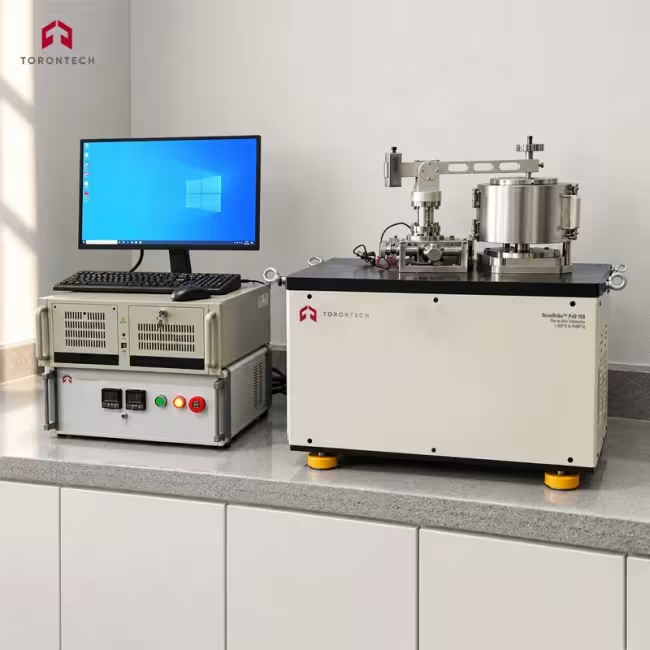
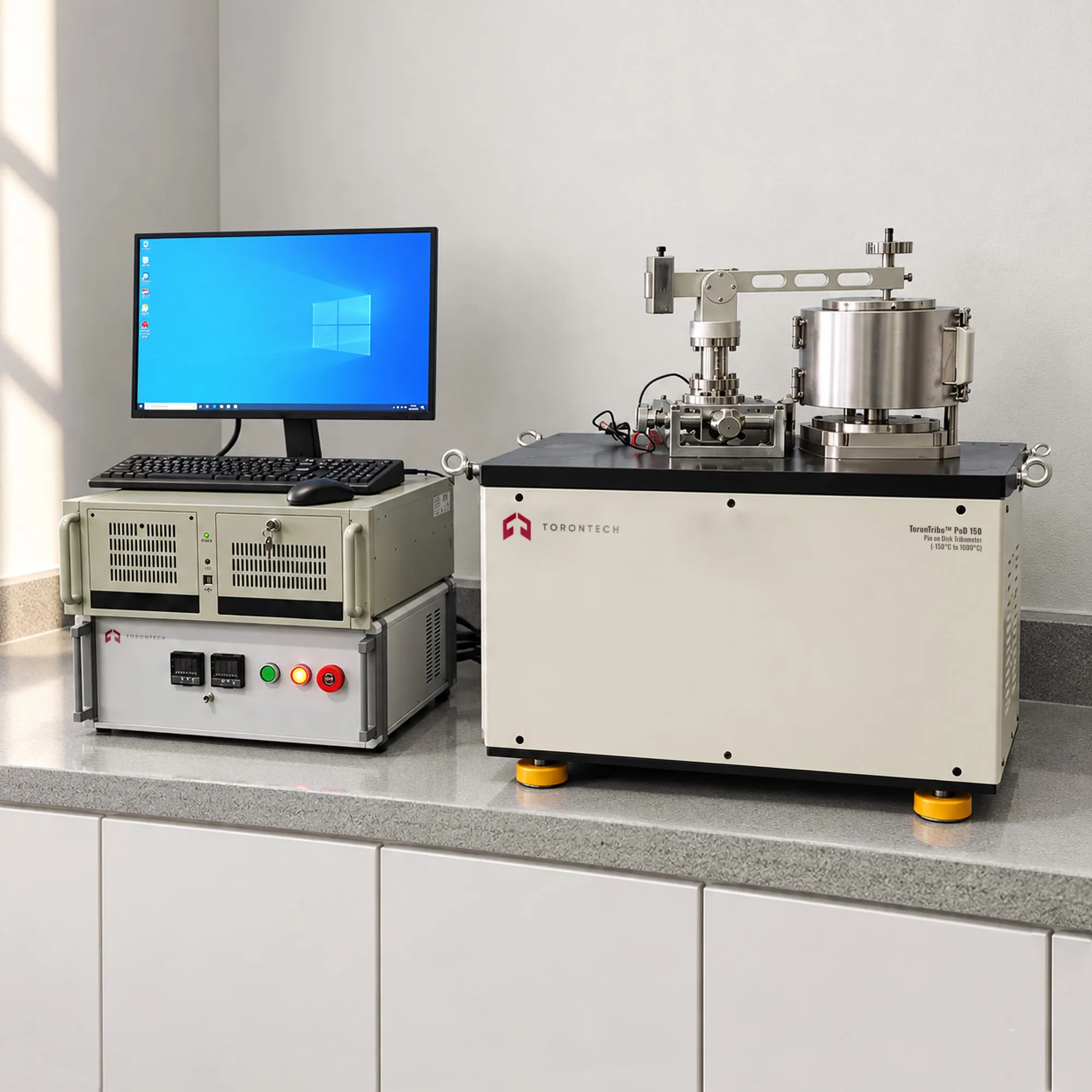
Pin on Disk Tribometer (-150°C to 1000°C)
Pin on Disk Tribometer (-150°C to 1000°C) - ToronTribo™ PoD 150
Pin-on-disk tribometer evaluates friction and wear performance of materials across an exceptionally wide temperature range, serving materials laboratories, coating developers, and component manufacturers working with metals, ceramics, and coatings. The ToronTribo™ PoD 150 offers both pin-disc and ball-on-disc friction pair configurations, letting operators choose the contact geometry that best matches their material or component application. A water circulation cooling system, high-temperature heating system, and dedicated temperature control system work together to span testing from -150°C up to 1000°C on a single platform.
The tester covers two normal force loading ranges, 0.1 to 10 N for delicate samples and 10 to 200 N for standard testing, both applied through direct weight loading for straightforward, reliable force control. Maximum friction torque reaches 2.5 N·m at spindle speeds up to 2000 rpm, with an adjustable friction radius from 10 to 35 mm to accommodate different specimen sizes. Test media extends beyond dry friction and oil lubrication to include inert gas atmospheres such as nitrogen, carbon dioxide, and helium, supporting testing in controlled or non-oxidizing environments.
Materials researchers, coating developers, and component manufacturers use the ToronTribo™ PoD 150 to characterize how a single material performs from cryogenic conditions through extreme high-temperature service, a range few tribometers can cover on one instrument. The inert gas testing capability further supports research into how atmosphere composition affects friction and wear behavior independent of temperature.
Pin on Disk Tribometer (-150°C to 1000°C) - ToronTribo™ PoD 150 Applications
The ToronTribo™ PoD 150 supports friction and wear evaluation for materials and coatings across an unusually wide temperature and atmosphere range.
- High-Temperature Coating Development: evaluates wear resistance of thermal barrier and hard coatings intended for service up to 1000°C
- Cryogenic Materials Research: assesses friction and wear behavior of materials at temperatures down to -150°C for cryogenic and aerospace applications
- Inert Atmosphere Tribology Studies: characterizes how nitrogen, carbon dioxide, or helium atmospheres influence friction and wear compared to ambient air testing
- Aerospace and High-Temperature Alloy Testing: supports material qualification for engine and exhaust components operating across wide thermal cycles
- Ceramic and Hard Material Wear Testing: measures wear resistance of ceramics and hard materials under both point and area contact geometries
- Lubricant Performance Across Temperature Extremes: evaluates how lubricants perform from low-temperature startup conditions through high-temperature operation
- Materials Science Research: supports comparative studies of how temperature and contact geometry together influence friction and wear mechanisms
Standards
The ToronTribo™ PoD 150 supports test procedures aligned with the internationally recognized ASTM standard for pin-on-disk and ball-on-disk friction and wear testing.
- ASTM G99-23 - Standard Test Method for Wear and Friction Testing with a Pin-on-Disk or Ball-on-Disk Apparatus
Pin on Disk Tribometer (-150°C to 1000°C) - ToronTribo™ PoD 150 Key Features
The ToronTribo™ PoD 150 combines dual contact geometries with an exceptionally wide temperature and atmosphere range.
- Exceptional Temperature Range: spans -150°C to 1000°C, covering cryogenic through high-temperature testing on a single platform
- Dual Friction Pair Configurations: supports both pin-disc and ball-on-disc contact geometries to match different material and application requirements
- Dual Normal Force Ranges: offers 0.1 to 10 N for delicate samples and 10 to 200 N for standard testing, both using direct weight loading
- Inert Gas Testing Capability: runs tests under nitrogen, carbon dioxide, helium, or other inert gases in addition to dry friction and oil lubrication
- Adjustable Friction Radius: sets the wear track radius from 10 to 35 mm to accommodate different specimen sizes
- High-Speed Rotation: reaches spindle speeds up to 2000 rpm for evaluating wear under varying sliding velocity
Theory and Method
Pin-on-disk and ball-on-disk testing measure friction and wear by pressing a stationary pin or ball against a rotating disk under a controlled normal force, generating a circular wear track at a set radius from the disk's center. A load cell measures the tangential friction force as the disk rotates, and the ratio of friction force to normal force yields the coefficient of friction, while the wear track itself provides a direct measurement of material loss from the disk, the pin, or both.
Temperature strongly influences this contact behavior because most materials undergo significant mechanical property changes across a wide thermal range. At cryogenic temperatures, materials can become more brittle and less able to accommodate the microscopic deformation that normally reduces friction and wear, while at high temperatures, oxidation, softening, and phase changes can alter both the material's hardness and its interaction with the contact surface. The ToronTribo™ PoD 150 addresses this by combining a heating system capable of reaching 1000°C with a cooling system that extends testing down to -150°C, allowing the same material and contact geometry to be evaluated across this full range within one test program.
Testing atmosphere adds a further variable, since oxygen in ambient air can react with freshly exposed material at the wear track to form oxide layers that themselves influence friction and wear behavior. Running tests under inert gases such as nitrogen, carbon dioxide, or helium removes this oxidative influence, letting engineers isolate the mechanical wear mechanism from any chemical reaction with the surrounding atmosphere. Comparing results across ambient air and inert gas environments at the same temperature helps researchers determine how much of a material's wear behavior comes from mechanical contact alone versus atmosphere-driven surface chemistry.
Pin on Disk Tribometer (-150°C to 1000°C) - ToronTribo™ PoD 150 Technical Specifications
| Parameter | Specification |
|---|---|
| Normal Force Loading Range | 0.1 to 10 N; 10 to 200 N |
| Maximum Friction Torque | 2.5 N·m |
| Maximum Speed | 2,000 rpm |
| Heating Range | Room temperature to 1000°C; -150°C to room temperature |
| Test Media | Dry friction, oil lubrication, and inert gases (N₂, CO₂, He, and others) |
| Normal Force Loading Method | Weight loading |
| Friction Radius | 10 to 35 mm, adjustable |