
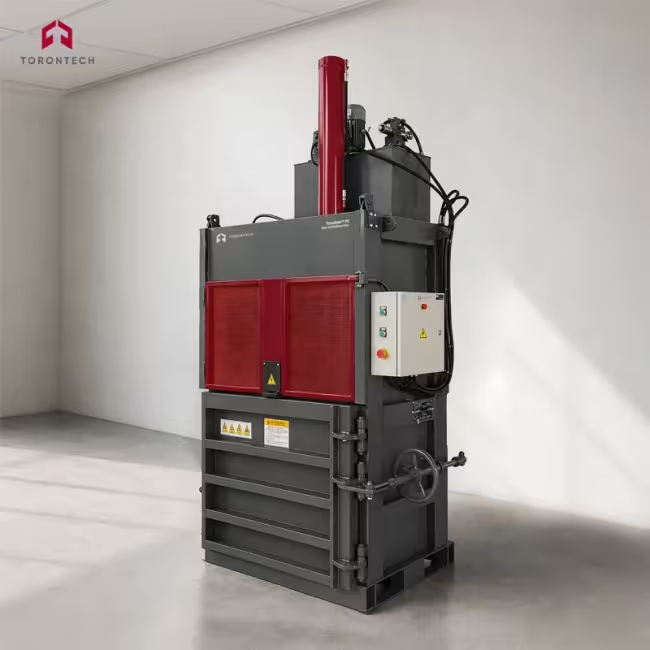
Paper and Cardboard Baler - ToronBale™ PC
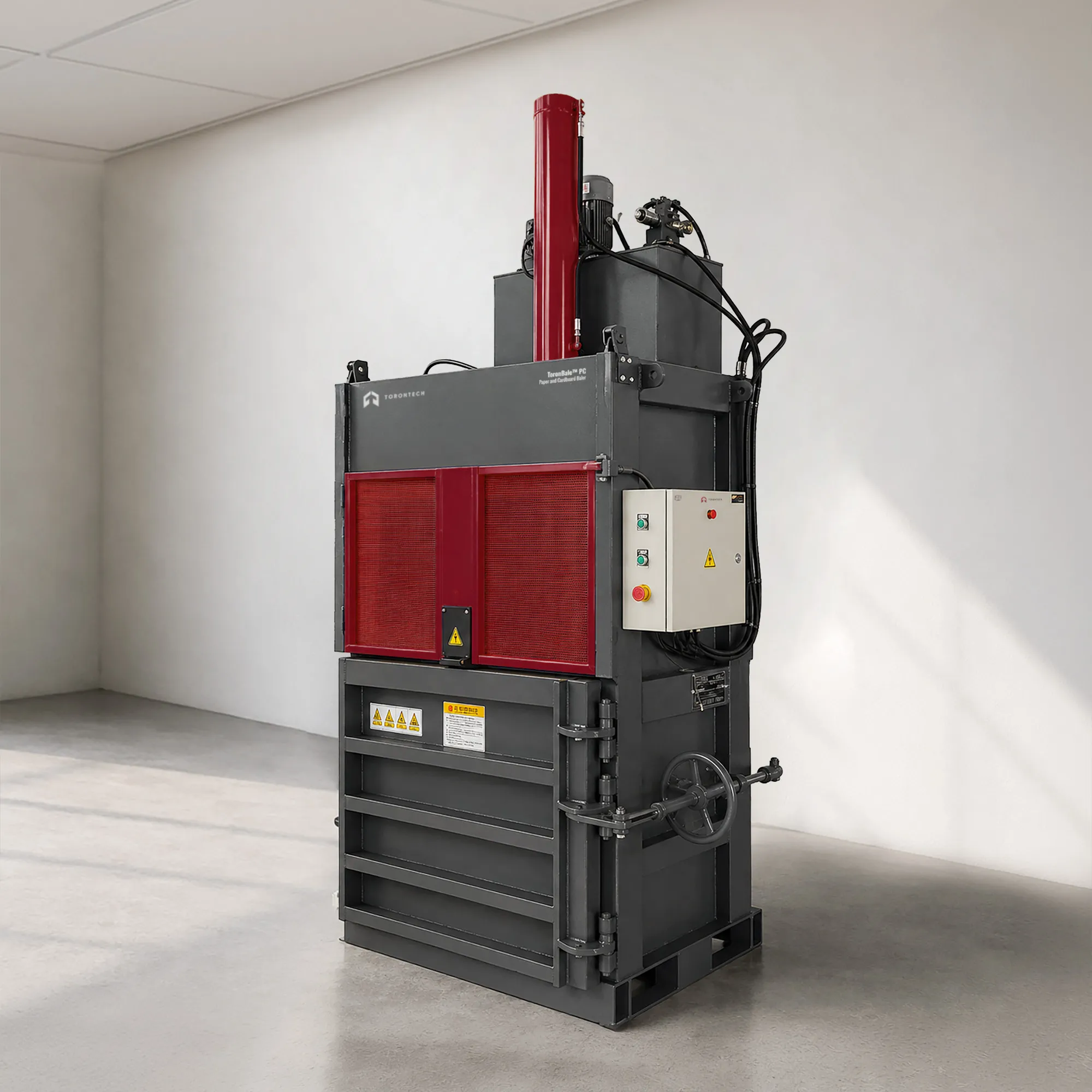
Paper and cardboard baler compacts recovered fiber into mill-ready bales at volumes that small back-room presses cannot sustain. Torontech offers the ToronBale™ PC in four sizes from 30 to 60 tons, producing bales between 150 kg and 700 kg. Feed openings run from 1,100 mm to 1,800 mm wide, wide enough to swallow uncut corrugated cartons and full press sheets without pre-breaking. Machine weights range from 1,900 kg to 4,500 kg.
The feed door lifts automatically as the platen rises. Operators charge the chamber continuously rather than working a separate door control between strokes. That matters at volume, where door handling adds up across hundreds of cycles a shift. A chain ejector then discharges the tied bale, removing the manual tipping step that limits throughput on older machines.
Bale dimensions follow what paper mills and freight economics reward. The 60 ton unit produces bales measuring 1,800 by 1,000 mm at up to 700 kg. Those dimensions suit trailer loading patterns rather than whatever the chamber happens to make. Corrugated plants, printers, material recovery facilities, and distribution centers use the ToronBale™ PC across the four sizes.
Paper and Cardboard Baler - ToronBale™ PC Applications
The ToronBale™ PC handles recovered paper and board across the grades that mills buy, in operations generating steady daily volume.
- Corrugated Packaging Plants: bales converting scrap, trim, and rejected board for return to the paper mill under supply agreements
- Commercial Printing and Bindery: compresses press waste, makeready, and guillotine trim into graded bales for sale as recovered fiber
- Material Recovery Facilities: densifies sorted OCC and mixed paper fractions coming off the sorting line
- Distribution Centers and 3PL Warehouses: handles high-volume inbound carton waste at receiving docks
- Retail Chains and Supermarkets: consolidates back-of-house corrugated where daily volume justifies a full-size press
- Office Buildings and Document Destruction: bales sorted office paper and shredded stock for the higher-value fiber grades
- E-Commerce Fulfillment Centers: processes the carton and void-fill volumes generated by pick-and-pack operations
- Paper Mills and Recycling Depots: prepares incoming loose fiber into transport-ready units before storage or resale
- Publishing and Newsprint Recovery: compacts returned newspaper and magazine stock for onward sale
Standards
Torontech builds the ToronBale™ PC to the safety conventions expected in North American and European facilities. The design uses an anti-rebound gate structure aligned with European and U.S. baler safety practice, a feed-gate interlock that halts platen travel, a start interlock that prevents operation with the safety door open, and an independent emergency stop. Confirm applicable certification marks and local code requirements with Torontech before installation, since safety documentation varies by destination market and configuration.
Paper and Cardboard Baler - ToronBale™ PC Key Features
The ToronBale™ PC combines wide-mouth loading with the interlocks and hydraulic components suited to continuous high-volume duty.
- Wide Feed Opening, up to 1,800 mm: takes uncut corrugated cartons and full press sheets without pre-breaking or folding
- Auto-Lifting Feed Door: the door rises in step with the platen, removing a separate handling motion from every cycle
- Automatic Chain Bale Ejector: discharges the tied bale from the chamber on command, eliminating manual tipping of loads up to 700 kg
- Press Force from 30 to 60 Tons: four ratings scale from single-site recovery through high-volume converting and mill feed operations
- Anti-Rebound Gate Structure: built to European and U.S. safety practice, holding compressed fiber in place and blocking uncontrolled door movement
- Feed Gate Ram Interlock: stops downward platen travel the moment the loading gate opens, keeping hands clear of the compaction zone
- Safety Door Start Interlock: the machine will not start while the safety door sits open, removing a common source of unintended cycling
- Independent Emergency Stop: a dedicated, prominently mounted circuit cuts hydraulic function apart from the main control system
- Reinforced Ram Guides: maintain a square platen face when fiber loads sit unevenly, protecting cylinder seals from side loading
- Automatic Load-Balancing Design: distributes compaction force across the platen so off-center charges do not produce sudden shifts mid-stroke
- Superposed Valve Block: Taiwanese-sourced stacked valve assembly occupies less installation volume and simplifies service access
- Direct-Coupled Motor and Pump: a cross-connected direct drive holds full concentricity between motor and pump, replacing conventional couplings and extending pump service life
- NOK Hydraulic Seals: Japanese-sourced sealing components extend service intervals and reduce seal replacement downtime
- A.M.C. Oil Pipe Joints: Japanese-made fittings hold hydraulic connections leak-free across thermal cycling and vibration
- Adjustable Bale Height: bale height sets between 500 and 1,050 mm depending on model, letting operators match bale weight to trailer or container loading patterns
Theory and Method
Baled fiber sells by weight, but it moves by volume, and that gap drives the economics of every paper baler. Loose corrugated occupies roughly ten times the space of the same mass baled, so a trailer fills long before it reaches its weight limit. Denser bales shift the constraint back to payload, where the freight is actually paid for. Press force exists to move that ratio, and each increment of density past the easy first stage costs disproportionately more force.
Feed geometry sets how fast the chamber fills. A 1,800 mm opening on the largest model accepts a flattened shipping carton whole, while a narrow throat would force an operator to tear or fold the same box first. The door lifting in step with the platen removes a second handling motion from every cycle. Fewer, larger charges also produce more even layers than many small ones, which matters because uneven layers cause bales to bulge and strap tension to concentrate.
Bale weight ranges are wide for a reason that has nothing to do with the machine. Recovered paper varies enormously in basis weight and moisture, and a bale of double-wall corrugated at ambient humidity weighs far more than the same volume of sorted office paper. Published ranges therefore describe what the chamber can produce across realistic grades, not a single guaranteed figure. Operators targeting a specific bale weight adjust bale height and stroke count to the material actually running.
Paper and Cardboard Baler - ToronBale™ PC Technical Specifications
| Parameter | ToronBale™ PC-30 | ToronBale™ PC-40 | ToronBale™ PC-50 | ToronBale™ PC-60 |
|---|---|---|---|---|
| Press Force | 30 tons (approx. 294 kN) | 40 tons (approx. 392 kN) | 50 tons (approx. 490 kN) | 60 tons (approx. 589 kN) |
| Feed Opening Size (L × H) | 1,100 × 500 mm | 1,200 × 500 mm | 1,500 × 500 mm | 1,800 × 550 mm |
| Baling Chamber Height | 1,400 mm | 1,500 mm | 1,500 mm | 1,600 mm |
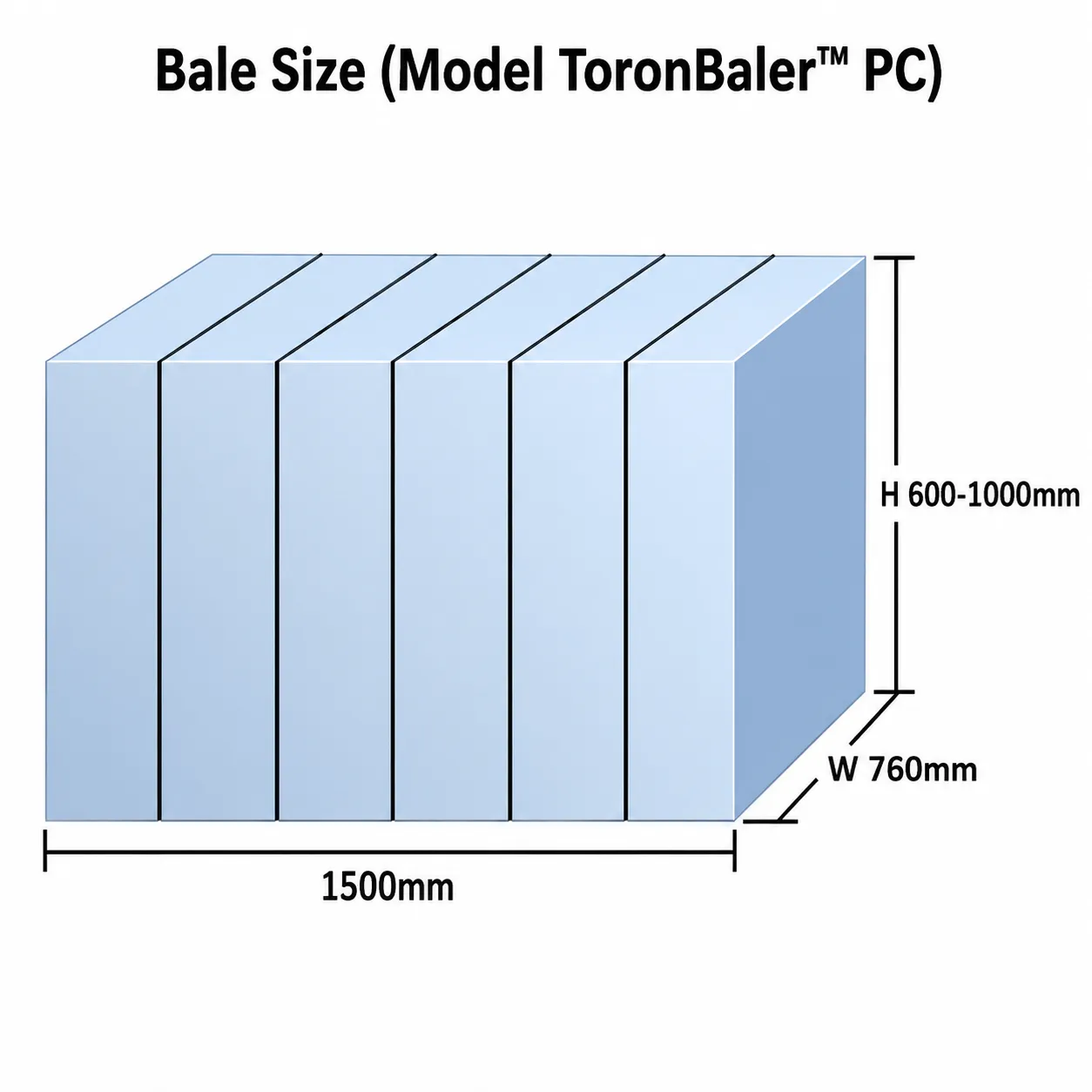
| Bale Size (L × W × H, H adjustable) | 1,100 × 700 × (500 to 900) mm | 1,200 × 800 × (600 to 1,000) mm | 1,500 × 760 × (600 to 1,000) mm | 1,800 × 1,000 × (700 to 1,050) mm |
| Bale Weight | 150 to 250 kg | 200 to 450 kg | 300 to 500 kg | 500 to 700 kg |
| Motor Power | 5.5 kW | 7.5 kW | 7.5 kW | 11 kW |
| Machine Weight | 1,900 kg | 2,300 kg | 2,800 kg | 4,500 kg |
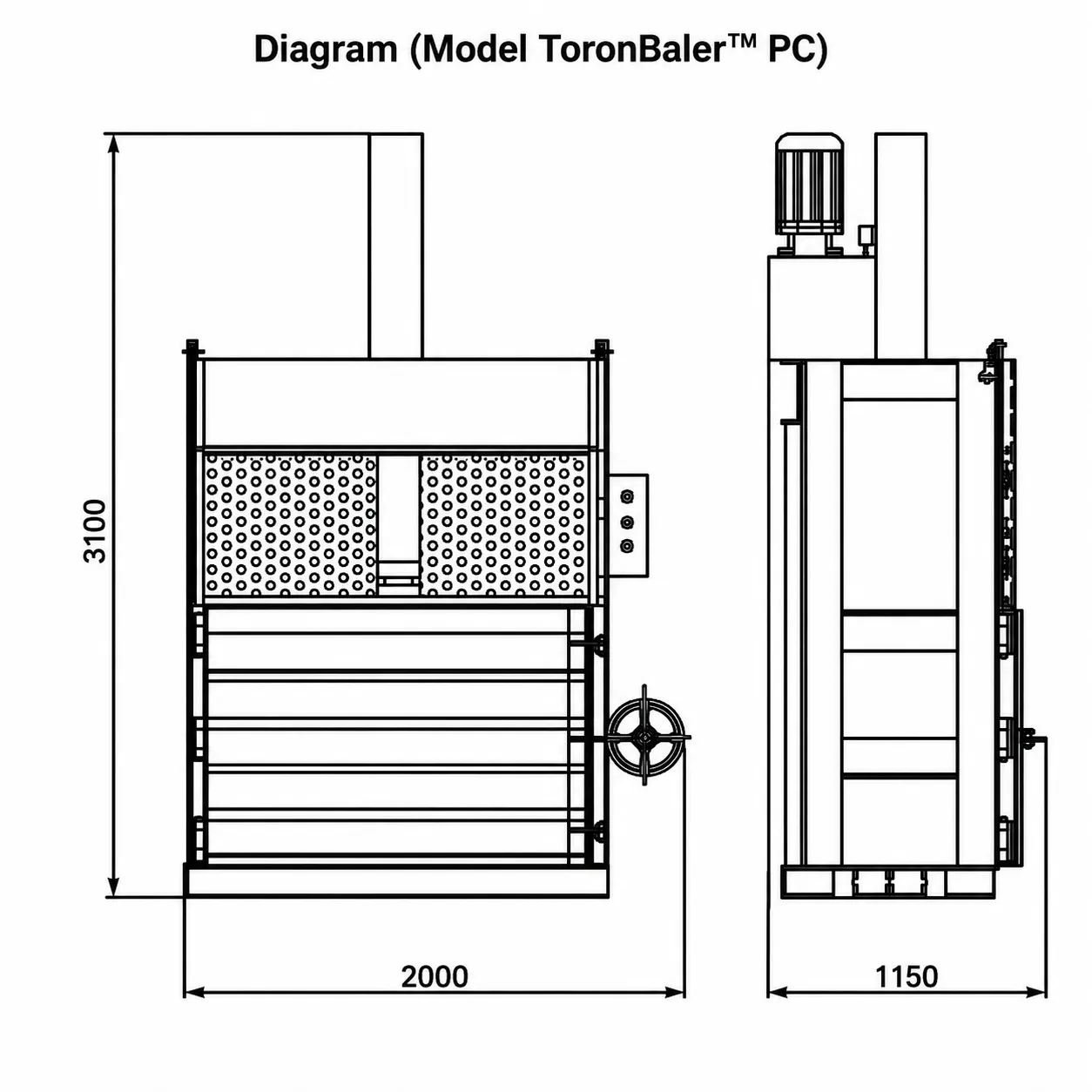
| Overall Dimensions (L × W × H) | 1,500 × 1,050 × 2,900 mm | 1,650 × 1,200 × 3,100 mm | 2,000 × 1,150 × 3,100 mm | 2,260 × 1,350 × 3,170 mm |
| Bale Ejection | Automatic chain ejector | Automatic chain ejector | Automatic chain ejector | Automatic chain ejector |
| Materials Handled | Cardboard, cartons, newspaper, mixed paper | Cardboard, cartons, newspaper, mixed paper | Cardboard, cartons, newspaper, mixed paper | Cardboard, cartons, newspaper, mixed paper |