
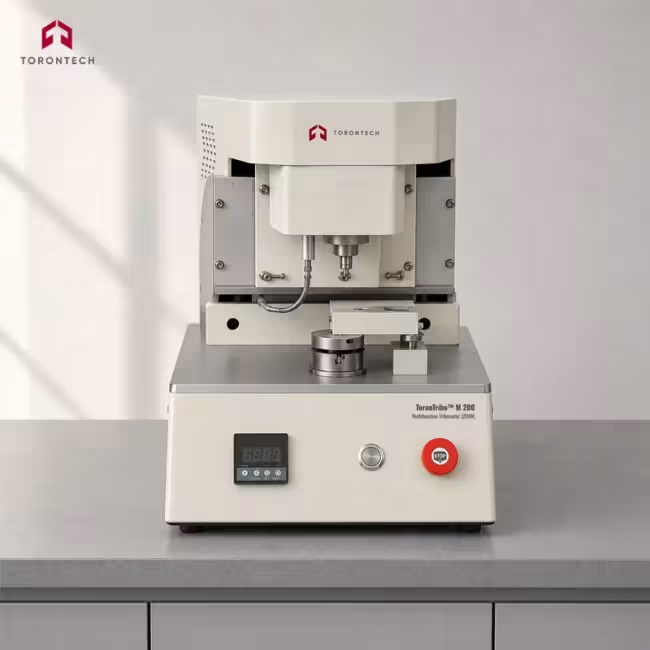
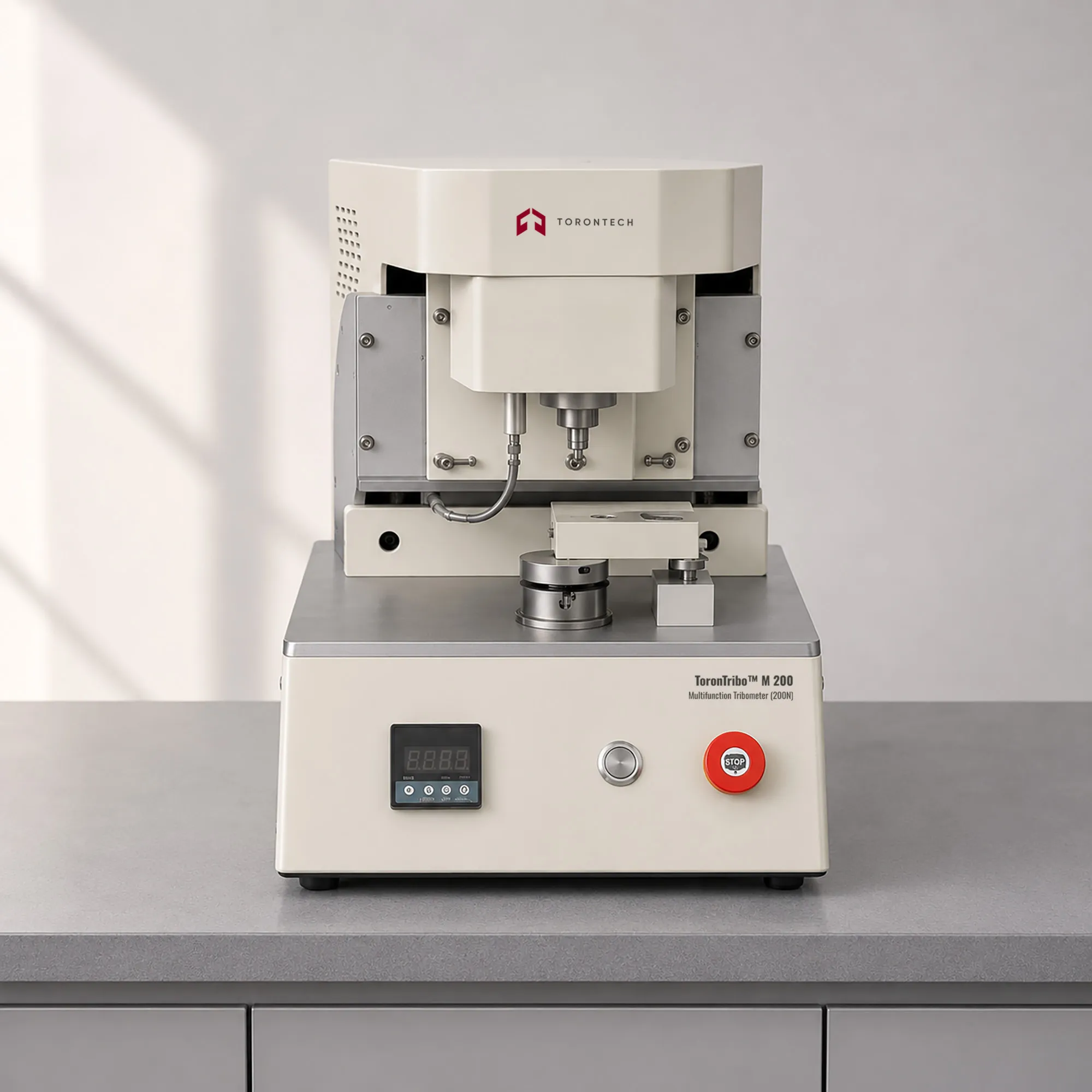
Multifunction Tribometer (200N)
Multifunction Tribometer (200N) - ToronTribo™ M 200
200 N Rotary Reciprocating Friction & Wear Tester
Multifunction tribometer evaluates friction and wear performance across materials, coatings, and lubricants using a single benchtop platform. The ToronTribo™ M 200 applies up to 200 N of normal force while the specimen moves through rotating, reciprocating, or ring-block motion, letting one instrument reproduce several standard tribology test geometries without a change of equipment. Operators monitor friction force, normal force, and temperature continuously, giving quality and research teams measured data instead of estimated wear behavior.
Because the tester covers pin-on-disc, ball-on-disc, and ring-block configurations, it suits laboratories that need to compare wear mechanisms across different contact geometries on the same platform. Speed, frequency, stroke, and test duration are all adjustable, so the ToronTribo™ M 200 reproduces a range of sliding and oscillating conditions relevant to smaller components and lighter-load applications. The system supports both dry friction and oil-lubricated testing for a closer match to real service conditions.
Materials laboratories, component manufacturers, and research institutions use the ToronTribo™ M 200 to screen metals, polymers, ceramics, and coatings during development and quality control. Each test produces a continuous friction, load, and temperature curve for direct comparison between material pairs or surface treatments. The compact footprint and multi-mode capability make it a practical entry point for labs building out tribology testing capacity.
Multifunction Tribometer (200N) - ToronTribo™ M 200 Applications
The ToronTribo™ M 200 supports friction and wear evaluation across industries working with smaller components, coatings, and lighter contact loads.
- Coating and Surface Treatment Development: screens wear resistance of plating, hard coatings, and surface treatments during formulation and quality control
- Component and Materials Research: compares wear behavior of metals, polymers, and ceramics under rotating, reciprocating, or ring-block contact
- Bearing and Bushing Material Selection: evaluates friction and wear characteristics of candidate materials for small bearings, bushings, and sliding contacts
- Lubricant Screening: tests coefficient of friction and wear rate of oils under dry and lubricated conditions before committing to full-scale lubricant testing
- Automotive Component Development: assesses wear performance of small parts such as seals, fasteners, and light-duty sliding components
- Academic and Materials Science Research: supports tribology coursework and research into friction mechanisms and wear mode behavior across multiple test geometries
- Quality Control Laboratories: verifies incoming material or coating batches meet wear resistance requirements before production use
Standards
The ToronTribo™ M 200 supports test procedures aligned with internationally recognized ASTM and DIN tribology standards covering pin-on-disk, ball-on-disk, and linear reciprocating wear methods.
- ASTM B611-13 - Standard Test Method for Determining the High Stress Abrasion Resistance of Hard Materials
- ASTM G99-23 - Standard Test Method for Wear and Friction Testing with a Pin-on-Disk or Ball-on-Disk Apparatus
- ASTM G133-05 - Standard Test Method for Linearly Reciprocating Ball-on-Flat Sliding
- DIN 50324:1992-07 - Tribology, Testing of Friction and Wear, Model Test for Sliding Friction of Solids (Ball-on-Disc System)
Multifunction Tribometer (200N) - ToronTribo™ M 200 Key Features
The ToronTribo™ M 200 packs rotary, reciprocating, and ring-block testing into a compact, adjustable platform.
- Multi-Mode Motion Testing: switches between rotating, reciprocating, and ring-block motion on one platform, reducing the need for separate single-purpose testers
- Multiple Friction Pair Configurations: supports pin-on-disc, ball-on-disc, and ring-block setups to match the test geometry to the application
- Wide Speed Range: covers rotational speeds from 1 to 2000 rpm, accommodating both low-speed and accelerated wear test protocols
- Adjustable Reciprocating Parameters: frequency from 0.1 to 20 Hz and stroke up to 40 mm allow tailored simulation of oscillating contact conditions
- Dry and Lubricated Testing: runs tests under dry friction or oil-lubricated conditions to match the intended service environment
- Real-Time Data Monitoring: records friction force, normal force, and temperature continuously and plots each parameter as a live curve
- Elevated Temperature Testing: operates up to 200°C, allowing wear evaluation under mild thermal conditions
- Compact Benchtop Footprint: fits laboratory bench space at 530 x 345 x 500 mm, suited to labs with limited floor area
Theory and Method
Rotary and reciprocating wear testing both measure how contacting surfaces resist sliding motion, but each geometry produces a different contact history. A rotary pin-on-disc or ball-on-disc setup drives the upper specimen through a continuous circular track across the lower disc, generating a wear track of constant radius and steady-state sliding velocity. A load cell measures the tangential friction force as the disc rotates, and the ratio of friction force to normal force yields the coefficient of friction.
Reciprocating motion changes this contact history by reversing direction at the end of each stroke. Sliding velocity rises from zero at each stroke reversal to a peak at mid-stroke, then falls back to zero, so the contact repeatedly cycles through different lubrication and wear regimes within a single pass. The ToronTribo™ M 200 applies this motion through a servo-driven stage that holds stroke length and frequency constant while normal force and temperature sensors log data throughout the test.
The ring-block configuration adds a third geometry, pressing a stationary block against a rotating ring under load. This setup concentrates contact along a line rather than a point, producing higher local contact pressure for a given normal force and revealing wear behavior relevant to shafts, bearings, and rotating seals. Running the same material pair through rotary, reciprocating, and ring-block modes on one platform lets engineers see how contact geometry itself changes friction and wear results, information that a single-mode tester cannot provide.
Multifunction Tribometer (200N) - ToronTribo™ M 200 Technical Specifications
| Parameter | Specification |
|---|---|
| Maximum Normal Force | 200 N |
| Rotational Speed Range | 1 to 2,000 rpm |
| Oscillation Frequency Range | 0.1 to 20 Hz |
| Maximum Reciprocating Friction Force | 50 N |
| Maximum Rotating Torque | 1.5 N·m |
| Maximum Reciprocating Stroke | 40 mm |
| Reciprocating Friction Pair Forms | Ball-on-disc, pin-on-disc |
| Rotating Friction Pair Forms | Ball-on-disc, pin-on-disc |
| Ring Friction Pair Form | Ring-block |
| Temperature Range | Room temperature to 200°C |
| Friction Medium | Dry friction, oil lubrication |
| Dimensions (L x W x H) | 530 x 345 x 500 mm |