

Monochromatic Wavelength X-Ray Fluorescence Spectrometer
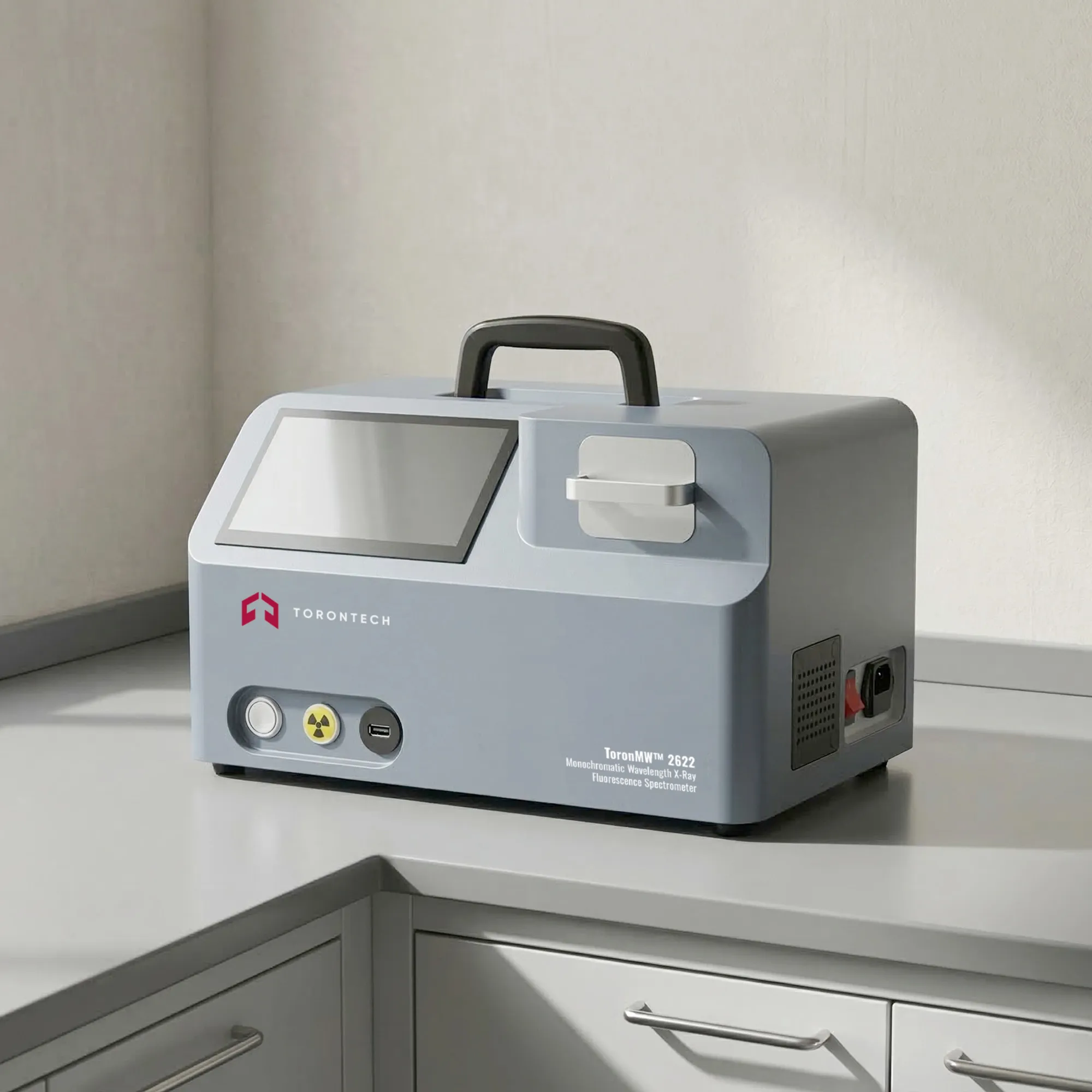
Monochromatic Wavelength X-Ray Fluorescence Spectrometer – ToronMW™ 2622
A Monochromatic Wavelength X-Ray Fluorescence Spectrometer is designed for trace and ultra-trace elemental analysis where lower background and better sensitivity matter.
Monochromatic Wavelength X-Ray Fluorescence Spectrometer – ToronMW™ 2622 is based on monochromatic excitation energy-dispersive X-ray fluorescence technology and is positioned for rapid sulfur, chlorine, and silicon analysis in petroleum products, plus selected food and industrial applications
ToronMW™ 2622 uses monochromatic excitation energy dispersive X-ray fluorescence, abbreviated as MEDXRF. This approach modifies conventional EDXRF by introducing a monochromatized excitation source, which reduces background interference and improves sensitivity for trace-level elemental measurement. The instrument is presented for rapid analysis of sulfur, chlorine, silicon, and phosphorus across petroleum, food, and light-element industrial testing workflows.
The listed petroleum scope includes gasoline, diesel, jet fuel, kerosene, naphtha, other distillate fuels, residual oil, lubricating base oil, hydraulic oil, crude oil, automotive gasoline, alcohol-containing gasoline, and biodiesel. For petroleum labs, the instrument is mainly positioned around sulfur and chlorine compliance testing plus trace silicon analysis in finished fuels and related streams.
Monochromatic Wavelength X-Ray Fluorescence Spectrometer – ToronMW™ 2622 Application
- Sulfur analysis in petroleum products: This instrument is suited to rapid sulfur testing in fuels and petroleum products where sulfur content affects product quality, refining decisions, and regulatory compliance.
- Chlorine analysis in light hydrocarbons and crude-related streams: The system for chlorine testing in light hydrocarbon products and crude-oil-related applications.That makes this type of instrument useful for refinery corrosion control, feedstock screening, and contamination monitoring.
- Trace silicon and phosphorus analysis in fuels and oils: The analyzer is also intended for trace silicon and phosphorus determination. Silicon monitoring is valuable in fuel and lubricant quality control because silicon contamination can point to dirt ingress, additive carryover, or process contamination, while phosphorus monitoring is relevant in selected fuel, lubricant, edible oil, and food workflow.
- Food and materials screening: Outside petroleum testing, ToronMW™ 2622 cam ne used for phosphorus in edible oils, aluminum in food additives, and aluminum, phosphorus, and potassium in food and industrial applications. This broader scope makes the platform attractive for labs that want one XRF system for multiple light-element and trace-element tasks instead of a single-use sulfur-only analyzer.
Standards
- ASTM D2622 – sulfur in petroleum products by wavelength-dispersive X-ray fluorescence spectroscopy. ASTM states this method provides rapid and precise measurement of total sulfur in petroleum and petroleum products with minimal sample preparation.
- ASTM D6334 – sulfur in gasoline by wavelength-dispersive X-ray fluorescence spectroscopy.
- ISO 20884 – sulfur content in automotive fuels by wavelength-dispersive X-ray fluorescence spectroscopy. ISO states this method applies to liquid, homogeneous automotive fuels within a defined sulfur range.
- ASTM D7536 – chlorine in aromatics by monochromatic wavelength-dispersive X-ray fluorescence spectrometry. ASTM states this method covers chlorine determination in aromatic hydrocarbons, derivatives, and related chemicals.
- ASTM D4929 Procedure C – organic chlorides in crude oil using X-ray fluorescence spectrometry after preparation of the washed naphtha fraction.
Monochromatic Wavelength X-Ray Fluorescence Spectrometer – ToronMW™ 2622 Key Features
- Monochromatic excitation EDXRF platform designed for trace and ultra-trace elemental testing with reduced background interference.
- Rapid petroleum analysis capability for sulfur, chlorine, silicon, and phosphorus in gasoline, diesel, jet fuel, kerosene, naphtha, crude oil, residual oil, lubricating base oil, hydraulic oil, biodiesel, and related fuels.
- Broad application coverage beyond petroleum, including edible oils, food additives, and selected industrial light-element analysis tasks.
- Ultra-low detection limits at 300 seconds, including Si 1.5 ppm, P 0.3 ppm, S 0.3 ppm, and Cl 0.2 ppm, with instrument detection limits further stated as S ≤ 0.15 ppm, Cl ≤ 0.1 ppm, and Si ≤ 0.5 ppm.
- Wide concentration range from low ppm up to wt% levels, making the instrument suitable for both trace contamination checks and higher-content measurements.
- 300-second measurement cycle for routine analysis.
- Leak-resistant side-irradiation chamber design that helps keep accidental sample leakage away from sensitive internal components and simplifies cleanup.
- Repeatability and reproducibility data provided for sulfur, chlorine, and silicon across low-level measurements.
- Flexible AC/DC power adapter input from 100–240 VAC, 50/60 Hz.
Theory and Method
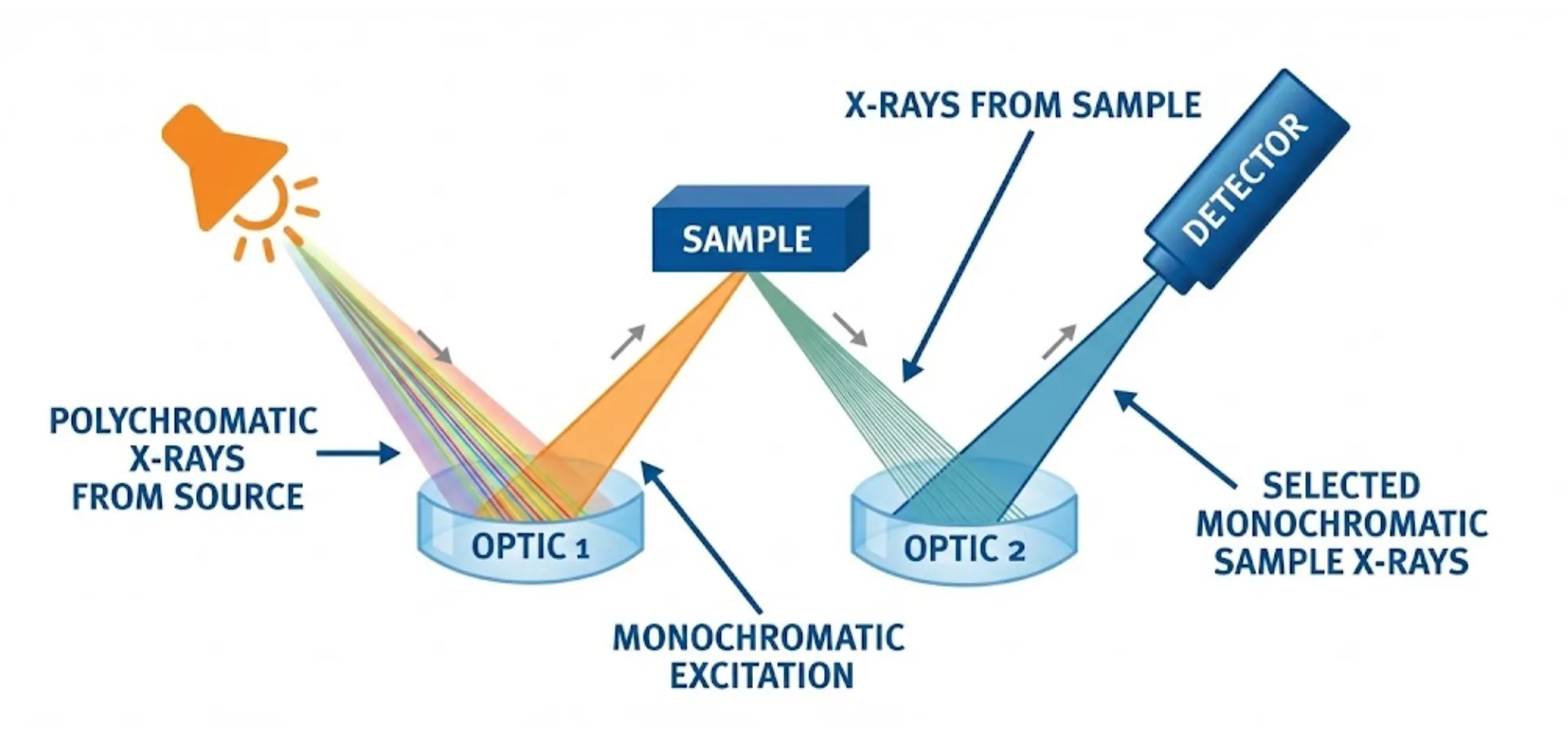
This diagram illustrates the process of Monochromatic Wavelength Dispersive X-ray Fluorescence (MWDXRF). This is a highly sensitive analytical technique used to determine the elemental composition of a sample by measuring the characteristic X-rays it emits.
Here is a breakdown of the process from left to right:
1. The X-ray Source and Excitation
- Polychromatic X-rays: The source (represented by the orange icon) emits a broad spectrum of X-ray energies, shown as a "rainbow" of rays.
- Optic 1: These rays hit a specialized curved crystal optic. This optic acts as a filter, capturing only a specific wavelength (energy) and focusing it into an intense, Monochromatic Excitation beam (the orange beam).
- Why it matters: Using a single-energy beam to hit the sample significantly reduces "background noise," which allows the system to detect much smaller traces of elements.
2. Interaction with the Sample
- Sample: The monochromatic beam strikes the sample material. This energy "excites" the atoms within the sample, causing them to lose electrons and then release energy in the form of their own X-rays as they stabilize.
- X-rays from Sample: The sample emits a variety of X-rays (shown as multiple green lines). Each element in the sample emits X-rays at very specific, unique energy levels—like a chemical fingerprint.
3. Collection and Detection
- Optic 2: A second curved crystal optic is positioned to collect the X-rays coming off the sample. It is tuned to "pick out" only the specific wavelength of the element being measured (e.g., Sulfur or Lead).
- Selected Monochromatic Sample X-rays: This optic focuses only that specific "fingerprint" energy (the blue beam) into the detector.
- Detector: The detector counts the number of X-rays it receives. Because the signal has been narrowed down twice by the optics, the resulting data is extremely precise with very little interference.
Monochromatic Wavelength X-Ray Fluorescence Spectrometer – ToronMW™ 2622 Technical Specification
| Specification | Monochromatic Wavelength X-Ray Fluorescence Spectrometer – ToronMW™ 2622 |
|---|---|
| Measurement method | MEDX monochromatic energy-dispersive analysis |
| Typical analytes / matrices | Gasoline, diesel, jet fuel, kerosene, other distillate fuels, naphtha, residual oil, lubricating base oil, hydraulic oil, crude oil, automotive gasoline, alcohol-containing gasoline, biodiesel |
| Element range | Si, S, Cl |
| Test concentration range | S and Cl: 0.5 ppm–10 wt%; Si: 1.5 ppm–10 wt% |
| Detection limit | S ≤ 0.15 ppm; Cl ≤ 0.1 ppm; Si ≤ 0.5 ppm |
| Ultra-low detection limit at 300 s | Si 1.5 ppm; P 0.3 ppm; S 0.3 ppm; Cl 0.2 ppm |
| Measurement time | 300 s |
| Repeatability | S: RSD ≤ 5% for seven repeated tests above 5 ppm; RSD ≤ 10% for 2–5 ppm; range ≤ 0.5 ppm below 2 ppm. Cl: RSD ≤ 5% for seven repeated tests above 5 ppm; RSD ≤ 10% for 2–5 ppm; range ≤ 0.5 ppm below 2 ppm. Si: RSD ≤ 5% for seven repeated tests above 10 ppm; RSD ≤ 10% for 6–10 ppm; range ≤ 1.5 ppm below 6 ppm. |
| Reproducibility | S and Cl below 2 ppm deviation ≤ 1 ppm; Si below 5 ppm deviation ≤ 2 ppm |
| Operating environment | 5°C–35°C; 20%–85% RH |
| Voltage | AC/DC power adapter input 100–240 VAC, 50/60 Hz |
| Sample chamber design | Side-irradiation, vertical sample insertion, leak-resistant layout |