
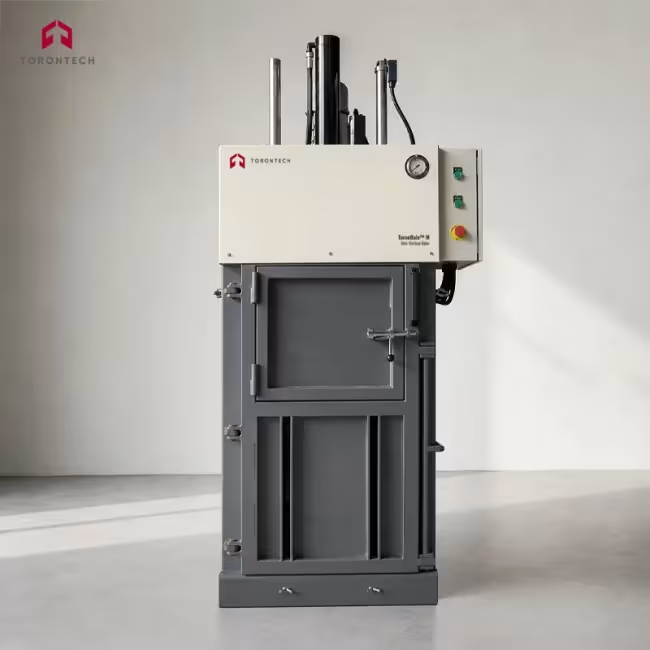
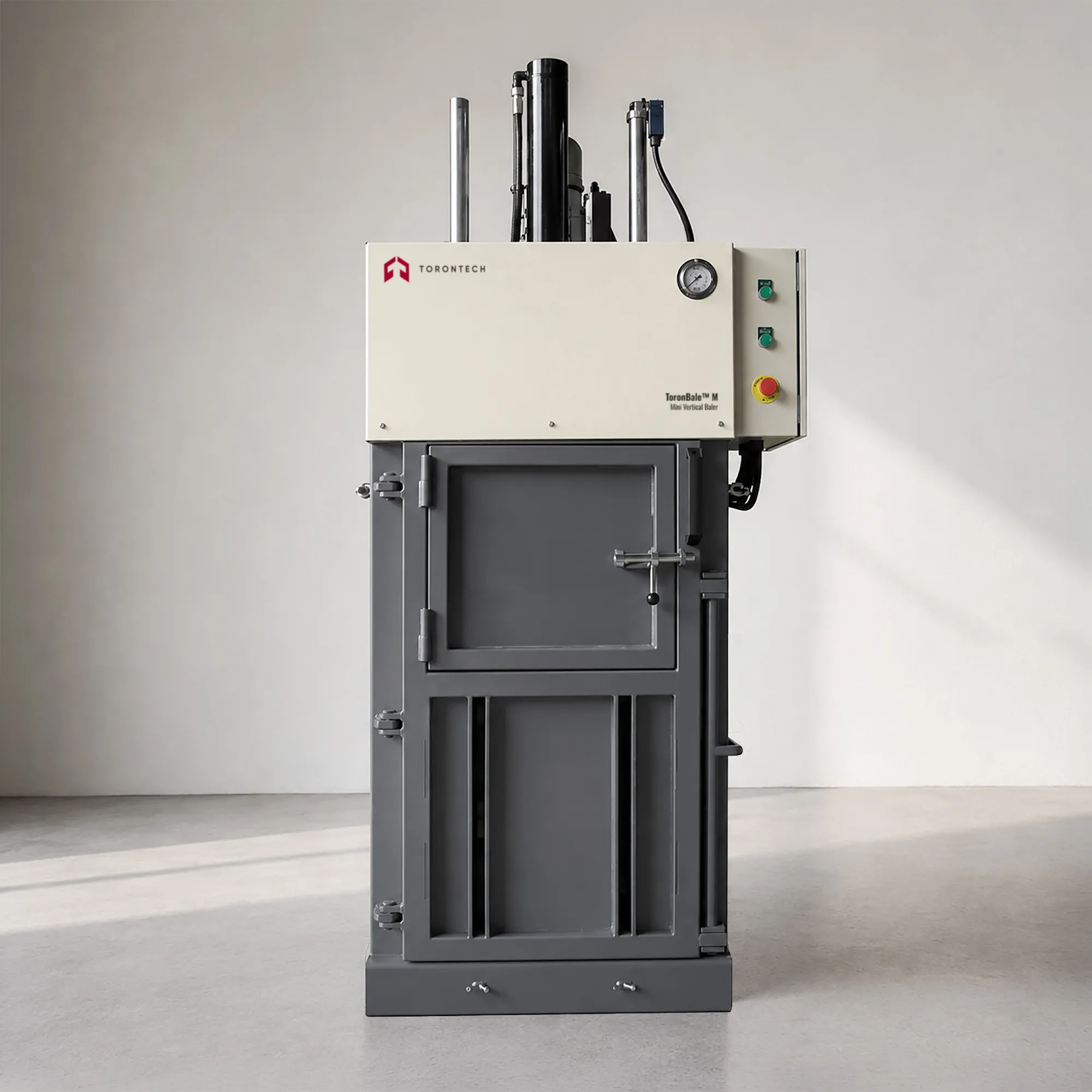
Mini Vertical Baler - ToronBale™ M
Mini vertical baler compacts waste for businesses whose daily volume never justified a full-size press. Torontech offers the ToronBale™ M in three sizes at 5, 10, and 20 tons, producing bales from 15 kg up to 120 kg. The two smaller models occupy a floor area of just 900 by 570 mm, roughly the space of a domestic refrigerator. Machine weights run from 450 kg to 1,000 kg.
Power demand stays low across the range. Motors draw 1.5 kW, 2.2 kW, and 3 kW respectively. The machine therefore fits sites where spare circuit capacity is limited, or where an electrical upgrade would cost more than the baler itself. That opens baling to cafes, small shops, clinics, and vessel galleys that would otherwise keep paying for loose-waste collection.
An optional liquid receiver sits under the chamber to catch what comes out of moist material during compression. Food residue and damp packaging release liquid under pressure, and without a tray it reaches the floor. Small operations handling mixed waste rather than clean cardboard benefit most from the tray. The option is available across all three sizes.
Mini Vertical Baler - ToronBale™ M Applications
The ToronBale™ M serves operations generating modest but steady waste volumes, where floor space and electrical capacity both matter.
- Small Retail and Convenience Stores: bales daily carton waste in a back room without dedicating a full equipment bay
- Cafes, Restaurants, and Bars: compacts packaging, and with the liquid tray option handles damp food-service waste
- Hotels and Guesthouses: processes housekeeping and kitchen waste in service corridors with limited floor area
- Offices and Professional Practices: bales sorted paper and packaging without the space or power a large press requires
- Commercial Vessels and Yachts: reduces waste volume on board where storage between ports is the binding constraint
- Clinics and Small Healthcare Sites: consolidates general packaging waste in back-of-house areas
- Workshops and Light Manufacturing: handles component packaging and offcuts at low daily volumes
- Schools and Institutional Kitchens: bales cafeteria packaging and paper waste on a modest budget
- Resorts and Tourist Facilities: manages seasonal waste peaks in properties without central waste infrastructure
Standards
Torontech builds the ToronBale™ M to the safety conventions expected in North American and European facilities. The design uses an anti-rebound gate structure aligned with European and U.S. baler safety practice, a feed-gate interlock that halts platen travel, and an independent emergency stop mounted separately from the main controls. Confirm applicable certification marks and local code requirements with Torontech before installation, since safety documentation varies by destination market and configuration.
Mini Vertical Baler - ToronBale™ M Key Features
The ToronBale™ M carries the same hydraulic components and safety interlocks as Torontech's larger presses, in a frame sized for small premises.
- Compact 900 by 570 mm Footprint: the 5 and 10 ton models occupy about the floor area of a domestic refrigerator, fitting back rooms and service corridors
- Low Power Demand: motors draw 1.5 to 3 kW, avoiding the electrical upgrade that larger presses often force on older premises
- Optional Bottom Liquid Receiver: a tray under the chamber collects liquid pressed out of moist material, keeping floors dry and discharge controlled
- Three Press Ratings, 5 to 20 Tons: bale weights from 15 kg to 120 kg let buyers match the machine to actual daily volume
- Automatic Chain Bale Ejector: discharges the tied bale from the chamber on command, removing manual tipping
- Anti-Rebound Gate Structure: built to European and U.S. safety practice, holding compressed material in place and blocking uncontrolled door movement
- Feed Gate Ram Interlock: stops downward platen travel the moment the loading gate opens, keeping hands clear of the compaction zone
- Independent Emergency Stop: a dedicated, prominently mounted circuit cuts hydraulic function apart from the main control system
- Reinforced Ram Guides: maintain a square platen face when material sits unevenly, protecting cylinder seals from side loading
- Automatic Load-Balancing Design: distributes compaction force across the platen so off-center charges do not produce sudden shifts mid-stroke
- Integrated Valve Block: Taiwanese-sourced valve assembly simplifies service access on a machine that may sit far from technical support
- Direct-Coupled Motor and Pump: a cross-connected direct drive holds full concentricity between motor and pump, replacing conventional couplings and extending pump service life
- NOK Hydraulic Seals: Japanese-sourced sealing components extend service intervals and reduce seal replacement downtime
- A.M.C. Oil Pipe Joints: Japanese-made fittings hold hydraulic connections leak-free across thermal cycling and vibration
- Adjustable Bale Height: bale height sets between 200 and 800 mm depending on model, letting operators produce bales light enough to move without a pallet jack
Theory and Method
Press force alone tells a buyer very little. What compacts material is pressure, which is force divided by the area of the bale face, and small chambers concentrate modest force into useful pressure. The 20 ton model presses an 800 by 600 mm face, giving roughly 400 kPa across the bale. A 60 ton machine spreading its force over an 1,800 by 1,000 mm face delivers less than that. Tonnage scales with chamber size, not with compaction quality.
What a small machine actually gives up is throughput, not bale integrity. Chamber volume and cycle time set how much material passes through in a shift, and both are modest here. A business generating a few cubic meters of loose waste a day fills the chamber comfortably, while one generating ten times that would spend the shift waiting on the press. Matching chamber capacity to daily volume matters more than chasing tonnage.
Moisture changes the problem. Compressing food residue or damp packaging drives liquid out of the material, and that liquid has to go somewhere. Left to run onto the floor it creates a slip hazard, attracts pests, and can put non-compliant discharge into a floor drain. The optional receiver under the chamber collects it for controlled disposal, which is why the option exists on a machine class often installed near food preparation areas.
Mini Vertical Baler - ToronBale™ M Technical Specifications
| Parameter | ToronBale™ M-5 | ToronBale™ M-10 | ToronBale™ M-20 |
|---|---|---|---|
| Press Force | 5 tons (approx. 49 kN) | 10 tons (approx. 98 kN) | 20 tons (approx. 196 kN) |
| Feed Opening Size (L × H) | 600 × 400 mm | 600 × 400 mm | 700 × 400 mm |
| Baling Chamber Height | 1,000 mm | 1,000 mm | 1,200 mm |
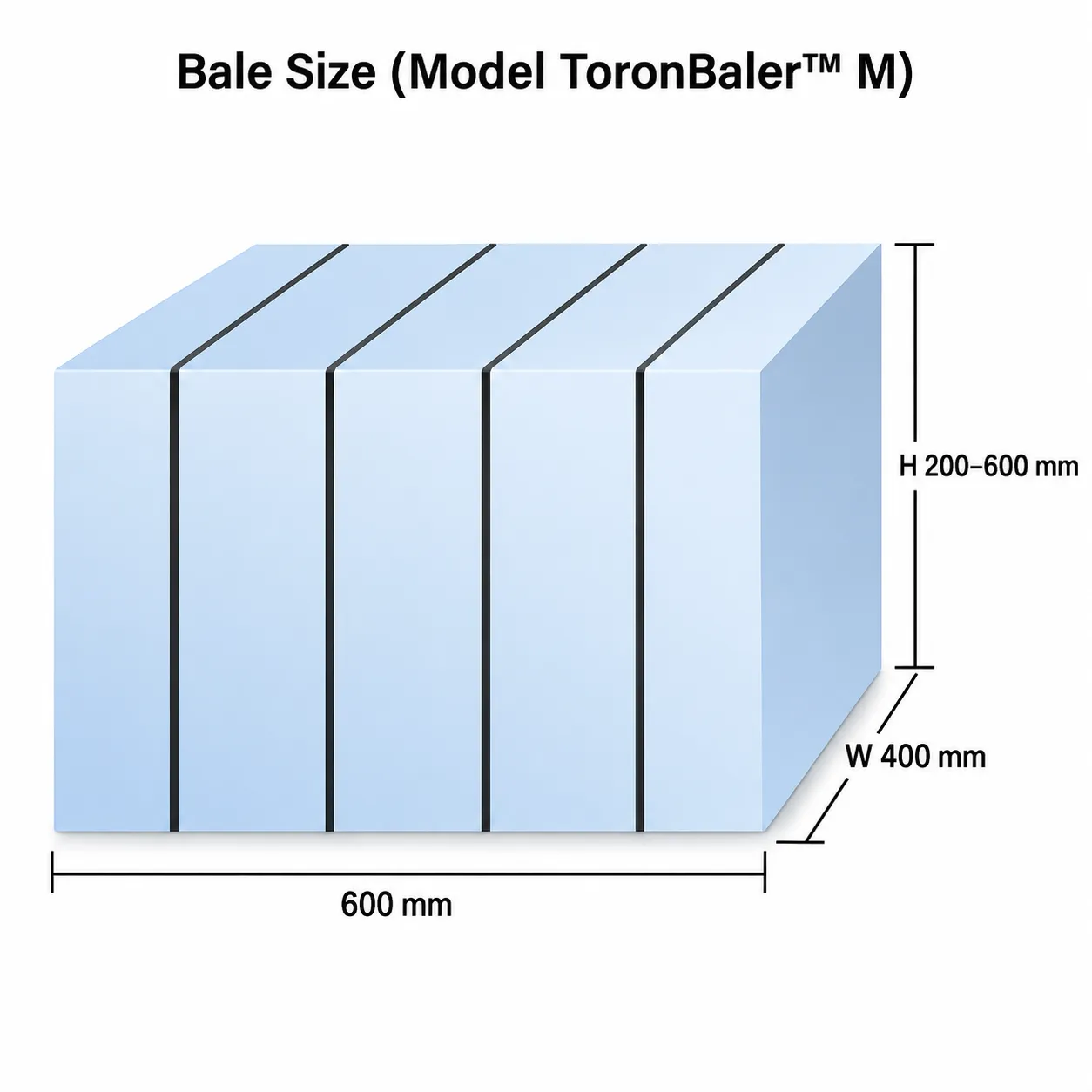
| Bale Size (L × W × H, H adjustable) | 600 × 400 × (200 to 600) mm | 600 × 400 × (200 to 600) mm | 800 × 600 × (400 to 800) mm |
| Bale Weight | 15 to 40 kg | 20 to 50 kg | 60 to 120 kg |
| Motor Power | 1.5 kW | 2.2 kW | 3 kW |
| Machine Weight | 450 kg | 500 kg | 1,000 kg |
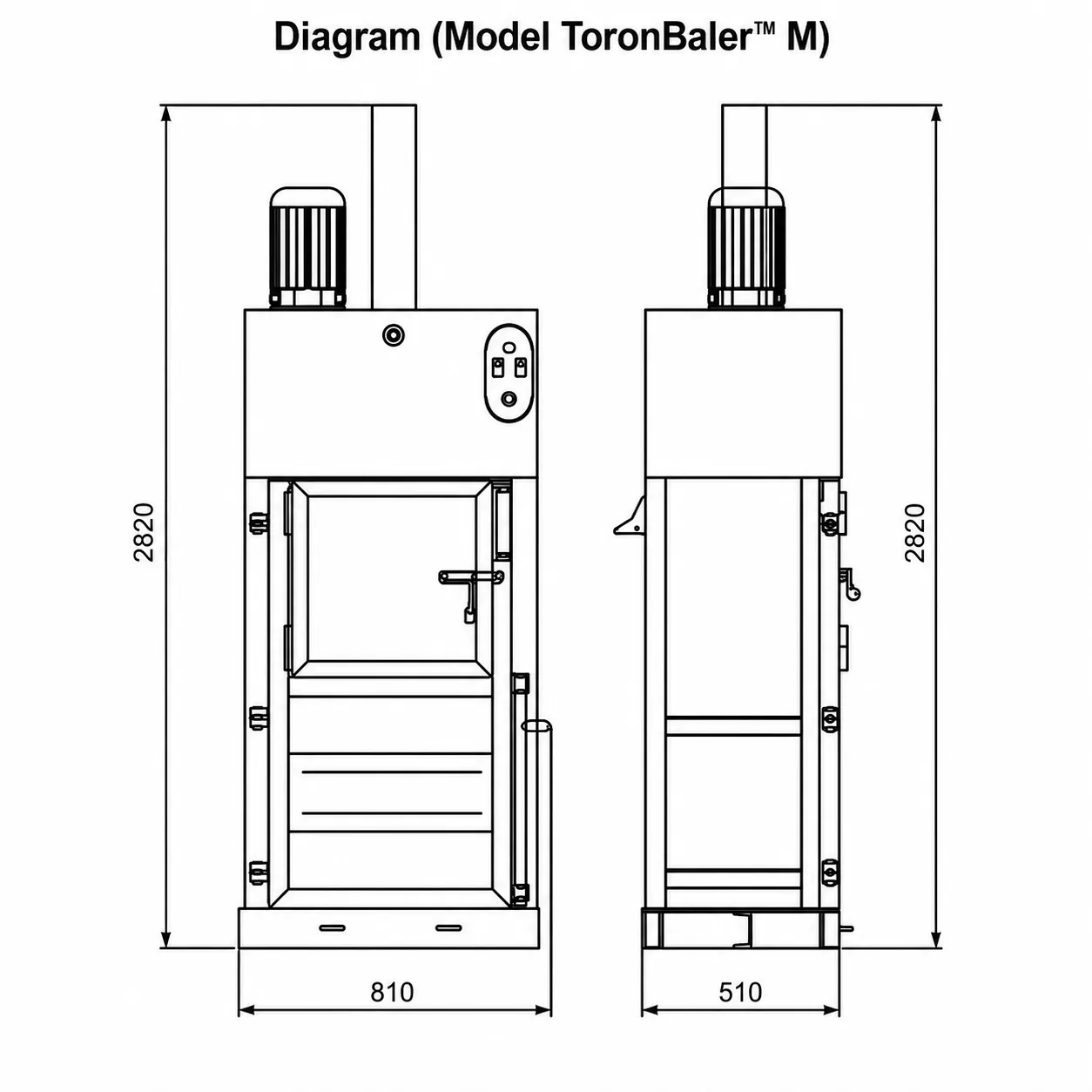
| Overall Dimensions (L × W × H) | 900 × 570 × 2,240 mm | 900 × 570 × 2,240 mm | 1,180 × 800 × 2,550 mm |
| Bale Ejection | Automatic chain ejector | Automatic chain ejector | Automatic chain ejector |
| Liquid Receiver | Optional | Optional | Optional |
| Materials Handled | Food residue, paper, plastics, textile | Food residue, paper, plastics, textile | Food residue, paper, plastics, textile |