
Micro Peel Strength Tester
Micro Peel Strength Tester – ToronPST™ Series
Peel Force and Bond Strength Tester for Flexible Laminates
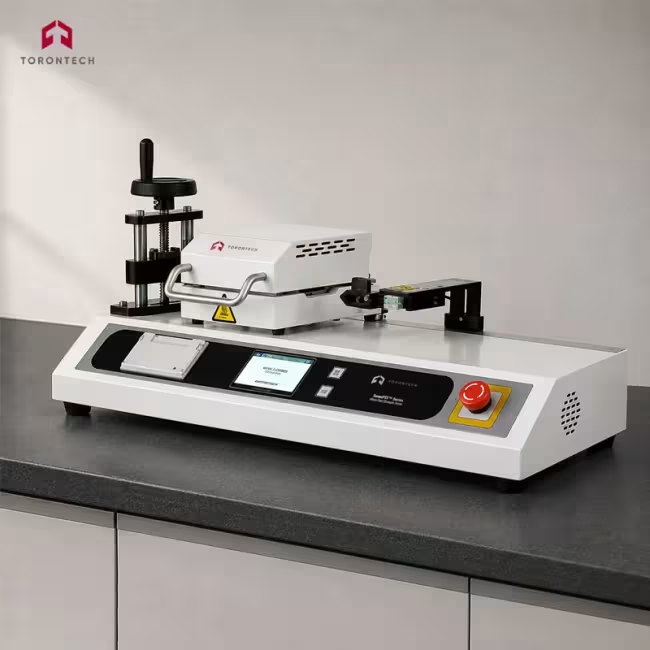
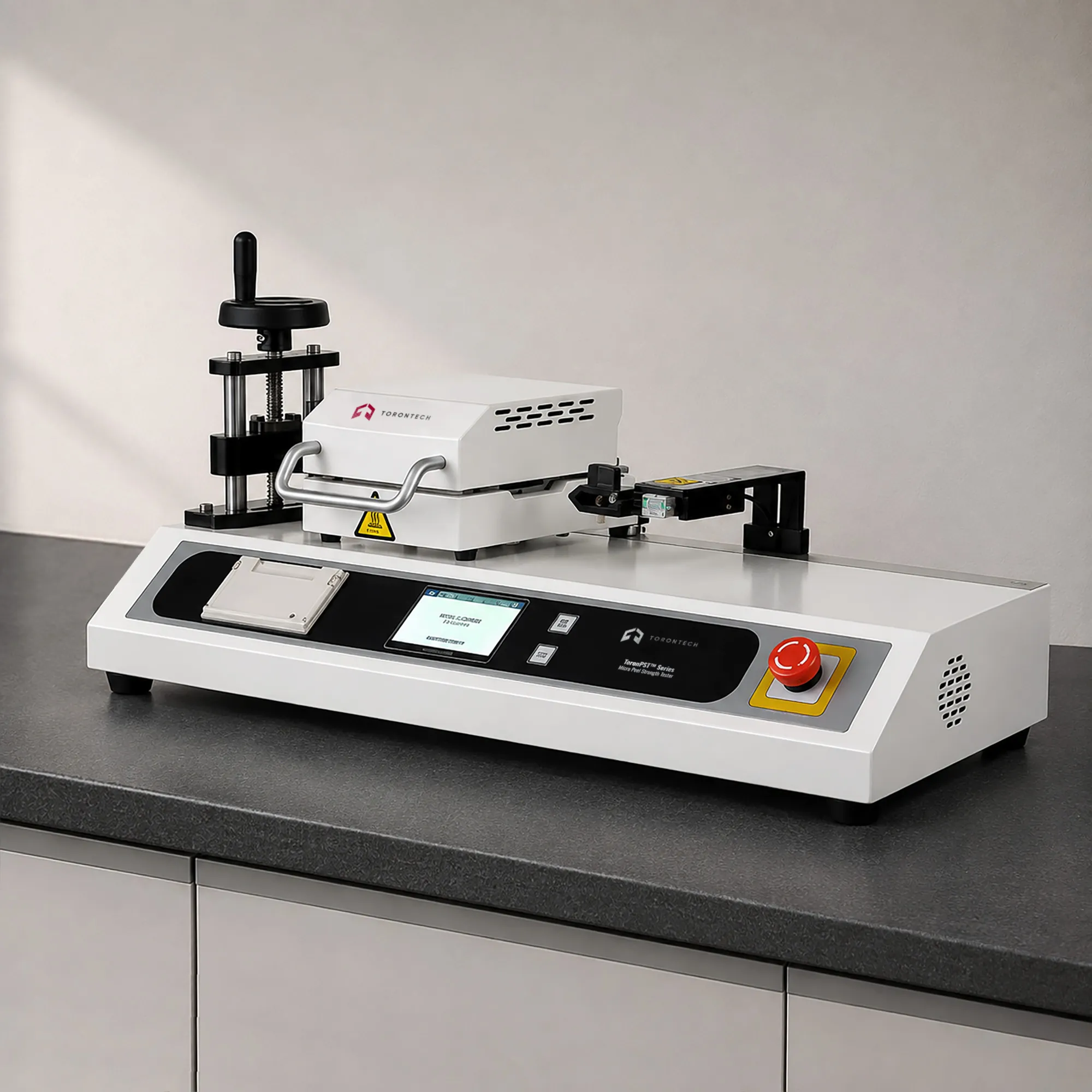
The ToronPST™ Series is a micro peel strength tester that measures the peel force and bond strength of flexible laminated plastics, tapes, and coated materials. The instrument runs 90°, 180°, and T-peel tests with matching fixtures, so one bench covers the common peel geometries. Low-range load cells and a high-accuracy load frame resolve the small forces typical of delicate laminates and adhesives.
Selectable 5N to 200N load cells and 470 mm of peeling distance let the ToronPST™ Series handle light release liners through stronger laminate bonds. Test speed sets freely over 1 to 500 mm/min from the color touchscreen, and force measures to 0.03% of full scale. A built-in micro-printer produces a test report at the bench.
The horizontal peel bed keeps the specimen flat and the peel angle steady for repeatable results, and overload protection guards the load cell. Optional computer software adds curve display, data storage, and reporting. The ToronPST™ Series (Peel Force and Bond Strength Tester for Flexible Laminates) suits packaging, tape, label, and medical-material QC and R&D labs.
Micro Peel Strength Tester – ToronPST™ Series Applications
The ToronPST™ Series measures peel force and bond strength across laminates, tapes, and coated materials.
- Flexible Laminates: measures ply-bond strength between the layers of laminated packaging films.
- Pressure-Sensitive Tapes and Labels: runs 90° and 180° peel-adhesion tests on tapes and labels.
- Release Liners and Films: measures the release force of liners from adhesive layers.
- Medical Tapes and Patches: checks the peel force of medical tapes and skin patches for QC.
- Coated and Laminated Papers: tests the bond strength of coated and laminated paper structures.
- Adhesive Development: supports formulation and process work by quantifying peel force.
- Delamination Studies: measures the force to separate bonded layers for failure analysis.
- Packaging Quality Control: verifies lamination bond strength during production.
Standards
The ToronPST™ Series runs peel tests aligned with recognized peel-adhesion practice for flexible materials.
- ASTM D3330 - Standard Test Method for Peel Adhesion of Pressure-Sensitive Tape
The 90°, 180°, and T-peel geometries follow common peel-test practice, and the instrument can be configured to a laboratory's applicable peel or bond-strength method and specimen width.
Micro Peel Strength Tester – ToronPST™ Series Key Features
The ToronPST™ Series is a dedicated low-force peel bench with three peel geometries and touchscreen control.
- Dedicated Peel and Bond Testing: measures peeling force and bond strength of flexible laminates and coated materials.
- 90°, 180°, and T-Peel Modes: runs the common peel geometries with matching fixtures for standard-based results.
- Low-Range Load Cells: selectable 5N, 10N, 30N, 50N, and 200N load cells resolve the small forces of delicate laminates and tapes.
- Touchscreen Operation: a color TFT touchscreen sets test speed and runs the test without a connected PC.
- High-Accuracy Load Cell: force measurement to 0.03% of full scale supports precise, repeatable peel data.
- Adjustable Test Speed: test speed sets freely over 1 to 500 mm/min from the touchscreen.
- Long Peel Travel: 470 mm of peeling distance handles long peel runs in one pass.
- Built-In Micro-Printer: prints a test report at the bench for quick record-keeping.
- Interchangeable Grips: optional professional grips adapt the instrument to different specimen types.
- Overload Protection: built-in protection guards the load cell and specimen.
- RS232 Communication: a serial port connects the instrument to a PC.
- Optional Analysis Software: optional computer software adds curve display, data storage, and reporting.
Theory and Method
A peel test measures the force needed to separate two bonded layers, which reflects the strength of the bond or adhesive between them. The instrument clamps one layer in a grip and pulls it away from the other at a controlled speed and angle, while a load cell records the force through the peel. The result is a force-versus-distance curve along the bond line.
The peel angle sets how the load is applied. A 180° peel folds the peeled layer back on itself, a 90° peel holds it perpendicular to the bond, and a T-peel pulls two flexible layers apart in a T shape. Each geometry suits different materials and standards, so the instrument offers all three with the matching fixtures.
Peel strength is reported as the average force over the peel, often normalized per unit width. Because laminate and tape bonds fail at low forces, a low-range load cell and a steady, slow crosshead speed give the resolution needed for repeatable results. The horizontal peel bed keeps the specimen flat and the peel angle consistent across the run.
Micro Peel Strength Tester – ToronPST™ Series Technical Specifications
| Parameter | Specification |
|---|---|
| Load Cell Range | 5 N, 10 N, 30 N, 50 N, 200 N (selectable) |
| Load Accuracy | 0.03% of full scale (max) |
| Test Speed | 1 to 500 mm/min |
| Speed Accuracy | 1 mm/min |
| Peeling Distance | 470 mm |
| Sample Width | 10, 15, 20, 25.4, 50 mm (optional) |
| Voltage | AC 220 V, 50 Hz (110V is also available) |
| Power Consumption | 30 W |
| Dimensions | 750 mm (L) × 340 mm (W) × 120 mm (H) |
| Net Weight | 43 kg |
Standard Delivery
| Item | Description |
|---|---|
| Main Unit | Horizontal micro peel test bench with touchscreen |
| Load Cell (5 N) | Standard low-range force sensor |
| Peeling Grips (30 mm) | Standard grips for 30 mm specimens |
Optional Accessories
| Item | Description |
|---|---|
| Control Software | Computer software for curves, data storage, and reporting |
| 90° Peeling Fixtures | Fixtures for 90-degree peel geometry |
| 180° Peeling Test Plates | Plates for 180-degree peel geometry |
| Additional Load Cells | Interchangeable 10, 30, 50, and 200 N load cells |
| Calibration Accessories | Reference accessories for force calibration |