
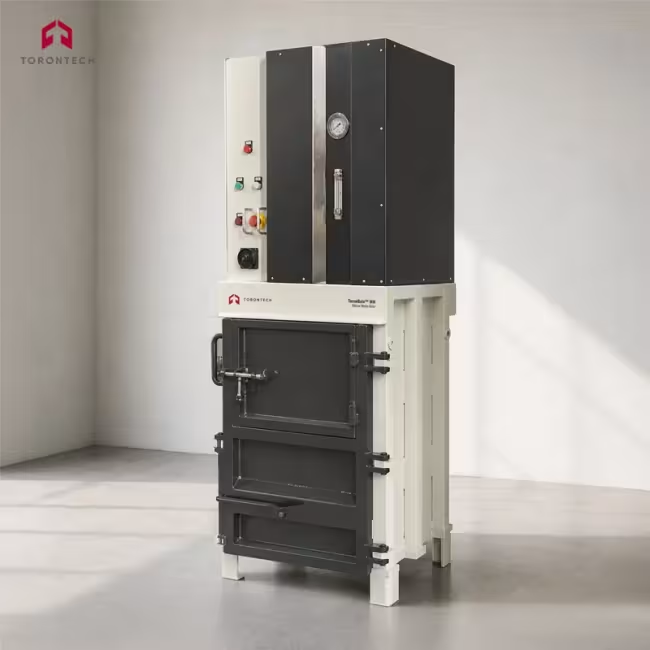
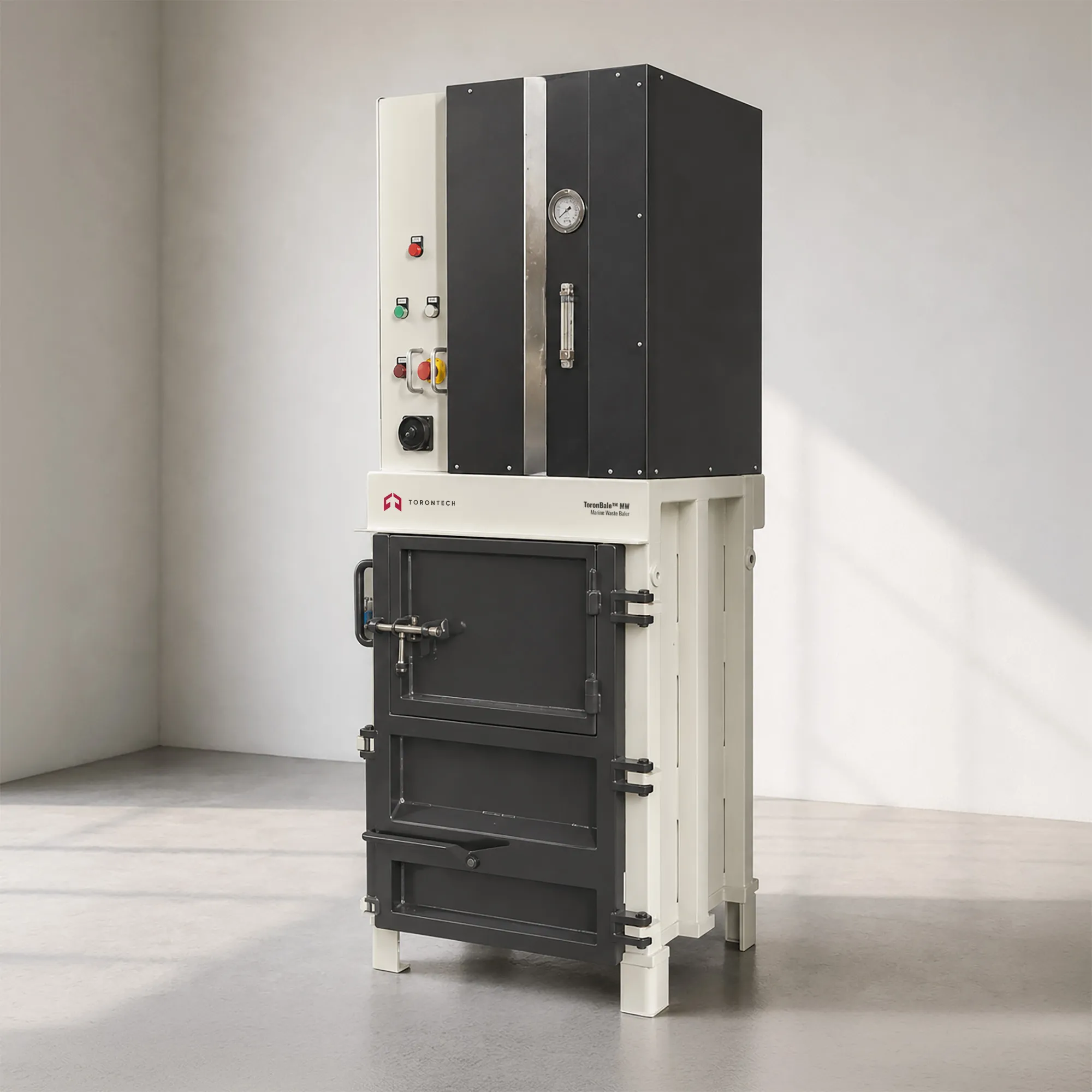
Marine Waste Baler - ToronBale™ MW
Marine waste baler compacts galley residue, packaging, and disposable tableware aboard vessels and offshore installations where waste has to be stored rather than discharged. Torontech supplies the ToronBale™ MW as a single 5 ton unit measuring 700 by 500 mm on the deck and 1,958 mm tall. Material compacts into a removable stainless steel inner box measuring 536 by 426 by 500 mm. Machine weight is 500 kg and the motor draws 1.5 kW.
Construction differs from a shore-based machine of the same capacity. The frame is built for corrosive service and the inner box is stainless steel. An enclosed housing keeps dust and spray out of the mechanism. Salt-laden air, wash-down water, and wet food waste ruin ordinary painted carbon steel quickly in a confined engine room or galley space.
A ship cannot put its garbage out for collection. Everything generated between ports accumulates on board. Storage space was fixed the day the vessel was built. Compacting waste at the point it arises extends how long a vessel, platform, or remote island facility can operate before disposal becomes the limiting factor.
Marine Waste Baler - ToronBale™ MW Applications
The ToronBale™ MW suits operations that generate waste in confined spaces without access to regular collection.
- Cargo Ships and Tankers: compacts galley and accommodation waste accumulating across long ocean passages between ports
- Cruise and Passenger Vessels: handles the high volume of food service packaging and disposable tableware passenger operations produce
- Offshore Drilling Platforms: reduces waste volume where every backload to shore costs supply vessel capacity
- Fishing Vessels and Factory Trawlers: manages provisioning packaging and galley residue on extended fishing trips
- Naval and Patrol Craft: consolidates waste during deployments without shore support
- Island and Remote Facilities: serves locations where waste leaves only by boat or aircraft on a fixed schedule
- Harbor and Port Reception Facilities: compacts waste received from visiting vessels before onward transport
- Hotels and Restaurants: handles food service waste in back-of-house areas where hygiene and odor control matter
- Hospitals and Care Facilities: consolidates general packaging waste in service areas with washable equipment surfaces
Standards
Torontech has no published standards compliance for the ToronBale™ MW at this time. The design includes a feed-gate interlock that halts downward platen travel when the loading gate opens, along with an independent emergency stop mounted separately from the main controls. Marine buyers should note that shipboard equipment often requires type approval from a classification society, and Torontech has not published such approval for this model. Confirm approval status, certification, and documentation with Torontech before ordering.
Marine Waste Baler - ToronBale™ MW Key Features
The ToronBale™ MW is built for one environment, and every difference from a shore machine of the same size traces back to it.
- Stainless Steel Inner Box: the wetted chamber resists corrosion from salt, wash-down water, and organic residue, and lifts out complete for transfer to storage
- Enclosed Housing Design: the frame encloses the working mechanism, keeping dust and spray away from rods, guides, and seals
- Corrosion-Resistant Frame Construction: the structure is specified for harsh, humid, salt-laden service rather than clean indoor conditions
- Compact 700 by 500 mm Footprint: fits alongside galley passages, provision stores, and service flats where deck area is fully committed
- Under 2 m Overall Height: at 1,958 mm the unit clears the low deckhead heights common in accommodation and service spaces
- Low 1.5 kW Power Draw: modest demand suits vessel and platform electrical systems where spare capacity is limited
- 500 kg Machine Weight: light enough for installation on upper decks and platform modules subject to structural loading limits
- Feed Gate Ram Interlock: stops downward platen travel the moment the loading gate opens, keeping hands clear of the compaction zone
- Independent Emergency Stop: a dedicated, prominently mounted circuit cuts hydraulic function apart from the main control system
- Reinforced Ram Guides: maintain a square platen face when mixed waste sits unevenly, protecting cylinder seals from side loading
- NOK Hydraulic Seals: Japanese-sourced sealing components extend service intervals, which matters where a technician cannot be called out at sea
- A.M.C. Oil Pipe Joints: Japanese-made fittings hold hydraulic connections leak-free across thermal cycling and vessel motion
Theory and Method
Volume, not weight, governs waste handling at sea. International rules prohibit discharging most categories of garbage overboard, so a vessel carries everything it generates until it reaches a port reception facility. Storage space aboard is fixed and competes with cargo, stores, and accommodation. Reducing loose galley waste to a fraction of its original bulk therefore buys operating days directly, which is a different calculation from the freight-cost logic that drives shore-based baling.
The marine environment attacks equipment through several routes at once. Airborne salt deposits on every surface and draws moisture from humid air, producing a persistent electrolyte film that corrodes carbon steel. Wet food residue adds organic acids and chlorides from the inside. A stainless inner box removes the worst of that exposure from the wetted surfaces, and an enclosed housing keeps spray and dust away from cylinder rods, guides, and seals.
Compaction itself follows the same principle as any small press. The 5 ton cylinder acts across a 536 by 426 mm box footprint, giving useful pressure despite modest tonnage because the area is small. What matters more aboard ship is what happens after compaction. The inner box lifts out complete, so a compacted load transfers to storage without loose material escaping into a confined space where odor and pests become a crew welfare problem.
Marine Waste Baler - ToronBale™ MW Technical Specifications
| Parameter | Specification |
|---|---|
| Press Force | 5 tons (approx. 49 kN) |
| Feed Opening Size | 540 × 300 mm |
| Baling Chamber Height | 810 mm |
| Inner Box Size (L × W × H) | 536 × 426 × 500 mm |
| Inner Box Material | Stainless steel |
| Motor Power | 1.5 kW |
| Machine Weight | 500 kg |
| Overall Dimensions (L × W × H) | 700 × 500 × 1,958 mm |
| Housing | Enclosed design |
| Materials Handled | Food residue, paper, plastics, disposable tableware |