
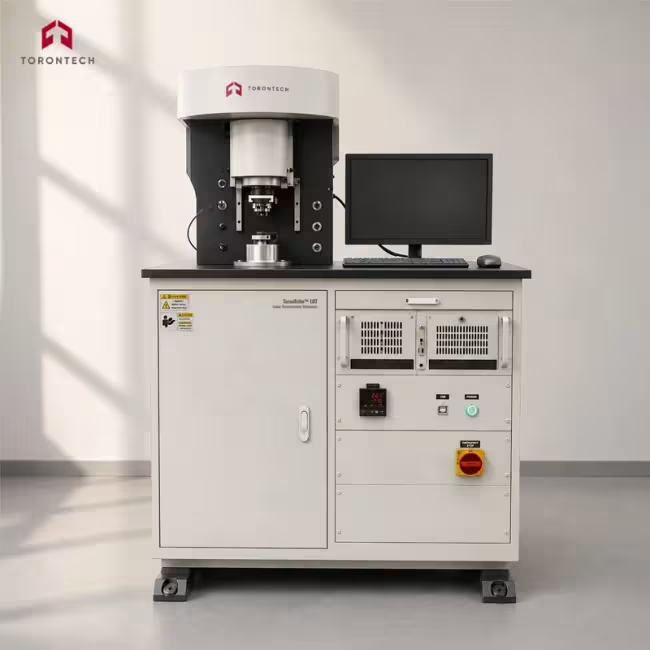
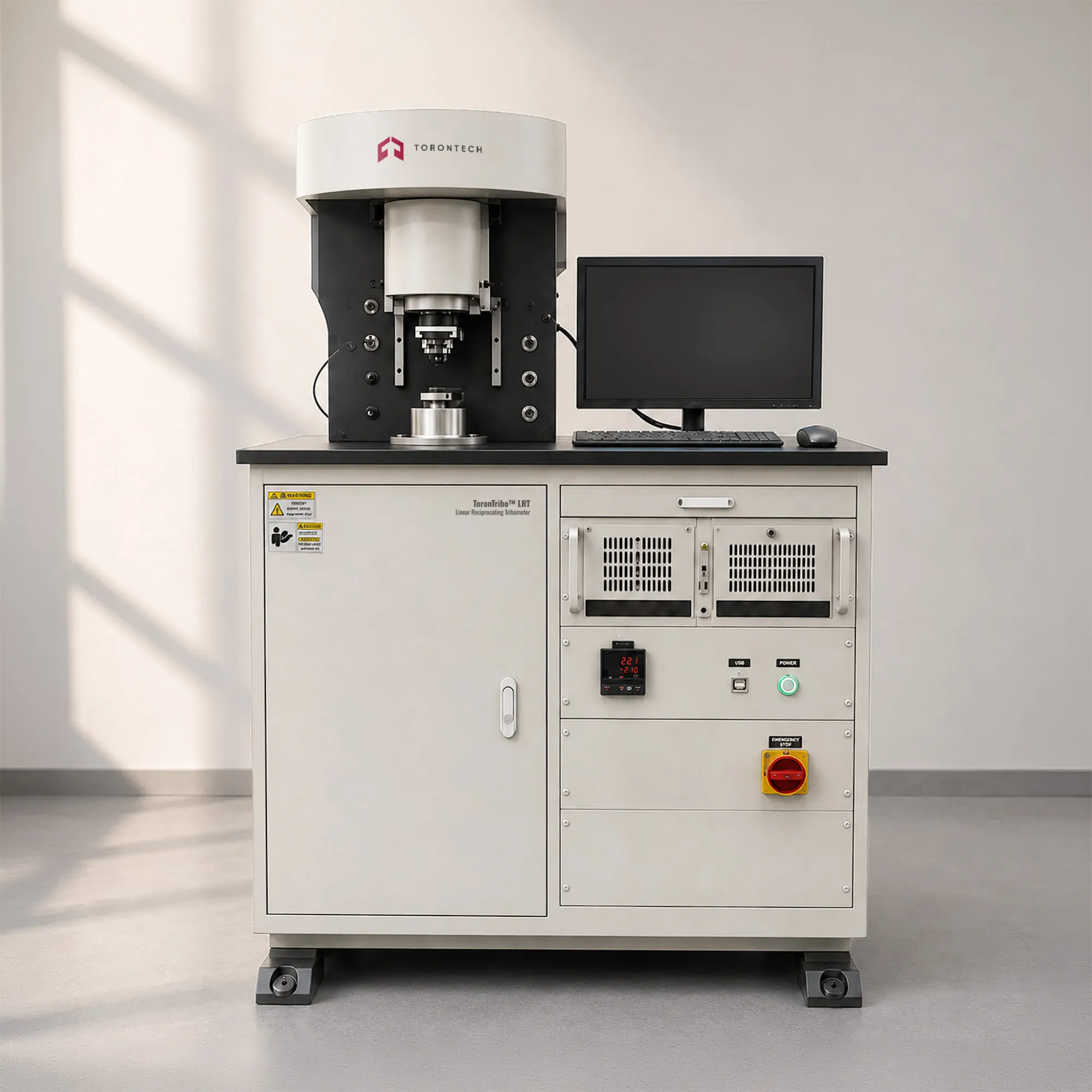
Linear Reciprocating Tribometer
Linear Reciprocating Tribometer - ToronTribo™ LRT
Linear Reciprocating Friction and Wear Tester
Linear reciprocating tribometer evaluates friction and wear performance in materials, coatings, and lubricants for laboratories, manufacturers, and research institutions. The ToronTribo™ LRT applies a controlled normal force while the test specimen moves through reciprocating, rotating, or ring-block motion, reproducing the sliding and oscillating contact conditions found in real mechanical systems. Operators track friction force, normal force, and surface temperature in real time, so material and coating decisions rest on measured data rather than estimation.
The instrument accommodates several friction pair configurations, including pin-on-disc, ball-on-disc, ring-block, and pillar-tile arrangements. Because normal force, speed, frequency, stroke length, and test duration are all adjustable, the ToronTribo™ LRT reproduces a wide span of service conditions, from light sliding contact to high-load abrasive wear. A temperature range extending to 600°C lets engineers assess how materials and surface treatments hold up when mechanical wear combines with thermal stress.
Automotive, aerospace, machinery, and materials-science teams use the tester to qualify metals, polymers, ceramics, coatings, and lubricating greases before they reach production. Each test generates a continuous friction, load, and temperature curve, giving engineers a clear picture of wear behavior across the full test cycle. The ToronTribo™ LRT gives laboratories a single platform that covers multiple ASTM-recognized wear test methods.
Linear Reciprocating Tribometer - ToronTribo™ LRT Applications
The ToronTribo™ LRT supports friction and wear testing across industries evaluating materials, coatings, and lubricants under sliding or oscillating contact.
- Automotive and Powertrain Components: evaluates wear and friction of piston rings, cylinder liners, bearings, and other reciprocating engine parts under simulated service loads
- Lubricant and Grease Development: measures extreme pressure and anti-wear performance of oils and greases using the SRV high-frequency linear-oscillation method
- Surface Coating and Treatment Evaluation: quantifies wear resistance of hard coatings, platings, and surface treatments applied to tools, dies, and machine components
- Aerospace Materials Testing: assesses friction and wear behavior of alloys and composites used in high-load, high-temperature aerospace assemblies
- Polymer and Plastic Component Testing: measures wear rate and coefficient of friction of engineering plastics used in bushings, seals, and sliding assemblies
- Ceramic and Advanced Materials Research: characterizes wear resistance of ceramics and hard materials used in cutting tools, bearings, and wear-resistant linings
- Metallurgical and Materials Science Research: supports academic and industrial research into friction mechanisms, wear mode transitions, and material pair compatibility
Standards
The ToronTribo™ LRT supports test procedures aligned with internationally recognized ASTM and DIN tribology standards, covering pin-on-disk, ball-on-disk, linear reciprocating, and SRV grease and lubricant test methods.
- ASTM B611-13 - Standard Test Method for Determining the High Stress Abrasion Resistance of Hard Materials
- ASTM D5706 - Standard Test Method for Determining Extreme Pressure Properties of Lubricating Greases Using a High-Frequency, Linear-Oscillation (SRV) Test Machine
- ASTM D5707 - Standard Test Method for Measuring Friction and Wear Properties of Lubricating Grease Using a High-Frequency, Linear-Oscillation (SRV) Test Machine
- ASTM D6425 - Standard Test Method for Measuring Friction and Wear Properties of Extreme Pressure (EP) Lubricating Oils Using a High-Frequency, Linear-Oscillation (SRV) Test Machine
- ASTM D7217 - Standard Test Method for Determining Extreme Pressure Properties of Solid Bonded Films Using a High-Frequency, Linear-Oscillation (SRV) Test Machine
- ASTM D7421 - Standard Test Method for Determining Extreme Pressure Properties of Lubricating Oils Using a High-Frequency, Linear-Oscillation (SRV) Test Machine
- ASTM G99-23 - Standard Test Method for Wear and Friction Testing with a Pin-on-Disk or Ball-on-Disk Apparatus
- ASTM G133-05 - Standard Test Method for Linearly Reciprocating Ball-on-Flat Sliding Wear
- DIN 50324:1992-07 - Tribology, Testing of Friction and Wear, Model Test for Sliding Friction of Solids (Ball-on-Disc System)
Linear Reciprocating Tribometer - ToronTribo™ LRT Key Features
The ToronTribo™ LRT combines multiple test geometries, adjustable parameters, and real-time monitoring on a single platform.
- Multi-Mode Motion Testing: integrates reciprocating, rotating, and ring-block motion on one platform, letting operators evaluate different wear mechanisms without switching equipment
- Multiple Friction Pair Configurations: supports pin-on-disc, ball-on-disc, ring-block, and pillar-tile setups to accommodate a wide range of test geometries and material combinations
- High-Force Capacity: applies up to 1000 N of normal force for wear and friction evaluation under demanding load conditions
- High-Speed and High-Frequency Operation: reaches rotational speeds up to 2000 rpm and oscillation frequencies up to 200 Hz for accelerated wear testing
- Wide Temperature Range Testing: operates from room temperature up to 600°C, supporting wear evaluation of materials and coatings intended for high-temperature service
- Real-Time Data Acquisition: continuously records friction force, normal force, and temperature, and plots each parameter as a live curve during the test
- Adjustable Test Parameters: normal force, speed, frequency, stroke, and test duration are user-configurable to replicate specific service conditions
- Customizable Configuration: higher-capacity force, speed, and displacement parameters are available for applications requiring extended test ranges
Theory and Method
Linear reciprocating wear testing evaluates how two contacting surfaces perform under repeated back-and-forth sliding motion. A test specimen, typically a ball, pin, or cylindrical tip, presses against a lower sample under a controlled normal force while a drive mechanism moves the lower sample through a fixed stroke length at a set frequency. Each pass generates friction between the two surfaces, and the resulting resistance is measured continuously as the contact point sweeps across and reverses along the wear track.
The ToronTribo™ LRT applies this principle through a servo-driven reciprocating stage paired with force and temperature sensors. As frequency and stroke length increase, sliding velocity through the contact point rises and falls in a sinusoidal pattern, shifting the interface between boundary and mixed lubrication regimes. This velocity variation is central to the SRV method (from the German Schwingung Reibung Verschleiß, meaning oscillation, friction, wear), which uses high-frequency linear oscillation to evaluate the extreme pressure and anti-wear performance of lubricating oils and greases under conditions that mimic reciprocating engine components.
Beyond reciprocating motion, the tester's rotating and ring-block configurations extend the same force- and temperature-controlled platform to pin-on-disc, ball-on-disc, and ring-on-block contact geometries. Each geometry produces a different wear track shape and contact pressure distribution, letting engineers select the configuration that best represents the mechanical interface under study. Comparing wear volume, friction coefficient, and surface temperature across these configurations helps identify the material pairing and lubrication strategy that best resists wear in the target application.
Linear Reciprocating Tribometer - ToronTribo™ LRT Technical Specifications
| Parameter | Specification |
|---|---|
| Maximum Normal Force | 1000 N (customizable to higher capacity) |
| Maximum Rotational Speed | 2000 rpm (customizable to higher capacity) |
| Maximum Oscillation Frequency | 200 Hz |
| Maximum Reciprocating Friction Force | 100 N (customizable to higher capacity) |
| Maximum Rotating Torque | 4.7 N·m (customizable to higher capacity) |
| Maximum Reciprocating Displacement (Stroke) | 12 mm (customizable to higher capacity) |
| Reciprocating Friction Pair Forms | Ball-on-disc, pin-on-disc, pillar-tile |
| Rotating Friction Pair Forms | Ball-on-disc, pin-on-disc |
| Ring Friction Pair Form | Ring-block |
| Temperature Range | Room temperature to 600°C (customizable to higher capacity) |
| Lubricating Grease Test Method | SRV high-frequency linear-oscillation method (ASTM D5706, D5707, D6425, D7217, D7421) |