
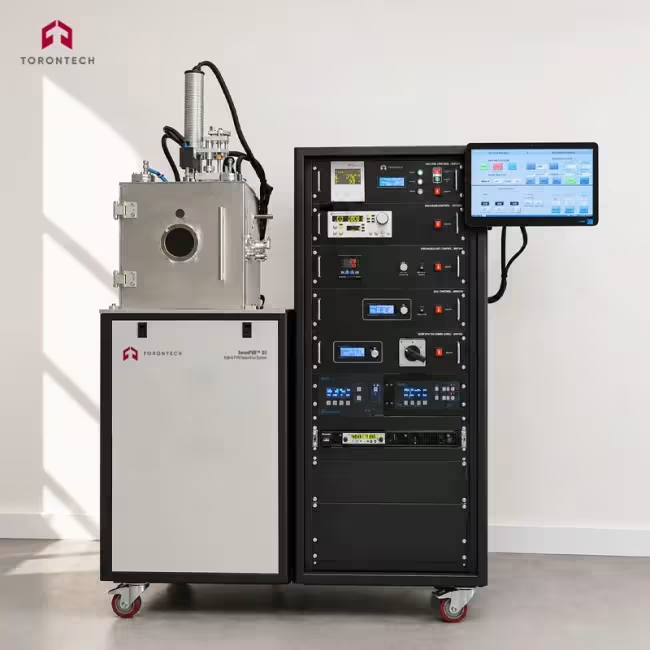
Hybrid PVD Deposition System
Hybrid PVD Deposition System - ToronPVD™ DS
Combined Thermal Evaporation & Magnetron Sputtering System
The ToronPVD™ DS is a hybrid PVD deposition system combining four-channel thermal evaporation and DC/RF magnetron sputtering in a single SS304L chamber for multilayer thin film deposition and co-deposition research. Four 10V to 250A thermal sources with proprietary boxed co-evaporation design operate alongside DC/RF sputtering sources in 1, 2, and 3-inch configurations. The system reaches 10⁻⁸ Torr base pressure and 10⁻⁷ Torr in one hour for a loaded chamber. A 1.5-hour cycle and LabVIEW touch screen control support four to six daily experiments.
RF (13.6 MHz, 300 to 1200 W) and DC (0 to 1000 V, 2000 W) power supplies cover both insulating and conductive targets across all deposition modes. Digital MFC controls Ar, N₂, O₂, He, CH₄, and H₂ at 0.1 SCCM for reactive oxide and nitride deposition. Working pressure is precisely controlled across 1 to 100 mTorr for plasma generation. An optional PID heater at 50 to 700 °C (±1 °C) accepts 3", 4", and 6" wafers.
A dual-channel thickness controller with 1 to 4 QCMs at 0.1 Å/s precision monitors deposition rate and cumulative thickness across both thermal and sputtering sources. Optional ICP, CCP, and DC-RF plasma cleaning of the substrate is available before deposition. The SS304L chamber, in prismatic or cylindrical configuration, has electro-polished surfaces with standard 1", QF, CF, and ISO feedthrough ports, UV-blocking observation window, and rotatable shutter. The L120×W80×H180 cm system passes through standard doorways on lockable wheels.
Hybrid PVD Deposition System - ToronPVD™ DS Applications
The ToronPVD™ DS serves research and production PVD laboratories requiring both thermal evaporation and magnetron sputtering in a single vacuum system, where running both deposition modes in the same pump-down cycle reduces processing time and preserves interface cleanliness. Its four-source co-evaporation capability and configurable sputtering guns make it suited to heterogeneous multilayer and alloy film research programs.
- Multilayer Organic/Inorganic Device Research: sequential deposition of organic or metallic layers by thermal evaporation and sputtered oxide or nitride films in a single vacuum cycle without venting between layers
- OLED and Organic Device Fabrication: thermal evaporation of organic emitter and transport layers combined with sputter-deposited conductive contact films for OLED and OPV device development
- Co-Evaporation Alloy and Compound Film Research: simultaneous operation of multiple thermal sources for composition-controlled co-evaporation of alloy and compound films requiring precise multi-material flux control
- Hard Coating and Multi-Material Stack Research: reactive sputtering of nitride and oxide films combined with thermally evaporated metallic seed or functional layers in a single deposition platform
- Semiconductor Device Prototyping: deposition of metal contacts by thermal evaporation and dielectric films by RF sputtering on wafer substrates up to 6 inches in a single pump-down session
- Optical Thin Film Research: thermal evaporation of metallic reflector layers combined with reactive RF sputtered oxide coatings for optical filter, anti-reflective, and mirror film stacks
- Academic and University Multi-Source PVD Research: flexible platform for research programs requiring both evaporation and sputtering without separate tool changeovers between deposition steps
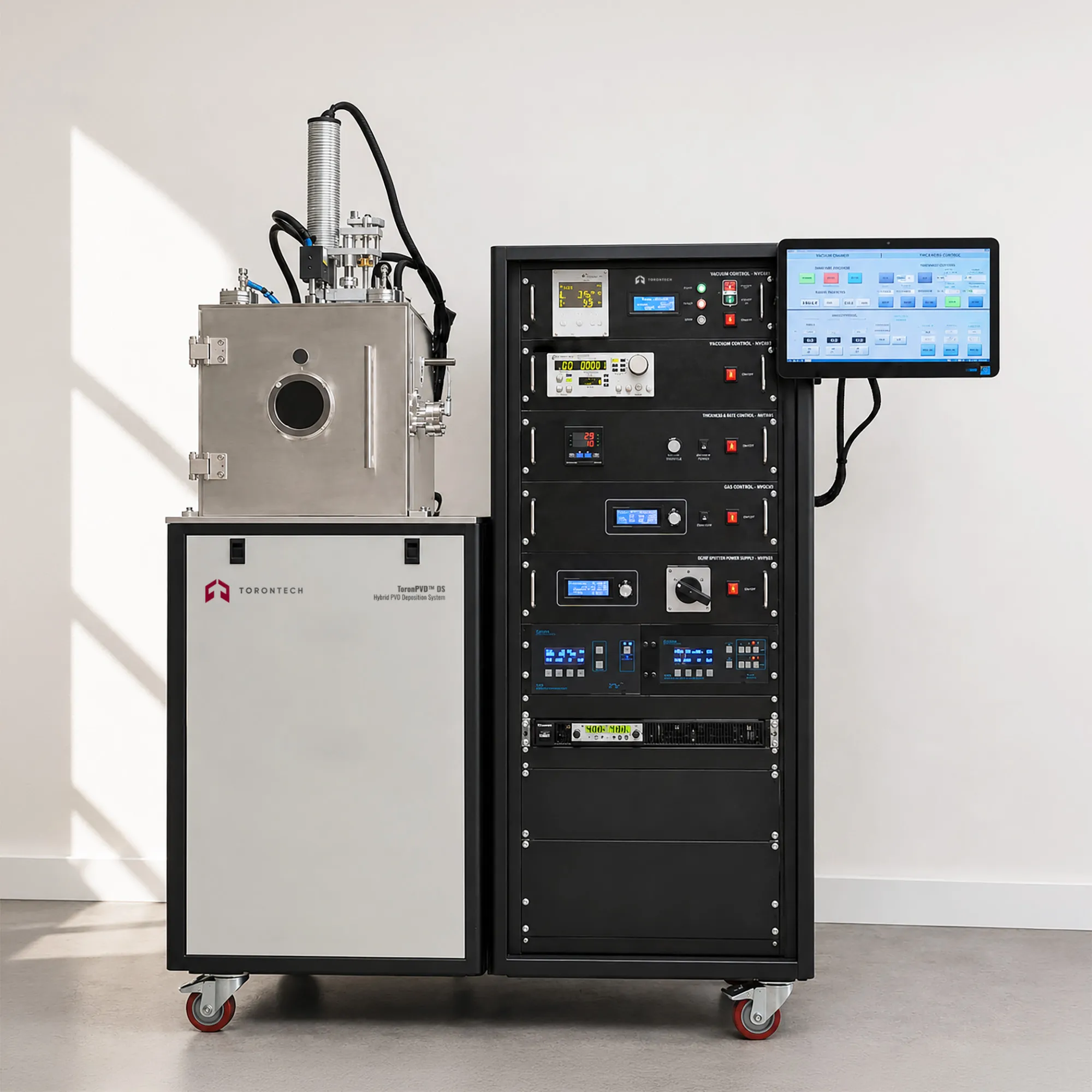
Hybrid PVD Deposition System - ToronPVD™ DS Key Features
The ToronPVD™ DS integrates four-source thermal co-evaporation, DC/RF magnetron sputtering, MFC gas control, PLC automation, and dual-channel thickness monitoring in a single high-vacuum platform for multilayer and multi-material thin film research.
- Four 10V to 250A Thermal Sources with 2×2 Co-Evaporation Configuration: high-current co-evaporation sources with proprietary boxed design preventing cross-contamination and supporting easy boat and basket replacement
- Proprietary Boxed Source Design: enclosed source geometry prevents evaporant cross-contact between adjacent crucibles, preserving composition purity in co-deposited films
- DC/RF Sputtering Sources (1", 2", 3"), 85 mm Flex-Head Design: covers magnetic and non-magnetic target materials with flex-head for flexible mounting and target alignment across all source positions
- RF Power Supply (13.6 MHz, 300 to 1200 W): covers insulating targets and reactive sputtering of oxide and nitride films at research and production power levels
- DC Power Supply (0 to 1000 V, 2000 W): high-power DC supply for metallic target sputtering and thermal co-evaporation source operation
- 10⁻⁸ Torr Base Pressure, 10⁻⁷ Torr in One Hour (Loaded): turbomolecular and mechanical pump stack with cryo and dry pump options; rapid pump-down supports the 1.5-hour experiment cycle
- Wide-Range Vacuum Control (1000 to 10⁻⁹ Torr): covers the full pressure range for both thermal evaporation and sputtering deposition modes in a single measurement system
- Precise Plasma Pressure Control (1 to 100 mTorr): independent pressure setting for stable plasma conditions during sputtering and reactive deposition processes
- Digital MFC Gas Control (Ar, N₂, O₂, He, CH₄, H₂) at 0.1 SCCM Sensitivity: six-gas MFC delivery for inert and reactive deposition across both evaporation and sputtering modes
- 0.1 Å/s Dual-Channel Thickness Monitoring with 1 to 4 QCMs: simultaneous precision rate and thickness measurement across active thermal and sputtering source channels
- Optional 50 to 700 °C PID Substrate Heater (±1 °C): substrate temperature control for film crystallinity and adhesion, compatible with 3", 4", and 6" wafers and 1 to 10 cm sample attachments
- 2 to 30 rpm Sample Rotation: continuously adjustable rotation for uniform film thickness distribution across the substrate surface
- Optional ICP, CCP, and DC-RF Substrate Plasma Cleaning: in-situ substrate surface preparation before deposition without breaking vacuum
- Automatic Closed-Loop Water Cooling with Interlock: thermal management prevents source operation without active coolant, protecting plasma sources and thermal source assemblies
- Throttle, Vent, and Isolation Valve Configuration: precise process pressure management; the chamber holds vacuum between experiments via the isolation valve
- SS304L Chamber (Prismatic or Cylindrical) with Electro-Polished Surfaces: feather-touch clean surfaces with standard 1", QF, CF, and ISO feedthrough ports for flexible integration
- Internal Lighting, 100 °C Baking, UV-Blocking Window, and Rotatable Shutter: full chamber accessories for process monitoring, conditioning, and moisture removal
- Easily Upgradeable with Additional Thermal and Sputtering Sources: modular architecture supports expansion of source count as research requirements grow
- LabVIEW Touch Screen Control with Full Panel Backup: automated sequence management for all source, gas, vacuum, and rotation functions, with manual panel backup available at all times
- 1.5-Hour Experiment Cycle, 4 to 6 Experiments Per Day: fast pump-down and process cycle supports multi-run daily throughput
- L120×W80×H180 cm Mobile Platform on Lockable Wheels: full-size combined system with large footprint passes through standard doorways for flexible laboratory placement
- One-Year Warranty for Design, Materials, and Workmanship: annual coverage for system components, design quality, and manufacturing
Theory and Method
Thermal evaporation and magnetron sputtering each address material classes and deposition conditions that the other cannot match, making their combination in a single chamber practical for complex multilayer device structures. Thermal evaporation heats a resistive source to vaporization, producing clean metallic and organic flux suited to contact metals and organic emitters. Magnetron sputtering ejects atoms from a solid target using plasma, covering refractory metals, oxides, and nitrides. Combining both in one vacuum cycle eliminates air-exposure contamination at organic-inorganic and metal-dielectric interfaces.
Four thermal sources in a 2×2 co-evaporation configuration allow simultaneous multi-material deposition for alloy, composition-graded, and compound films. The proprietary boxed source design prevents cross-contamination between adjacent crucibles and simplifies source material replacement. DC/RF sputtering in 1, 2, and 3-inch flex-head configurations covers magnetic and non-magnetic targets alongside the thermal sources. A dual-channel thickness controller with 1 to 4 QCMs monitors the combined deposition at 0.1 Å/s across all active sources.
The turbomolecular and mechanical pump combination reaches 10⁻⁸ Torr base pressure and 10⁻⁷ Torr in one hour for a loaded chamber. Wide-range vacuum control spanning 1000 to 10⁻⁹ Torr and precise 1 to 100 mTorr pressure control for plasma generation cover all operating conditions. LabVIEW touch screen control with full panel backup manages source power, gas, vacuum, and rotation sequences. An optional ICP, CCP, or DC-RF plasma cleaning unit prepares substrate surfaces before deposition.
Hybrid PVD Deposition System - ToronPVD™ DS Technical Specifications
| Parameter | Specification |
|---|---|
| RF Power Supply | 13.6 MHz, 300 to 1200 W |
| DC Power Supply | 0 to 1000 V DC, 2000 W |
| Base Pressure | 10⁻⁸ Torr |
| Working Vacuum (Loaded, 1 hour) | 10⁻⁷ Torr |
| Vacuum Control Range | 1000 to 10⁻⁹ Torr |
| Pump Configuration | Turbomolecular + Mechanical (cryo and dry pump as options) |
| Sputtering Pressure Range | 1 to 100 mTorr |
| Thermal Evaporation Sources | 4 (10V to 250A; 2×2 co-evaporation configuration) |
| Source Design | Proprietary boxed (cross-contamination prevention) |
| Sputtering Sources | DC/RF; 1", 2", 3" targets; 85 mm flex-head |
| Magnetic/Non-Magnetic Sputtering | Yes |
| Gas Inputs | Ar, N₂, O₂, He, CH₄, H₂; digital MFC; 0.1 SCCM sensitivity |
| Chamber Material | SS304L (prismatic or cylindrical); electro-polished |
| Feedthrough Ports | Standard 1-inch, QF, CF, ISO |
| Substrate Heating (Optional) | 50 to 700 °C (PID, ±1 °C) |
| Wafer Compatibility | 3", 4", 6"; 1 to 10 cm sample attachments |
| Sample Rotation Speed | 2 to 30 rpm |
| Plasma Cleaning (Optional) | ICP, CCP, DC-RF |
| Thickness Monitoring | Dual-channel; 0.1 Å/s; 1 to 4 QCMs |
| Internal Baking | Up to 100 °C |
| Observation Window | UV-blocking; rotatable shutter |
| Cooling System | Automatic closed-loop water cooling (interlock protected) |
| Control System | LabVIEW touch screen; full panel backup |
| Experiment Cycle Time | 1.5 hours (4 to 6 experiments per day) |
| Footprint | L120 × W80 × H180 cm |
| Door Clearance | Passes through standard doors |
| Mobility | Lockable wheels |
| Warranty | 1 year (design, materials, and workmanship) |