
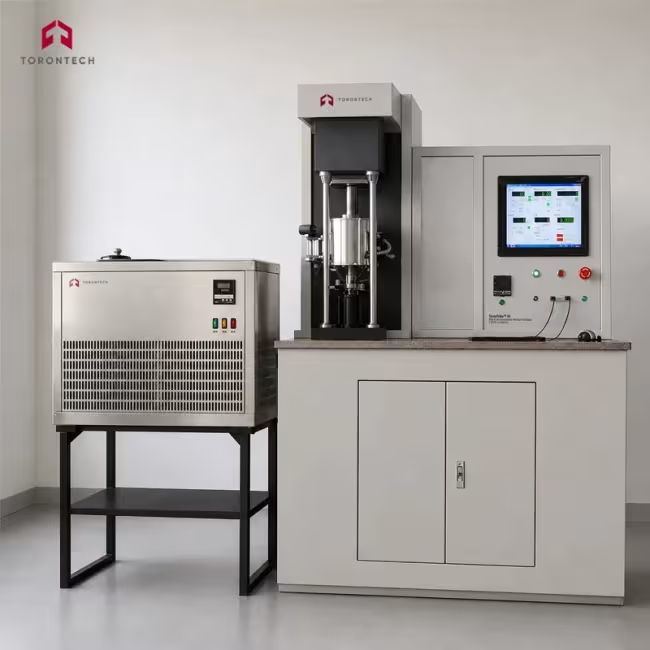
High & Low Temperature End-Face Tribometer (-150°C to 1000°C)
High & Low Temperature End-Face Tribometer (-150°C to 1000°C) - ToronTribo™ EF
High & Low temperature end-face tribometer evaluates friction and wear performance across an exceptionally wide thermal range, serving materials laboratories, seal manufacturers, and component developers working with lubricants, metals, plastics, coatings, rubber, and ceramics. The ToronTribo™ EF presses two flat end faces together under a controlled contact pressure and rotates one against the other, reproducing the face-on-face contact found in mechanical seals, thrust washers, and clutch-type friction interfaces.
The tester spans a temperature range from -150°C up to 1000°C, letting engineers evaluate a single material pair from cryogenic conditions through high-temperature service in one testing program. Normal force is adjustable across two ranges, 50 to 5000 N or 100 to 10,000 N, with a maximum friction force of 500 N and spindle speed up to 2000 rpm. Test duration is programmable from 1 second to 9,999 minutes, supporting both short screening tests and extended wear-life studies.
Mechanical seal manufacturers, materials research laboratories, and component developers use the ToronTribo™ EF to characterize how candidate materials and lubricants perform under sustained face-to-face rotating contact across extreme temperature conditions. The wide material compatibility, spanning metals, plastics, rubber, ceramics, and coatings, supports comparative testing across very different material classes on a single platform.
High & Low Temperature End-Face Tribometer (-150°C to 1000°C) - ToronTribo™ EF Applications
The ToronTribo™ EF supports friction and wear evaluation for face-to-face rotating contacts across an unusually wide temperature range.
- Mechanical Seal Face Material Testing: evaluates friction and wear behavior of seal face material pairs under conditions representative of rotating equipment seals
- Cryogenic Component Materials Research: assesses material performance at temperatures down to -150°C for components operating in cryogenic or low-temperature service
- High-Temperature Coating and Ceramic Testing: characterizes wear resistance of coatings and ceramic materials at temperatures up to 1000°C
- Clutch and Brake Facing Material Development: studies friction and wear of composite and polymer facing materials under sustained face contact
- Rubber and Elastomer Seal Testing: evaluates wear behavior of rubber and elastomer materials used in rotating seal applications
- Thrust Washer and Bearing Face Material Selection: compares candidate materials for thrust-bearing and washer applications under axial face contact
- Extreme Temperature Materials Screening: supports research requiring a single test platform to evaluate a material across both cryogenic and high-temperature extremes
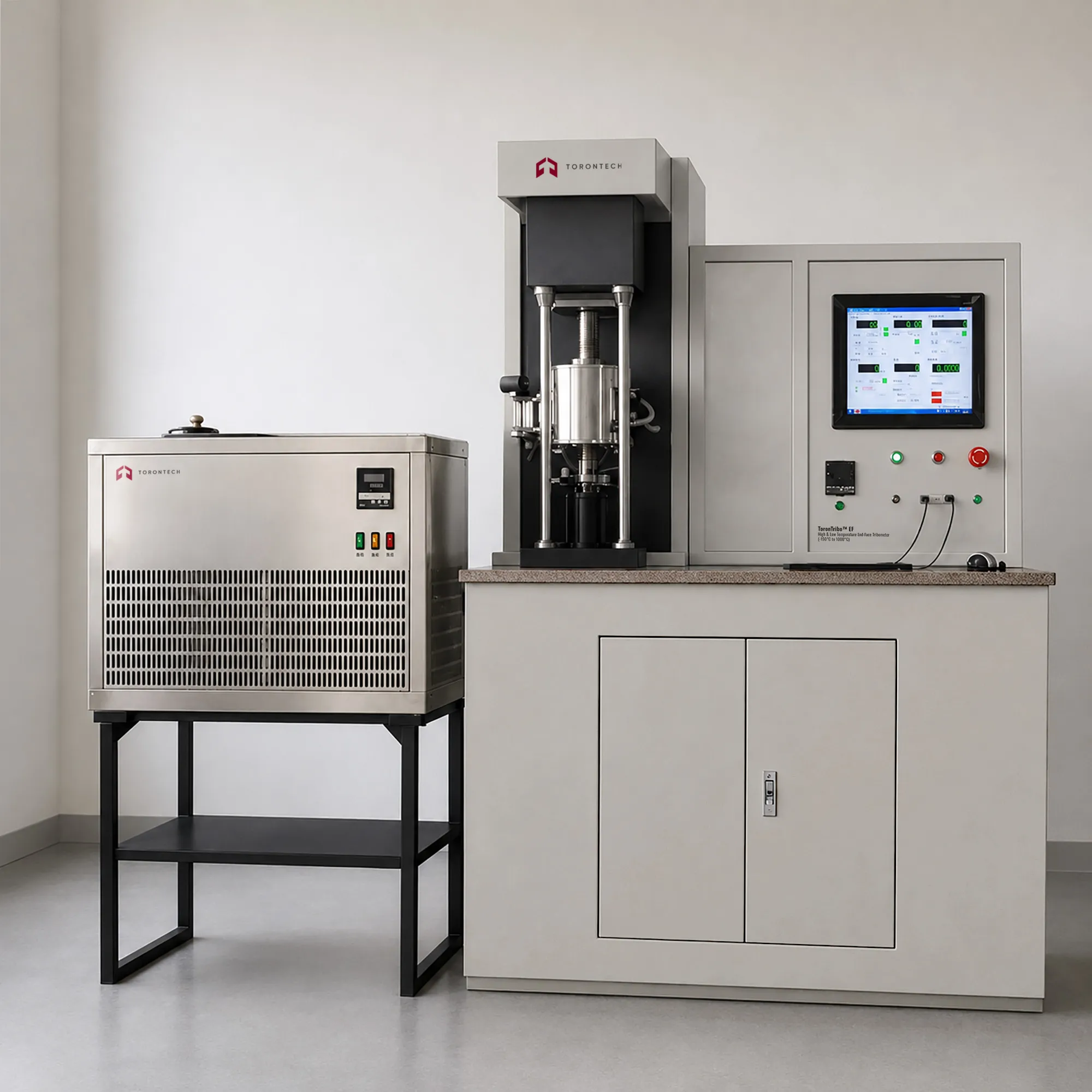
High & Low Temperature End-Face Tribometer (-150°C to 1000°C) - ToronTribo™ EF Key Features
The ToronTribo™ EF combines an exceptionally wide temperature range with flexible load and speed control for face-contact testing.
- Exceptional Temperature Range: spans -150°C to 1000°C, covering cryogenic through high-temperature testing on a single platform
- Dual Normal Force Ranges: offers 50 to 5000 N or 100 to 10,000 N loading options to match different contact pressure requirements
- Broad Material Compatibility: tests lubricants, metals, plastics, coatings, rubber, and ceramics under the same face-contact configuration
- High-Speed Rotation: reaches spindle speeds up to 2000 rpm for evaluating face contact under varying sliding velocity
- High Friction Force Capacity: measures friction forces up to 500 N, suited to demanding face-contact load conditions
- Extended Time Control: programs test duration from 1 second to 9,999 minutes, supporting both short screening tests and long-duration wear studies
Theory and Method
End-face friction and wear testing evaluates materials using a face-on-face contact geometry, in which two flat, typically annular surfaces press together under axial load while one surface rotates relative to the other. Unlike a point or line contact configuration, this geometry distributes load across a broader contact area, similar to the conditions found inside a mechanical seal, a thrust washer, or a clutch facing pressed against its mating surface. Because the entire face rotates through contact continuously, wear tends to distribute more evenly across the contact area than in point-contact tests, though temperature and pressure variations across the face can still create uneven wear patterns.
The ToronTribo™ EF applies this principle through a rotating spindle that drives one face against a stationary counterface held under a controlled axial load, while a heating and cooling system maintains the test chamber at the target temperature. Because the instrument spans temperatures from -150°C to 1000°C, the same material pair can be tested across dramatically different thermal regimes, revealing how thermal expansion, phase changes, or material softening affect friction and wear behavior at the face contact.
Temperature has an outsized effect on end-face contact performance because most face materials, whether metal, polymer, rubber, or ceramic, change mechanical properties significantly across a wide thermal range. A material that performs well at room temperature may become brittle at cryogenic temperatures or lose strength at high temperature, changing how the contact wears and how much heat the interface generates. Testing across the full temperature range relevant to an application, rather than at a single reference temperature, gives engineers a more complete picture of how a seal, washer, or friction material will perform throughout its actual service conditions.
High & Low Temperature End-Face Tribometer (-150°C to 1000°C) - ToronTribo™ EF Technical Specifications
| Parameter | Specification |
|---|---|
| Normal Force Range | 50 to 5000 N, or 100 to 10,000 N |
| Maximum Speed | 2,000 rpm |
| Maximum Friction Force | 500 N |
| Time Setting Range | 1 second to 9,999 minutes |
| Temperature Measurement Range | Room temperature to 1000°C; -150°C to room temperature |
| Friction Pair Form | End face friction pair |