
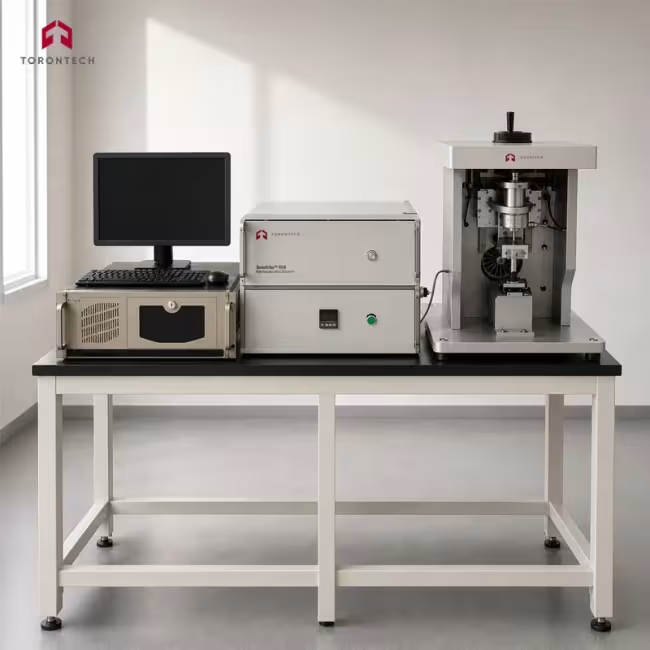
High-Frequency Micro Tribometer
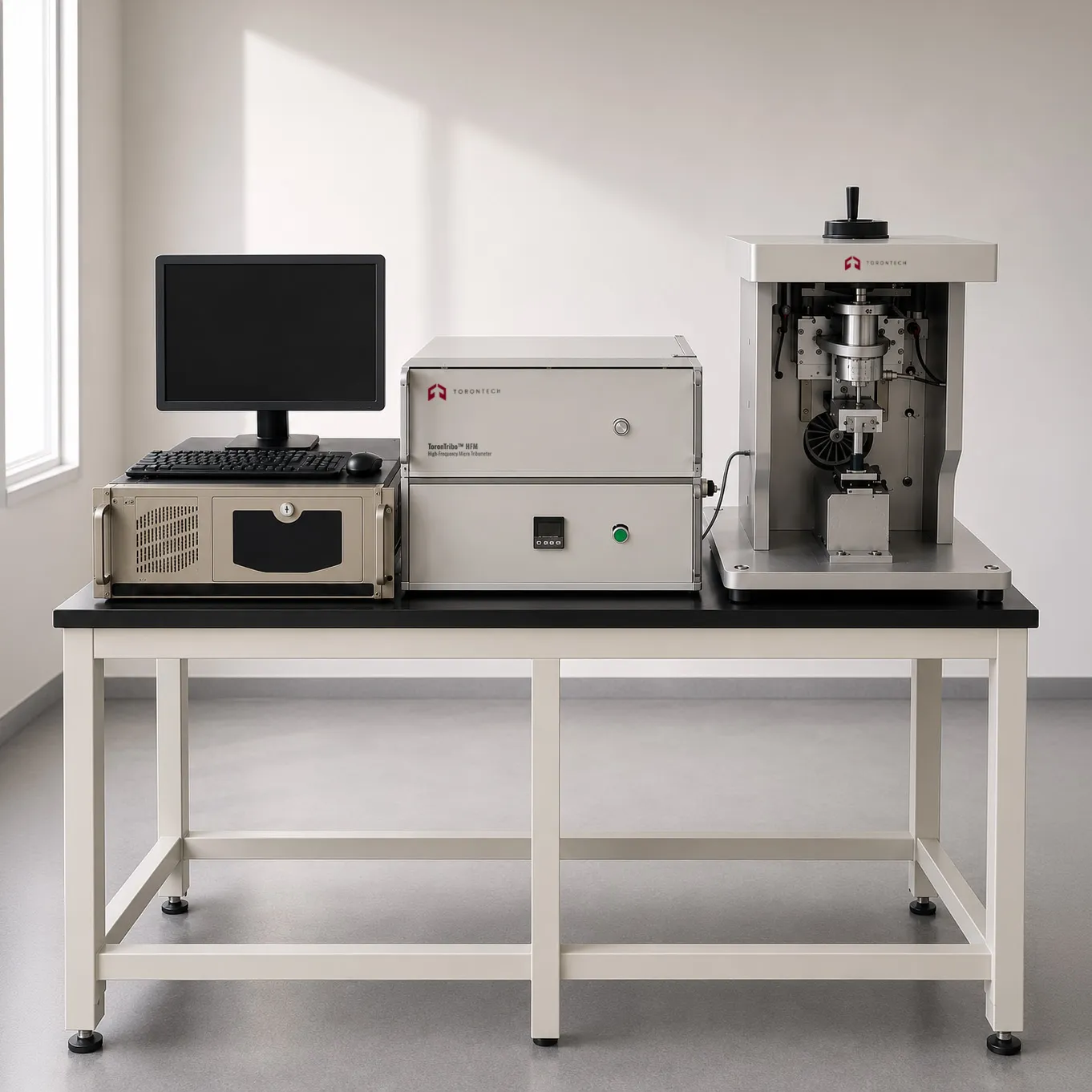
High-Frequency Micro Tribometer - ToronTribo™ HFM
High-frequency micro tribometer measures friction force and coefficient of friction under high-frequency, small-stroke reciprocating motion for materials and surface coatings. Operators control test force, displacement, and frequency independently, letting the instrument reproduce the fine-scale micro-motion contact found in electrical connectors, small bearings, and thin-film coatings. Continuous friction data collection during each test gives engineers a precise view of how a material pair responds to rapid, low-amplitude sliding.
The tester covers a displacement range of 50 to 500 micrometers with 10-micrometer control accuracy, paired with a repetitive test frequency from 5 to 80 Hz. Test force is adjustable from 10 to 500 N, with an optional low-force range down to 0.1 N for delicate samples and thin coatings. Testing runs in oil or water medium, and temperature control extends from ambient up to 200°C for evaluating material behavior under mild thermal exposure.
Electronics manufacturers, coating developers, and materials-research laboratories use this tribometer to characterize wear and friction behavior at the micro-motion scale, where damage accumulates differently than in larger-amplitude sliding contact. The combination of fine displacement control and high test frequency makes it suited to accelerated screening of coatings and small-scale components before they reach production.
High-Frequency Micro Tribometer - ToronTribo™ HFM Applications
The high-frequency micro tribometer supports friction and wear testing for components and materials where contact experiences fine-scale, high-frequency relative motion.
- Electrical Connector and Contact Testing: evaluates fretting wear and contact resistance changes in connector pins, switches, and relay contacts subjected to vibration-induced micro-motion
- Thin Coating and Surface Treatment Screening: measures wear resistance of thin hard coatings and surface treatments under small-amplitude, high-frequency sliding
- Small Bearing and Component Testing: characterizes friction and wear of miniature bearings, bushings, and precision mechanical components
- Medical Device Materials Research: assesses wear behavior of materials used in implants and small medical device components subject to micro-motion contact
- MEMS and Precision Instrument Development: supports friction and wear studies of micro-scale mechanical components and sensor assemblies
- Lubricant and Additive Screening: compares friction performance of oils and water-based media under controlled high-frequency contact conditions
- Materials Science Research: investigates fretting wear mechanisms and material pair compatibility at small displacement amplitudes
Standards
The high-frequency micro tribometer supports test procedures aligned with internationally recognized ASTM and DIN standards for reciprocating and ball-on-disc wear testing.
- ASTM B611-13 - Standard Test Method for Determining the High Stress Abrasion Resistance of Hard Materials
- ASTM G133-05 - Standard Test Method for Linearly Reciprocating Ball-on-Flat Sliding
- DIN 50324:1992-07 - Tribology, Testing of Friction and Wear, Model Test for Sliding Friction of Solids (Ball-on-Disc System)
High-Frequency Micro Tribometer - ToronTribo™ HFM Key Features
The high-frequency micro tribometer combines fine displacement control with high-frequency cycling for micro-motion wear testing.
- Precise Displacement Control: adjusts stroke length from 50 to 500 micrometers with 10-micrometer accuracy for repeatable micro-motion testing
- High-Frequency Operation: cycles from 5 to 80 Hz, supporting accelerated wear evaluation at fretting-relevant frequencies
- Wide Force Range: covers a standard test force range of 10 to 500 N, with an optional low-force range down to 0.1 N for delicate samples and thin coatings
- Dual-Medium Testing: runs tests in oil or water medium to compare lubricated and aqueous contact conditions
- Elevated Temperature Capability: operates from room temperature up to 200°C for testing under mild thermal exposure
- Dual Friction Pair Configurations: supports both pin-on-disc and ball-on-disc contact geometries for flexible test setup
Theory and Method
High-frequency micro-motion testing evaluates friction and wear at displacement amplitudes far smaller than conventional reciprocating wear tests, typically in the tens to hundreds of micrometers rather than millimeters. At this scale, the contact rarely achieves full sliding separation between passes, so wear debris and surface films remain trapped at the interface longer than they would in a larger-stroke test. This trapped material changes the friction behavior over the course of a test, so displacement accuracy and repeatable control directly determine whether the resulting data is meaningful.
The tester applies this principle through a precision drive that controls stroke length to within 10 micrometers while cycling at frequencies up to 80 Hz. A load cell measures the tangential friction force as the specimen moves through each cycle, and the ratio of friction force to applied normal force yields the coefficient of friction at each point in the stroke. Because the pin-on-disc and ball-on-disc contact geometries concentrate stress at a small point or line, even minor debris accumulation or surface film formation produces a measurable change in friction response.
Running tests in oil or water medium adds a further variable, since a fluid film at the interface can separate the contacting surfaces and reduce direct metal-to-metal contact depending on frequency and viscosity. Comparing dry and lubricated results at the same displacement and frequency settings helps engineers determine whether a coating or lubricant strategy is effective at protecting a contact from the fretting-scale wear mechanisms common in electrical and precision mechanical components.
High-Frequency Micro Tribometer - ToronTribo™ HFM Technical Specifications
| Parameter | Specification |
|---|---|
| Maximum Friction Force | 200 N |
| Test Force Loading Range | 10 to 500 N (optional low-force range: 0.1 to 10 N) |
| Displacement Range | 50 to 500 μm, adjustable |
| Displacement Control Accuracy | 10 μm |
| Repetitive Test Frequency | 5 to 80 Hz, adjustable |
| Test Medium | Oil, water |
| Temperature Range | Room temperature to 200°C |
| Friction Pair Forms | Pin-on-disc, ball-on-disc |