
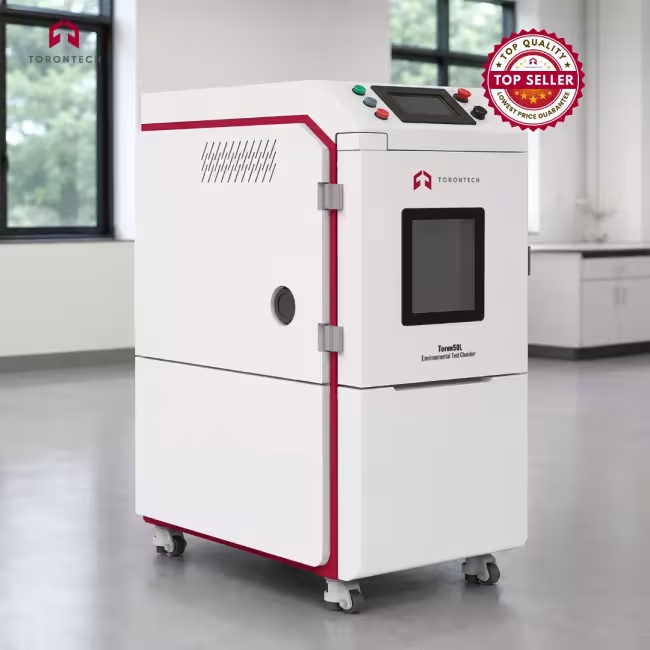
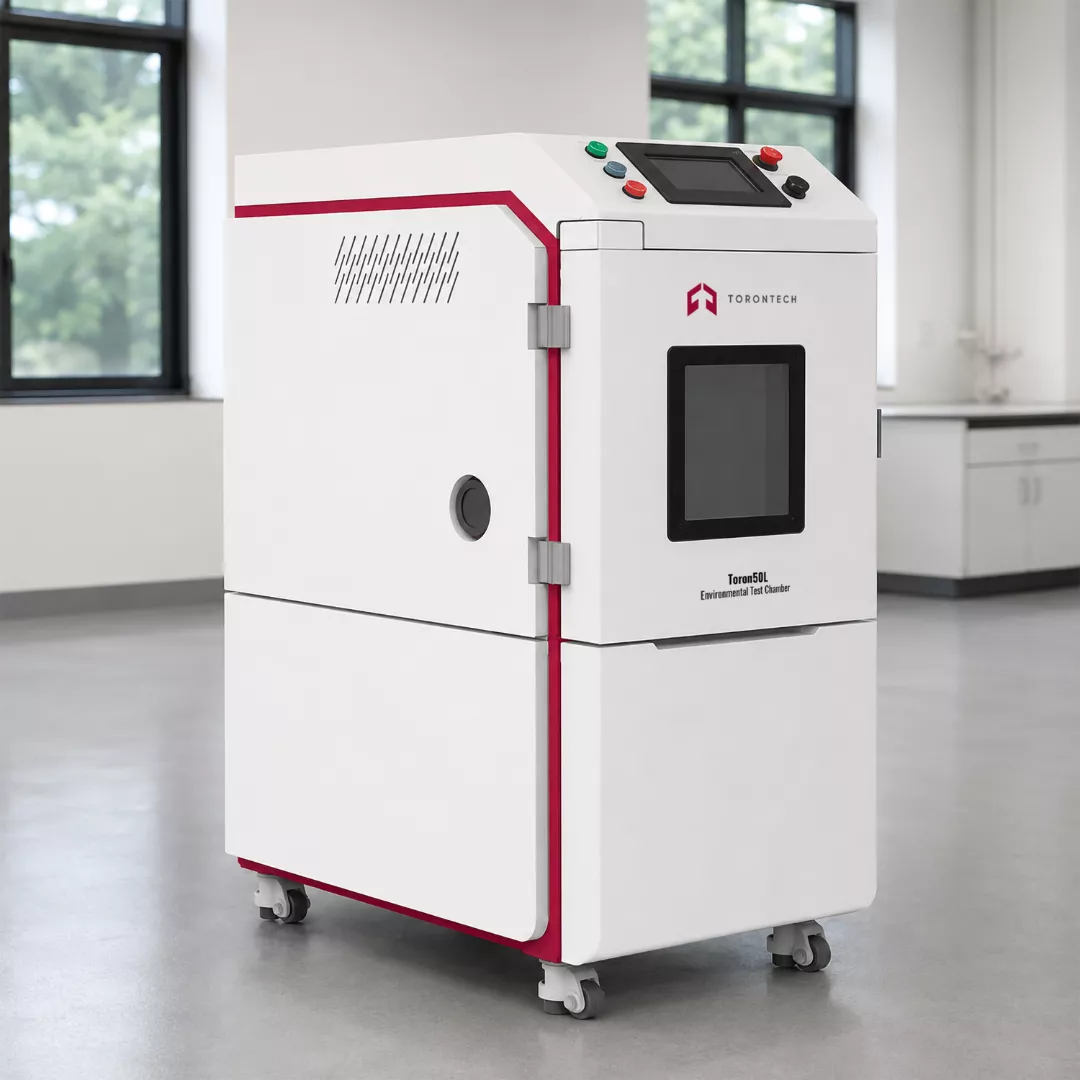
Environmental Test Chamber - Toron50L™
Environmental Test Chamber - Toron50L™
The Toron50L™ high and low temperature test chamber gives laboratories, R&D teams, and quality-control departments a compact way to expose small samples to extreme climate conditions. The unit holds a 50-liter workspace and drives temperatures from -70°C to +150°C, with an optional humidity function for full climatic simulation. Torontech builds the Toron50L™ for third-party labs, industrial QC facilities, and product development groups that need repeatable environmental stress results in a small footprint.
Engineers reach for this Environmental Test Chamber when they run temperature stress tests, reliability assessments, and climate-resistance evaluations on electronic and mechanical components. A German Secop compressor, forced-air circulation, and a Siemens PLC controller work together to hold set points steady across the full range. The chamber ships with a 7-inch touchscreen, 20 programmable profiles, and USB data export, so operators move from setup to reporting without extra hardware.
Environmental Test Chamber - Toron50L™ Applications
The Toron50L™ serves industries that qualify products against temperature, humidity, and thermal cycling before release.
- Electronics and Electrical Components: subjects PCBs, connectors, and finished devices to hot, cold, and damp-heat conditions to confirm reliability under field stress.
- Automotive and EV Components: evaluates sensors, control units, and battery cells across the wide temperature swings seen in engine bays and outdoor service.
- Aerospace and Defense: reproduces high- and low-temperature profiles per MIL-STD-810 methods for avionics, instrumentation, and airborne hardware.
- Telecommunications: verifies base-station modules, optical components, and network equipment against operating and storage temperature limits.
- Medical Devices and Pharmaceuticals: conditions instruments, packaging, and materials to check performance and stability under controlled climate.
- Materials Research and Development: characterizes plastics, coatings, adhesives, and composites for thermal expansion, aging, and moisture behavior.
- Battery and Energy Storage: tests cell and pack performance across cold-start and high-temperature conditions to support safety and lifespan studies.
Standards
The Toron50L™ is designed and built to align with recognized international methods for temperature and climatic testing.
- IEC 60068-2-1 - Environmental Testing, Part 2-1: Tests, Test A: Cold
- IEC 60068-2-2 - Environmental Testing, Part 2-2: Tests, Test B: Dry Heat
- MIL-STD-810F Method 501.4 - High Temperature
- MIL-STD-810F Method 502.4 - Low Temperature
Environmental Test Chamber - Toron50L™ Key Features
The Toron50L™ pairs a durable chamber build with a control system that keeps testing repeatable and easy to document.
- Extended -70°C to +150°C Range: covers cold-soak, dry-heat, and thermal cycling in one unit, so a single chamber handles a broad qualification program.
- Mirror-Finish SUS304 Interior: 1.5 mm stainless steel with continuous TIG-welded seams resists corrosion and holds up to long, repeated test cycles without leaks.
- 80 mm Composite Insulation: polyurethane foam and glass-wool layers reduce heat transfer, which stabilizes internal temperature and lowers energy draw.
- Anti-Condensation Door System: a double silicone seal plus a self-regulating door heater prevents frost and condensation during low-temperature runs.
- Heated Anti-Fog Viewing Window: a multi-layer tempered window with transparent heating film keeps a clear view of the sample throughout the test.
- German Secop Compressor: delivers the cooling capacity needed to reach and hold deep sub-zero set points with reliable, long-duration operation.
- Electronic Expansion Valve (Sporlan / Danfoss): meters refrigerant precisely for smoother temperature curves and steadier low-temperature performance.
- Energy-Saving Refrigerant Regulation: a pressure-regulating tank recovers part of the refrigerant at high and constant temperatures to cut power consumption.
- Vaisala Humidity Module: reads relative humidity accurately for dependable damp-heat and constant-humidity profiles when the humidity option is fitted.
- Siemens PLC with 7-Inch Touchscreen: shows live target and measured values, heating and cooling output, and run progress on an 800×480 color display.
- 20 Programmable Profiles: stores up to 20 curves of 99 segments each, so recurring test routines run automatically without manual reprogramming.
- USB Data Export: transfers records in Excel format from 2 GB of onboard memory, with optional PC remote monitoring for logging and printing.
- Layered Safety Protection: compressor overpressure and overload cutoffs, phase-sequence and leakage protection, heater overheat limits, and independent secondary temperature protection guard the equipment and sample.
- Audible and Visual Alarm: signals faults, cuts power when needed, and logs alarm events for later review to support troubleshooting.
Theory and Method
A high and low temperature test chamber controls its interior climate through two opposing processes: mechanical refrigeration removes heat, and electric resistance heating adds it. The Secop compressor circulates refrigerant through a closed vapor-compression loop. Refrigerant absorbs heat from the chamber air at the evaporator, then releases it outside through an air-cooled condenser. A finned stainless-steel heating tube counters the cooling on demand, and the PID controller balances the two so the air settles on the target temperature.
Forced-air circulation drives the uniformity numbers on the spec sheet. A stainless-steel centrifugal fan pushes conditioned air across the top of the workspace and pulls return air from the bottom, so every surface of the sample sees the same conditions. Solid-state relays switch the heater without mechanical contacts, which extends component life and sharpens temperature response. Pressure sensors and multiple solenoid valves modulate refrigeration output, keeping the cooling curve smooth instead of stepping between on and off states.
With the optional humidity system, the chamber adds moisture through external electric-steam humidification and removes it by condensing water on a chilled coil. A Vaisala sensing module reads relative humidity in real time, and the controller trims humidification and dehumidification to hold the set point. This closed feedback loop lets the Toron50L reproduce damp-heat and constant-humidity profiles alongside its temperature program, covering combined climatic tests from a single unit.
Environmental Test Chamber - Toron50L™ Technical Specifications
| Parameter | Specification |
|---|---|
| Internal Volume | 50 L |
| Internal Dimensions (W×D×H) | 350 × 350 × 400 mm |
| External Dimensions (W×D×H) | 600 × 1000 × 1200 mm |
| Temperature Range | -70°C to +150°C |
| Temperature Fluctuation | ≤ ±0.3°C |
| Temperature Uniformity | ≤ 2.0°C |
| Temperature Deviation | ≤ ±2.0°C |
| Heating Rate | 3°C/min (-40°C to +85°C, no load, average) |
| Cooling Rate | 2°C/min (+85°C to -40°C, no load, average) |
| Humidity Range | 20% to 98% RH (optional) |
| Refrigeration Mode | Mechanical compressor refrigeration |
| Cooling Method | Air cooling |
| Compressor | Secop (Germany) |
| Humidity Sensor | Vaisala acquisition module |
| Controller | Siemens PLC with 7-inch TFT touchscreen (800×480) |
| Operation Modes | Fixed-value control, program cycle |
| Program Capacity | 20 programs, up to 99 segments each |
| Data Interface | USB (Excel export) |
| Onboard Memory | 2 GB |
| Interior Material | 1.5 mm SUS304 stainless steel, mirror finish |
| Exterior Material | 1.5 mm cold-rolled steel, electrostatic powder coating |
| Insulation | Polyurethane foam and glass wool, approx. 80 mm |
| Noise Level | ≤ 72 dB(A) |
| Power Supply | 220 V (110 V optional), 50 Hz |
| Power Consumption | Approx. 2 kW |
| Ambient Operating Conditions | 0°C to +35°C, 5% to 95% RH (non-condensing) |
Temperature performance values reference a +23°C ambient, no-load test per applicable international test methods.