

Dynamic Fatigue Testing Machine
Dynamic Fatigue Testing Machine - ToronDFT™ Series
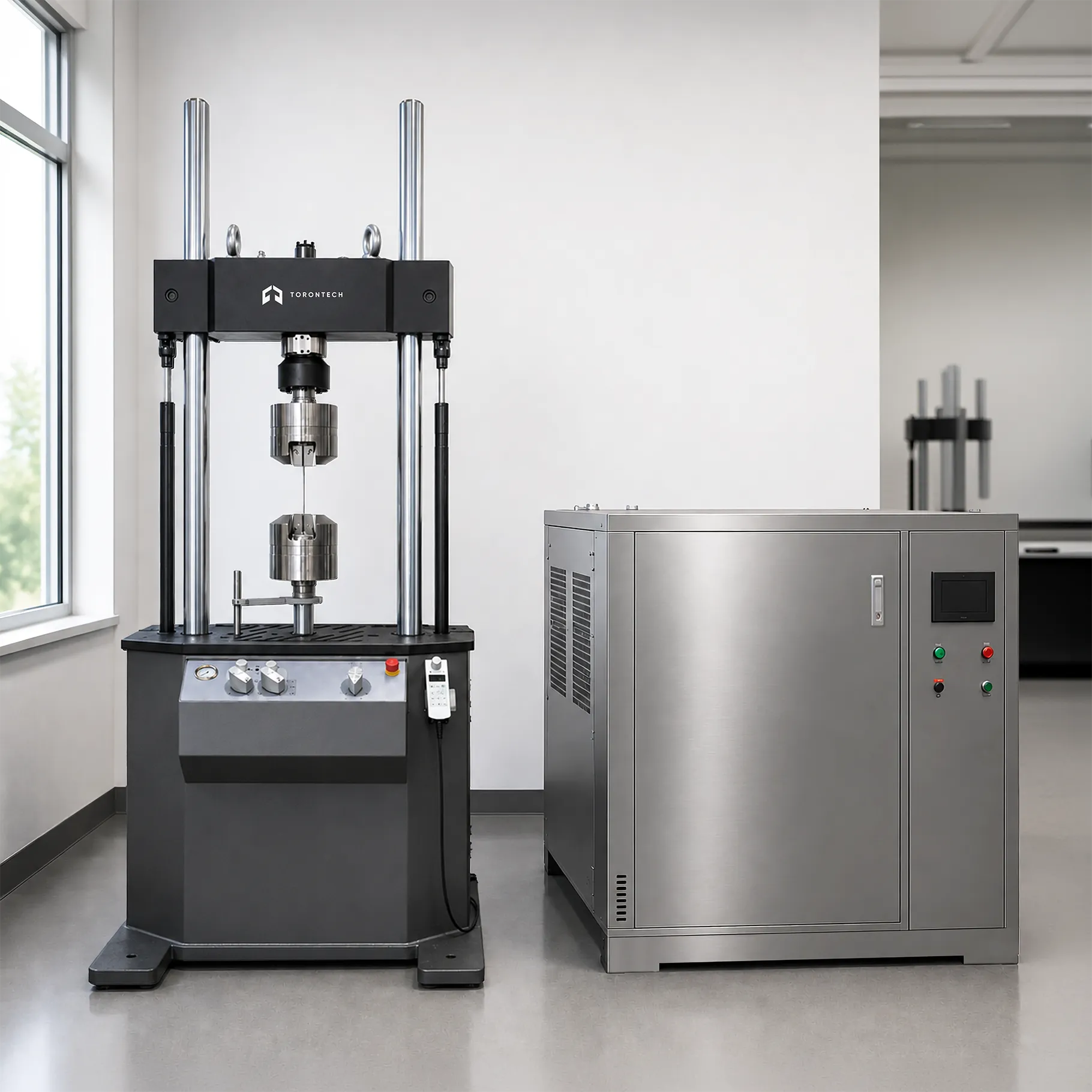
ToronDFT™ Series Dynamic Fatigue Testing Machine provides accurate, high-frequency cyclic loading for materials characterization, component validation, and fracture mechanics research. This floor-standing servohydraulic system is built around the ToronDFT™ series platform, available in load capacities of 25 kN, 50 kN, 100 kN, 250 kN, and 500 kN. It performs tension-tension, tension-compression, and fully reversed fatigue tests on metals, polymers, composites, and biomedical materials to generate S-N curves, determine endurance limits, and measure crack growth rates.
The ToronDFT™ series load frame uses twin rigid columns, a precision-ground crosshead, and a floor-standing architecture that keeps the actuator at the base for stable specimen loading. A high-performance dynamic actuator with a ±75 mm stroke delivers controlled sinusoidal, triangular, and user-defined waveforms at frequencies suited to both low-cycle and high-cycle fatigue regimes. A closed-loop servohydraulic control system pairs with a fatigue-rated load cell and optional extensometer to maintain precise force, displacement, or strain control throughout the test.
The system accommodates interchangeable grips and fixtures for axial tension, compression, bending, and special component tests. A hydraulic power unit sized to the selected load frame supplies consistent oil flow and pressure, and an integrated digital controller automates test execution, data acquisition, and waveform generation. The ToronDFT™ Series is configurable to match the test standard, specimen geometry, and throughput requirements of each laboratory.
Dynamic Fatigue Testing Machine - ToronDFT™ Series Applications
The ToronDFT™ Series supports fatigue and fracture mechanics testing across industries where cyclic durability determines product safety and service life.
- Metal and Alloy Research: characterizes fatigue strength, endurance limits, and strain-life behavior of ferrous and non-ferrous alloys for alloy development and specification compliance.
- Aerospace Structural Materials: generates S-N data and crack growth rates for aluminum alloys, titanium, and nickel-based superalloys used in airframe skins, turbine disks, and landing gear per ASTM E466 and ASTM E647.
- Automotive Component Development: evaluates the cyclic durability of suspension arms, drivetrain shafts, fasteners, and welded joints under load spectra representative of road service conditions.
- Biomedical Implant Testing: performs fatigue validation of spinal fixation devices, hip stems, knee components, bone plates, and dental implants to ASTM F1717, ASTM F2077, and ISO 14801.
- Composite Materials Testing: conducts tension-tension fatigue on fiber-reinforced polymer laminates and sandwich panels to ASTM D3479 and ISO 13003 for aerospace and wind energy applications.
- Weld and Joint Qualification: subjects butt welds, fillet welds, and adhesive-bonded joints to constant-amplitude and variable-amplitude fatigue loading to verify joint performance.
- Fracture Mechanics and Crack Growth: measures da/dN versus ΔK on compact tension (CT) and middle tension (MT) specimens to ASTM E647 for damage-tolerance analysis.
- Fastener and Spring Testing: determines the fatigue life of bolts, screws, rivets, and spring elements under axial and combined loading conditions.
Standards
The ToronDFT™ Series supports test procedures defined in a broad range of international fatigue and fracture mechanics standards.
- ASTM E466 - Standard Practice for Conducting Force Controlled Constant Amplitude Axial Fatigue Tests of Metallic Materials
- ASTM E606 - Standard Test Method for Strain-Controlled Fatigue Testing
- ASTM E647 - Standard Test Method for Measurement of Fatigue Crack Growth Rates
- ASTM E399 - Standard Test Method for Linear-Elastic Plane-Strain Fracture Toughness of Metallic Materials
- ASTM E468 - Standard Practice for Presentation of Constant Amplitude Fatigue Test Results for Metallic Materials
- ASTM D3479 - Standard Test Method for Tension-Tension Fatigue of Polymer Matrix Composite Materials
- ISO 1099 - Metallic Materials: Fatigue Testing: Axial Force-Controlled Method
- ISO 12106 - Metallic Materials: Fatigue Testing: Axial Strain-Controlled Method
- ISO 12108 - Metallic Materials: Fatigue Testing: Fatigue Crack Growth Method
- ISO 7500-1 - Metallic Materials: Calibration and Verification of Static Uniaxial Testing Machines
- DIN 50100 - Fatigue Testing: Execution and Evaluation of Cyclic Tests at Constant Load Amplitudes on Metallic Specimens and Components
Dynamic Fatigue Testing Machine - ToronDFT™ Series Key Features
The ToronDFT™ Series combines a rigid load frame, a responsive servohydraulic actuator, and a digital controller into a configurable fatigue testing platform.
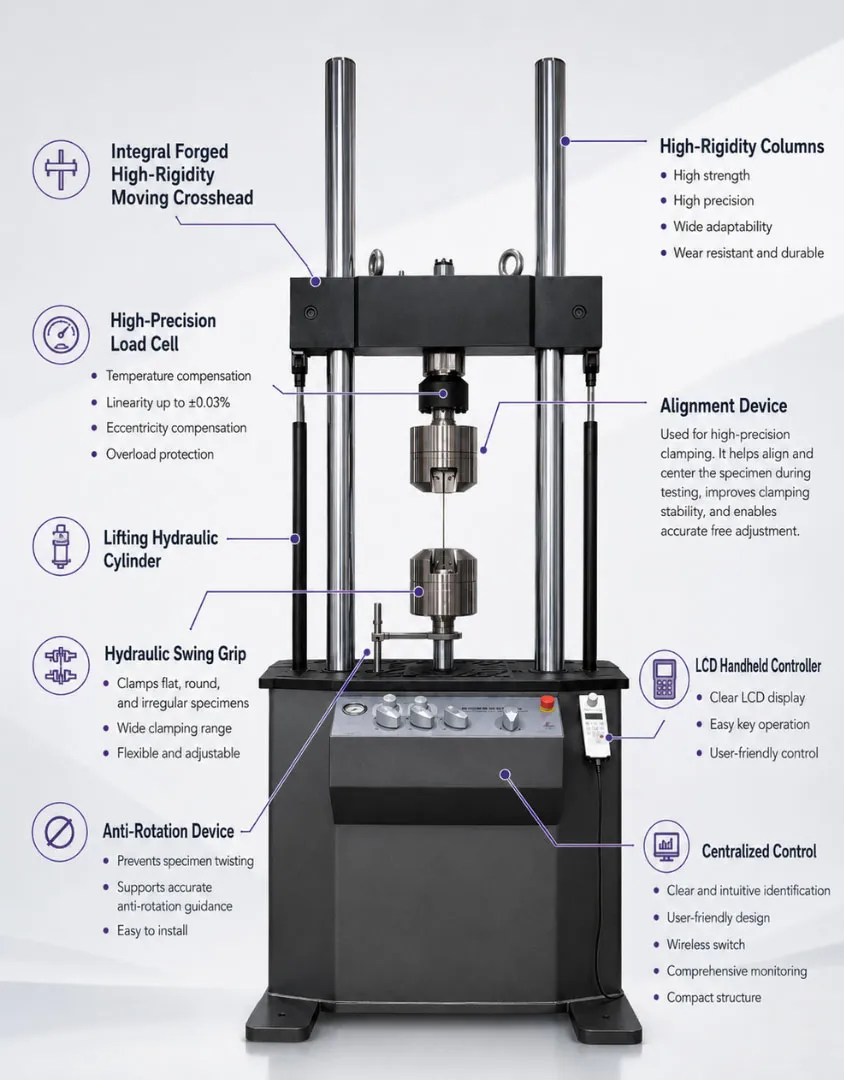
- Floor-Standing Load Frame: twin-column, floor-standing architecture with a base-mounted actuator provides a stable, low-center-of-gravity platform that minimizes vibration transfer to the specimen and surrounding equipment.
- High-Performance Dynamic Actuator: a fatigue-rated hydraulic actuator with a ±75 mm stroke delivers consistent cyclic motion across the full frequency range, supporting both high-cycle endurance runs and slow-rate low-cycle fatigue tests.
- Precision Load Cell: a fatigue-rated load cell (class 0.5 per ISO 7500-1) measures axial force with high accuracy and long-term stability, providing reliable feedback for closed-loop control over millions of cycles.
- Closed-Loop Servohydraulic Control: a servo valve and digital PID controller maintain force, displacement, or strain within tight tolerances, automatically compensating for specimen compliance changes as cracks initiate and grow.
- Integrated Digital Controller: automates waveform generation (sine, triangle, square, and custom profiles), data acquisition, cycle counting, and test termination based on user-defined failure criteria.
- Crosshead Lifting and Locking Mechanism: a motorized crosshead adjustment and hydraulic locking system allows rapid repositioning for different specimen lengths and fixture configurations without manual shimming.
- Interchangeable Grips and Fixtures: hydraulic wedge grips, mechanical grips, and custom fixtures accommodate flat, round, and component specimens for tension, compression, bending, and combined loading.
- Hydraulic Power Unit (HPU): a dedicated HPU sized to the selected load frame capacity provides stable oil pressure and flow, with filtration and cooling systems that extend servo valve and actuator service life.
- High Frame Stiffness: frame stiffness up to 6.5 × 10⁸ N/m on the 500 kN model reduces parasitic deflection, keeping the measured displacement representative of actual specimen deformation.
- Wide Vertical Test Space: maximum vertical clearances from 1,120 mm (25 kN and 50 kN models) to 2,000 mm (500 kN model) accommodate tall specimens, environmental chambers, and multi-point bending fixtures.
- Safety and Limit Protection: integrated emergency stop, upper and lower limit switches, and interlock functions protect the operator, the specimen, and the machine from overtravel and unexpected load events.
- Customizable Configuration: load capacity, actuator stroke, test space, base plate, grips, environmental chamber, and controller software can be tailored to the laboratory’s specific testing scope.
Theory and Method
Fatigue testing subjects a specimen to repeated cyclic loading that alternates between a maximum and minimum force (or strain) at a controlled frequency. Each load cycle induces microscopic slip along crystallographic planes within the material. Over thousands or millions of cycles, these slip events accumulate into persistent slip bands, then micro-cracks, and eventually a dominant crack that propagates until the specimen fractures. The relationship between the applied stress amplitude and the number of cycles to failure (the S-N curve) characterizes a material’s fatigue resistance.
The servohydraulic drive of the ToronDFT™ Series converts pressurized hydraulic fluid into precise, high-frequency piston motion. A servo valve modulates the oil flow to the actuator in real time, while a closed-loop controller compares the feedback signal from the load cell (or extensometer) against the command waveform and adjusts the valve position to maintain the target amplitude within tight tolerances. This architecture allows force-controlled tests for high-cycle fatigue (HCF) and strain-controlled tests for low-cycle fatigue (LCF), where plastic deformation dominates.
Fracture mechanics tests extend the fatigue evaluation beyond total life. The operator pre-cracks a notched specimen and then applies cyclic loading while monitoring crack length with a compliance gauge or potential drop system. Plotting the crack growth rate (da/dN) against the stress-intensity factor range (ΔK) produces a curve that captures threshold, Paris-regime, and near-instability behavior. Engineers use this data for damage-tolerance design, setting inspection intervals, and predicting remaining service life of structural components.
Dynamic Fatigue Testing Machine - ToronDFT™ Series Technical Specifications
| Parameter | ToronDFT™ 25 | ToronDFT™ 50 | ToronDFT™ 100 | ToronDFT™ 250 | ToronDFT™ 500 |
|---|---|---|---|---|---|
| Frame Type | Floor-standing | ||||
| Rated Load (kN) | 25 | 50 | 100 | 250 | 500 |
| Max. Vertical Test Space (mm) | 1,120 | 1,120 | 1,120 | 1,400 | 2,000 |
| Actuator Stroke (mm) | ±75 | ||||
| Working Table Height (mm) | 900 | 1,000 | |||
| Effective Column Spacing / Test Width (mm) | 540 | 650 | 800 | ||
| Column Diameter (mm) | 80 | 90 | 110 | ||
| Base Width, Left-Right (mm) | 1,100 | 1,200 | 1,500 | ||
| Base Depth, Front-Back (mm) | 800 | 1,000 | |||
| Overall Height (mm) | 2,700 | 3,100 | 4,200 | ||
| Frame Stiffness (N/m) | 5 × 10⁸ | 6.5 × 10⁸ | |||
| Approximate Weight (kg) | ≈1,250 | ≈1,650 | ≈2,100 | ||