

Dual Analysis Ferrograph – ToronFG™ 200
Dual Analysis Ferrograph – ToronFG™ 200
Ferrograph testing helps condition-monitor lubricated machinery by separating wear debris from in-service oils and presenting particles for fast visual diagnosis. Dual Analysis Ferrograph – ToronFG™ 200 prepares two ferrograms in parallel, so labs can process more samples per shift while keeping deposition consistent. The system uses a controlled magnetic field to arrange particles by magnetization and size, which supports quicker interpretation under a microscope. Automated sample handling also reduces operator time during routine checks.
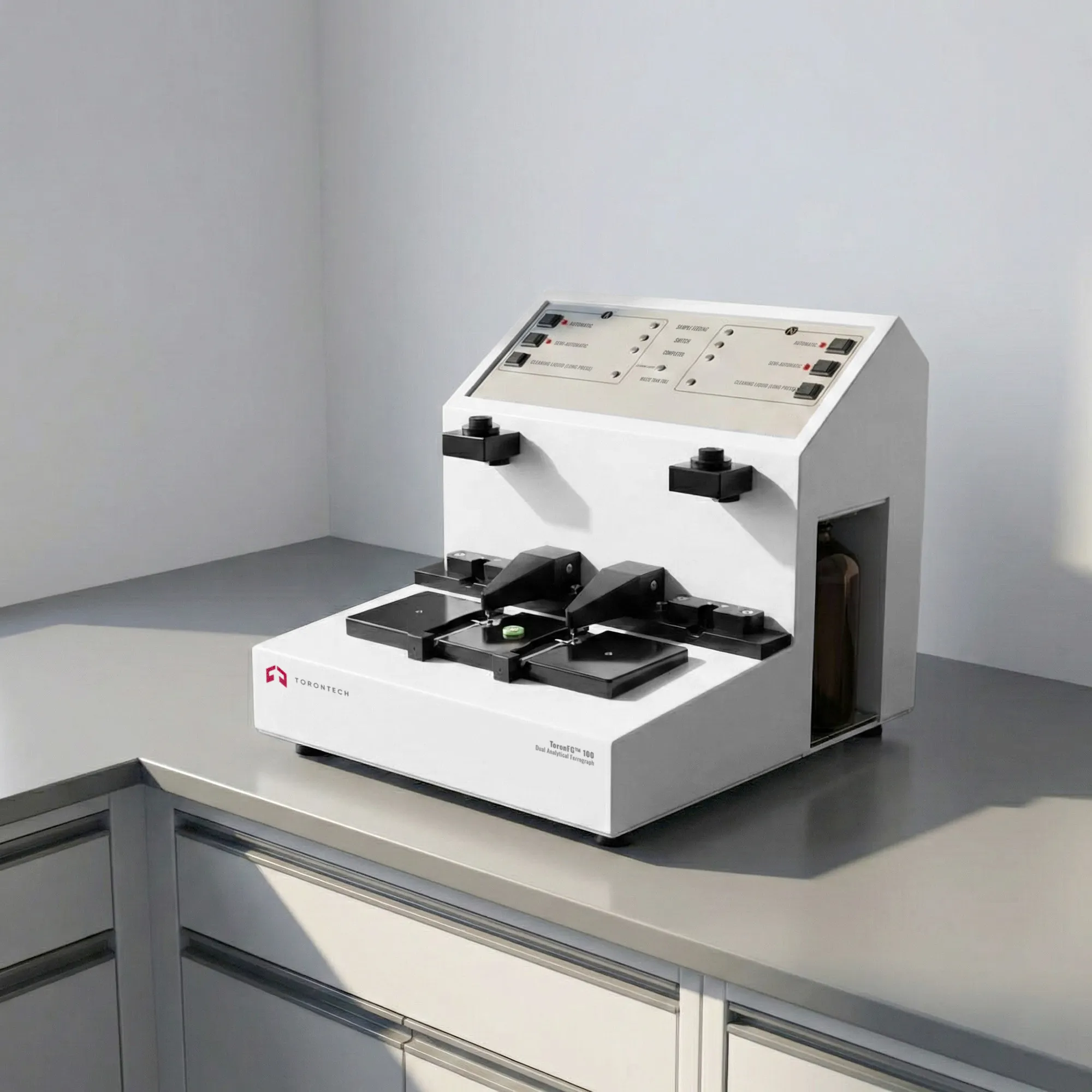
ToronFG™ 200 is a dual-channel analytical ferrograph designed for wear particle separation and ferrogram preparation from lubricating and hydraulic oils. The instrument deposits ferrous and non-ferrous particles onto a ferrographic substrate using a high-gradient magnetic field and a controlled flow path. A clear deposition track supports classification of metallic, organic, and nonmetallic debris during microscopy. Two independent channels allow side-by-side preparation for comparative diagnosis, trending, and confirmation testing.
Dual Analysis Ferrograph – ToronFG™ 200 Applications
- Transportation industry (diesel locomotives and heavy fleets): Wear debris trends help detect abnormal wear in bearings, gears, and pumps before failures disrupt operations. Ferrograph results also support maintenance planning when oil analysis indicates rising particle counts. Dual-channel preparation is useful when comparing “suspect” vs. “baseline” samples.
- Iron and steel industry (fan and rotating equipment): Fans, gear drives, and hydraulic systems often run under heavy loads and contamination risk. Ferrograph microscopy helps separate abrasive debris, fatigue particles, and contamination so teams can connect debris type to likely wear mechanisms. Routine sampling supports trend-based maintenance decisions.
- Electric power industry (generator set testing): Generator bearings, gearboxes, and hydraulic auxiliaries benefit from early warning signals. Ferrograph analysis helps identify particle morphology changes tied to scuffing, fatigue, or contamination events. Results can be used alongside vibration and temperature data for stronger diagnostics.
- Navy defense and marine drive gearboxes: Marine gearboxes and propulsion systems face variable loads, moisture exposure, and long duty cycles. Ferrograph testing helps detect early gear distress, bearing spall, and abrasive ingress. The ability to prepare two ferrograms supports confirmation runs and comparative checks across equipment.
Standards
- ASTM D7690: Microscopic identification of wear and contaminant particles on ferrograms from used lubricants.
- ASTM D7684: Classification and reporting guidance for microscopic characterization of particles from in-service lubricants.
- SH/T 0573: Test method for wear particles in used lubricating oils using analytical ferrography.
Dual Analysis Ferrograph – ToronFG™ 200 Key Features
- Dual-channel preparation supports two samples at the same time for higher daily throughput.
- Oil water content has limited impact on ferrogram preparation, supporting routine field samples.
- Automated operation after sample insertion frees the operator for other lab tasks.
- Adjustable sample flow rate helps maintain consistent deposition and repeatability.
- Two ferrograms can be prepared in under 20 minutes under typical workflows.
- Clear deposition track supports separation of metallic, organic, and nonmetallic particles for faster diagnosis.
- Particle arrangement follows magnetization response and size, helping rapid sorting during microscopy.
- Reduced particle accumulation improves track visibility and interpretation.
Theory and Method
A ferrograph separates particles from an oil sample while the fluid passes across a glass substrate inside a magnetic field. Ferrous particles align and deposit along the magnetic gradient, while non-ferrous and contaminants deposit based on flow and settling behavior. The deposition pattern concentrates larger and more strongly magnetized particles earlier on the track, which helps speed up microscopy. After the ferrogram is prepared, the substrate is examined to classify particle type, size, surface texture, and wear mechanism indicators.
Dual Analysis Ferrograph – ToronFG™ 200 Technical Specification
| Parameter | ToronFG™ 200 |
|---|---|
| Voltage | AC 220 V, 50 Hz (110V is also available) |
| Wear particle measurement range | 0 μm to 800 μm |
| Sampling / injection method | Micro-pump pressure type, automatic sampling |
| Cleaning method | Automatic cleaning and manual cleaning modes |
| Magnetic field | Permanent magnet, high-gradient magnetic field; max flux density about 1.8 T ± 0.1 T; max gradient >0.5 T/mm |
| Dilution / cleaning solvent | Tetrachloroethylene |
| Ferrograph channel | Dual-channel synchronous preparation |
| Plate inclination | 1° - 5° |
| Display | dual 1.54-inch OLED display, real-time status display |
| Oil sample transfer speed | 10 to 30 mL/h |
| Cleaning agent flow rate | 30 to 100 mL/h |
| Measurement resolution | 1 μm |
| Sample volume per analysis | 1 mL |
| Oil delivery pipe size | OD 2.6 mm, ID 1.8 mm |
| Ferrographic substrate size | 60 × 24 × 0.17 mm |
| Waste handling | Built-in waste liquid collection device; vacuum pump to extract waste liquid to bottle |
| Overall size | 395 × 355 × 335 mm (L × W × H) |
| Weight | About 14 kg |