
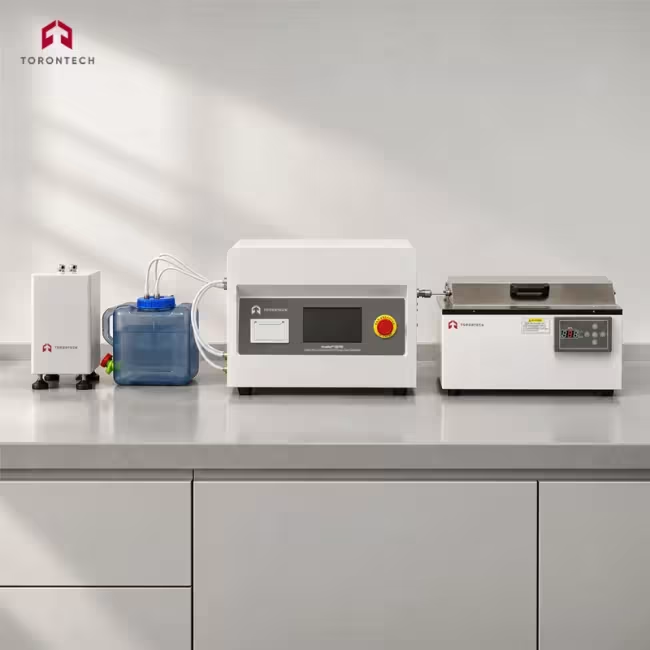
Catheter Power Injection and Burst Pressure Tester (Combined)
Catheter Power Injection and Burst Pressure Tester (Combined) - ToronMed™ CBPT05
Combined Catheter Power Injection, Flow Rate and Burst Pressure Test System
The ToronMed™ CBPT05 combined catheter power injection and burst pressure tester brings four positive-pressure test routines together on one benchtop platform. Medical device manufacturers use it to measure flow rate and pressure during power injection, static burst pressure, rated burst pressure (RBP), and balloon compliance. A liquid booster pump supplies hydraulic pressure up to 1,200 psi through high-pressure stainless steel piping. Laboratories running intravascular catheter programs gain one instrument that covers test requirements described in ISO 10555-1 and ISO 10555-4.
Testing runs at physiological temperature. A constant-temperature water bath holds the injectate at 37°C, so polymer catheters behave the way they do in the vasculature rather than at ambient conditions. The 7-inch color touchscreen guides operators through setup, and the external pressure sensor accepts connecting tubes in several sizes without hardware changes. Test profiles stay user-configurable, which suits laboratories validating multiple catheter families on a single instrument.
The CBPT05 writes every run to internal memory with capacity beyond 100,000 test records. Account-level permissions restrict who can modify methods or export results, which supports audit expectations in regulated device manufacturing. Automatic calibration shortens routine verification, and the built-in micro printer produces a hard copy at the bench. Catheter developers, contract manufacturers, and incoming inspection laboratories deploy the system for design verification and lot release alike.
Catheter Power Injection and Burst Pressure Tester (Combined) - ToronMed™ CBPT05 Applications
The CBPT05 serves manufacturers and test laboratories working with sterile single-use catheters, balloon dilatation devices, and the delivery systems used in interventional procedures.
- Intravascular Catheter Manufacturing: verifies flow rate and pressure behavior of PICC lines, central venous catheters, and angiographic catheters before release
- Balloon Dilatation Catheter Development: measures rated burst pressure and balloon diameter response across the working pressure range for coronary and peripheral devices
- Contrast Media Power Injection Testing: confirms that catheters withstand the flow rates and pressures generated by clinical power injectors during CT and angiography procedures
- Design Verification and Regulatory Submission: generates the burst and flow datasets required to support device dossiers and technical files
- Contract Manufacturing Quality Control: performs lot-level burst pressure checks and hydraulic performance verification on outsourced catheter production
- Incoming Inspection Laboratories: screens purchased catheter assemblies and tubing components against agreed pressure specifications
- Polymer Extrusion Process Development: correlates lumen geometry and wall thickness with measured burst pressure during tubing process optimization
- Failure Analysis and Root Cause Investigation: reproduces field pressure conditions to characterize leaks, delamination, and hub separation modes
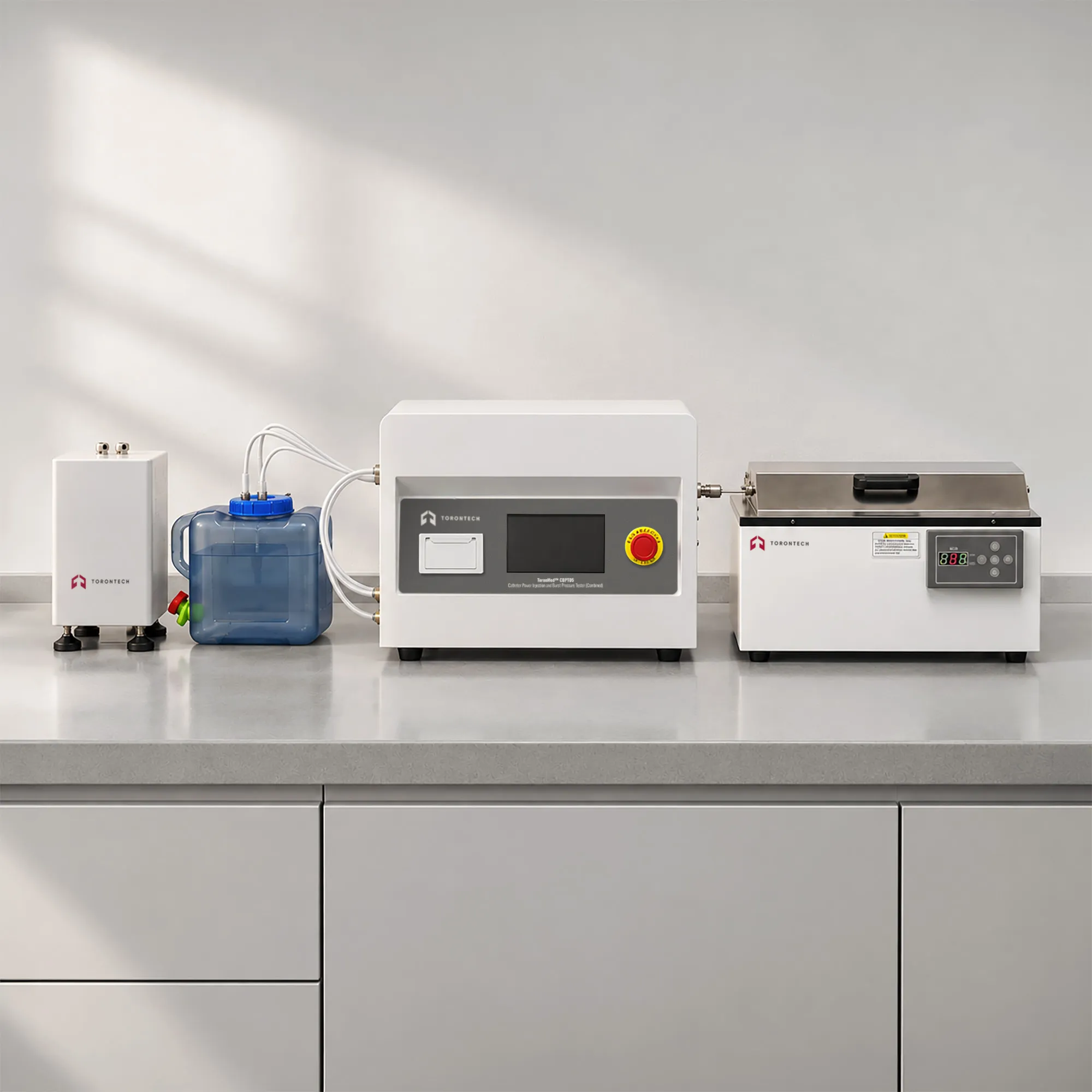
Standards
The CBPT05 is designed to align with the internationally recognized test methods that govern hydraulic performance of sterile intravascular catheters.
- ISO 10555-1 - Intravascular Catheters: Sterile and Single-Use Catheters: Part 1: General Requirements
- ISO 10555-4 - Intravascular Catheters: Sterile and Single-Use Catheters: Part 4: Balloon Dilatation Catheters
Catheter Power Injection and Burst Pressure Tester (Combined) - ToronMed™ CBPT05 Key Features
The CBPT05 combines a high-pressure hydraulic circuit, temperature-controlled injectate, and a data system built for regulated laboratory use.
- Four Test Modes on One Platform: constant flow, constant pressure, static and rated burst pressure, and optional pressure increment testing remove the need for separate benches
- 1,200 psi Hydraulic Capability: the liquid booster pump and stainless steel high-pressure piping reach the pressures required for balloon burst work
- 37°C Constant-Temperature Water Bath: conditions the injectate to body temperature so measured flow and burst values reflect clinical behavior
- External Interchangeable Pressure Sensor: accepts connecting tubes in different sizes, letting one instrument cover a wide catheter portfolio without rebuilding the fluid path
- 7-Inch Color Touchscreen: shows live pressure and flow traces and keeps method setup within a few taps
- 500 kHz Data Acquisition: 500,000-count internal resolution resolves fast pressure events that coarser systems miss
- User-Configurable Test Programs: laboratories build their own routines and reporting templates around internal protocols rather than fixed presets
- Automatic Calibration Routine: shortens periodic verification and reduces operator-dependent setup error
- Standard Threaded Luer Sample Ports: connect production catheters directly without custom adapters
- Overload Alarm and Automatic Shutdown: microcomputer control halts the run when pressure exceeds programmed limits, protecting both operator and sample
- Transparent Safety Shield: contains liquid spray at the moment of burst and keeps the failure visible for observation
- Leak-Free High-Pressure Internal Tubing: maintains pressure integrity across every joint in the hydraulic path so recorded values reflect the sample, not the system
- Power-Loss Data Retention: a high-precision clock chip and non-volatile memory preserve results and timestamps through supply interruptions
- Storage for Over 100,000 Records: retains long test histories on the instrument for trend review and retrospective analysis
- User Account Permission Management: role-based access controls who can edit methods, delete data, or export results
- Integrated Micro Printer: produces a bench-side hard copy immediately after each run
Theory and Method
Positive-pressure testing drives a controlled column of liquid into the catheter lumen and records how the device responds. The liquid booster pump acts as the pressure source, and a high-pressure solenoid valve gates delivery into the sample line. Hydraulic resistance inside a lumen follows the Hagen-Poiseuille relationship, where pressure drop rises with flow rate and tube length but falls with the fourth power of internal radius. Small geometry changes therefore produce large pressure differences, which the flow and pressure modes resolve.
Constant-flow mode fixes the volumetric delivery rate at up to 20 ml/s, and the transducer reports the back pressure the catheter generates. Constant-pressure mode inverts the experiment: the system holds a target pressure and measures the flow the lumen passes. Together these two modes describe the hydraulic envelope a clinical power injector would impose. A 500 kHz A/D sampling rate with 500,000-count resolution captures the pressure transient at the moment of failure, which a slower acquisition chain would average away.
Static burst testing raises pressure on a sealed sample until the wall or balloon fails, and the peak reading defines burst pressure. Rated burst pressure derives statistically across a sample population, so laboratories run replicates and apply the confidence treatment their protocol specifies. The optional pressure increment mode plots balloon diameter against inflation pressure using a dial indicator fixture, producing the compliance curve clinicians use when sizing a device. Bath control at 37°C holds injectate viscosity and polymer stiffness at physiological values.
Catheter Power Injection and Burst Pressure Tester (Combined) - ToronMed™ CBPT05 Technical Specifications
| Parameter | Specification |
|---|---|
| Test Range | 0 to 1,200 psi (0 to 8.3 MPa) |
| Accuracy | ±0.5% of full scale |
| Test Mode 1 | Constant flow rate to test pressure |
| Test Mode 2 | Constant pressure to test flow rate |
| Test Mode 3 | Burst pressure under static conditions, including rated burst pressure (RBP) |
| Test Mode 4 | Pressure increment, balloon diameter against inflation pressure (optional) |
| Maximum Constant Flow | 20 ml/s |
| Maximum Constant Pressure | 1,200 psi (8.3 MPa) |
| Constant-Temperature Bath Range | Ambient +5°C to 100°C |
| Temperature Control Accuracy | ±0.5°C |
| Display | 7-inch color touchscreen |
| Data Acquisition | 500 kHz A/D sampling, 500,000-count internal resolution |
| Data Storage Capacity | Over 100,000 test records |
| Sample Connection | Standard threaded Luer connectors |
| Voltage | AC 220 V 50 Hz / 110 V 60 Hz |
| Main Unit Dimensions | 540 × 400 × 425 mm (L × W × H) |
| Water Bath Dimensions | 285 × 500 × 340 mm (L × W × H) |
| Booster Pump Dimensions | 280 × 265 × 750 mm (L × W × H) |
| Main Unit Net Weight | 31 kg |
| Booster Pump Net Weight | 33 kg |
Standard Configuration
| Item | Description |
|---|---|
| Main Test Unit | Benchtop instrument housing the pressure control circuit and 7-inch touchscreen |
| Liquid Booster Pump | Floor-standing hydraulic pressure source rated to 1,200 psi |
| Constant-Temperature Water Bath | Circulating bath conditioning the injectate to 37°C |
| Liquid Reservoir | Storage container feeding the booster pump |
| Protective Device | Transparent shield containing liquid spray during burst events |
| Micro Printer | Built-in thermal printer for immediate test reports |
Optional Configuration
| Item | Description |
|---|---|
| Balloon Catheter Diameter Test Device | Dial indicator fixture measuring balloon diameter against inflation pressure for compliance curve generation |
| Data Analysis Software | Extended reporting, statistical treatment, and export functions for laboratory data systems |