
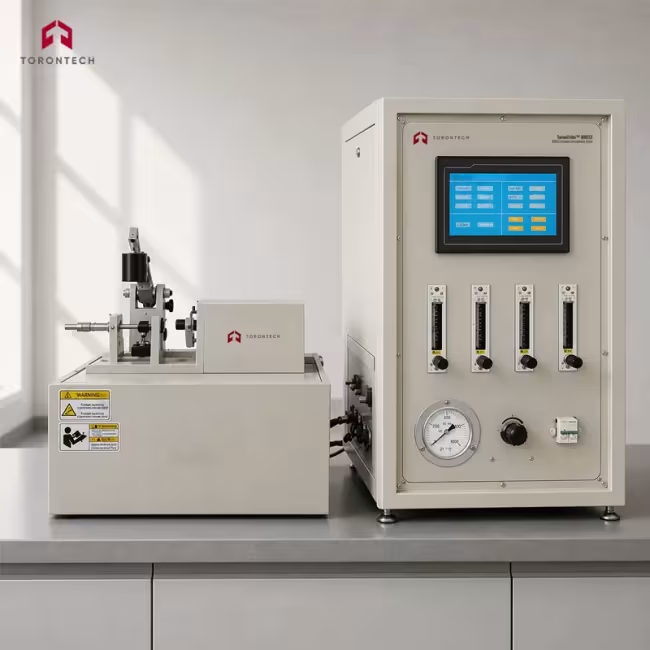
BOCLE Aviation Fuel Lubricity Tester
BOCLE Aviation Fuel Lubricity Tester - ToronTribo™ BOCLE
BOCLE aviation fuel lubricity tester evaluates the boundary lubrication performance of aviation turbine fuels, serving fuel refiners, additive developers, and aviation fuel quality laboratories. The ToronTribo™ BOCLE presses a standard steel ball against a rotating steel ring under a fixed load while the ring rotates through a fuel sample, generating a wear scar on the ball whose size directly indicates how well the fuel protects moving fuel-system components from friction and wear.
The instrument applies a constant normal force with force indication accuracy within ±1 percent, and holds spindle speed steady across a 1 to 500 rpm range, with speed error held to within ±1 rpm at the standard 240 rpm test point. Test environment control maintains oil box temperature at 25°C ±1°C and relative humidity at 10% ±0.2%, matching the tightly controlled atmospheric conditions that aviation fuel lubricity testing requires. Timer control ranges from 1 second to 9,999 minutes, with timing accuracy held to within ±6 seconds over a 30-minute run.
Fuel refiners, corrosion inhibitor and lubricity improver additive developers, and aviation fuel testing laboratories use the ToronTribo™ BOCLE to confirm that jet fuel meets required lubricity specifications before it reaches aircraft fuel systems. The standard steel ball and test ring dimensions match internationally recognized test requirements, supporting direct comparison of results across laboratories.
BOCLE Aviation Fuel Lubricity Tester - ToronTribo™ BOCLE Applications
The ToronTribo™ BOCLE supports lubricity evaluation for aviation turbine fuels and related fluids where boundary lubrication protects moving components.
- Jet Fuel Quality Control: verifies that refined aviation turbine fuel meets required lubricity specifications before release to distribution
- Corrosion Inhibitor and Lubricity Improver Development: screens candidate additive formulations for their ability to restore lubricity to heavily processed or desulfurized jet fuel
- Hydroprocessing and Desulfurization Impact Assessment: measures how refining processes that reduce sulfur content affect the natural lubricity of aviation fuel
- Sustainable Aviation Fuel Evaluation: assesses lubricity performance of synthetic and blended sustainable aviation fuels against conventional jet fuel benchmarks
- Fuel System Component Protection Research: supports studies correlating fuel lubricity with wear in fuel pumps, fuel controls, and other fuel-lubricated engine hardware
- Aviation Fuel Terminal and Refinery Testing: provides receipt and release testing to confirm fuel batches meet lubricity requirements at multiple points in the supply chain
- Comparative Fuel and Additive Research: ranks different fuel batches, blends, or additive treatments by wear scar diameter under identical test conditions
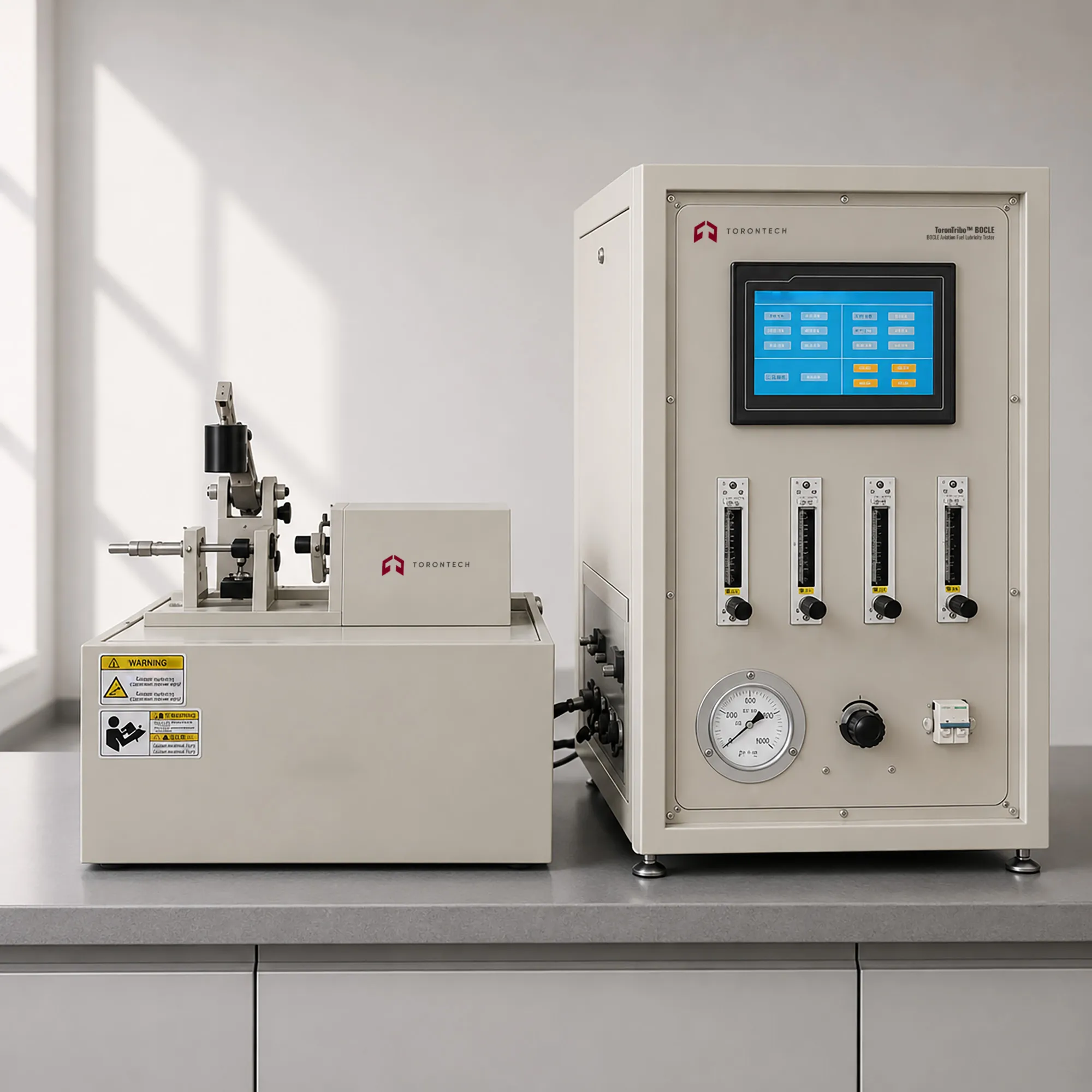
Standards
The ToronTribo™ BOCLE supports test procedures aligned with the internationally recognized ASTM standard for aviation turbine fuel lubricity evaluation using the Ball-on-Cylinder Lubricity Evaluator method.
- ASTM D5001 - Standard Test Method for Measurement of Lubricity of Aviation Turbine Fuels by the Ball-on-Cylinder Lubricity Evaluator (BOCLE)
BOCLE Aviation Fuel Lubricity Tester - ToronTribo™ BOCLE Key Features
The ToronTribo™ BOCLE combines precise load, speed, and environmental control for standardized aviation fuel lubricity testing.
- Controlled Normal Force: applies a constant test load with force indication accuracy within ±1 percent for consistent wear scar generation
- Precise Spindle Speed Control: holds rotational speed steady from 1 to 500 rpm, with accuracy within ±1 rpm at the standard 240 rpm test point
- Tight Environmental Control: maintains oil box temperature at 25°C ±1°C and relative humidity at 10% ±0.2% to match required test atmosphere conditions
- Accurate Timing System: controls test duration from 1 second to 9,999 minutes with timing accuracy within ±6 seconds over a 30-minute run
- Standard Test Piece Compatibility: uses a 12.7 mm steel ball and 49.22 x 13.06 mm test ring matching internationally recognized specimen dimensions
- Low Repeatability Error: holds experimental force indication repeatability error to within 1 percent for consistent results across repeated tests
Theory and Method
Aviation turbine fuel must provide enough boundary lubrication to protect fuel pumps and fuel controls from wear, even though jet fuel is a much thinner, less viscous fluid than dedicated lubricating oil. Refining processes that remove sulfur and other trace compounds to meet environmental and combustion requirements can also strip out the natural polar compounds that give fuel its lubricating properties, leaving some fuel batches without enough boundary lubrication to protect moving components.
The BOCLE test method measures this boundary lubrication directly by pressing a non-rotating steel ball against the outside diameter of a rotating steel ring, with the lower portion of the ring immersed in the fuel sample. As the ring rotates, it carries a continuous film of fuel to the ball-ring contact point, and the applied load forces metal-to-metal contact wherever the fuel film fails to fully separate the two surfaces. Over the course of the test, this repeated contact wears a flat scar into the ball, and the diameter of that scar becomes the direct, measurable indicator of the fuel's lubricating ability.
Controlling temperature and humidity precisely during the test matters because both variables influence how the fuel forms a boundary film at the contact interface. The ToronTribo™ BOCLE holds these conditions steady throughout each run, so that differences in wear scar diameter between fuel samples reflect genuine differences in fuel lubricity rather than variation in test conditions. Comparing wear scar diameter across untreated fuel, treated fuel, and reference fluids gives refiners and additive developers a reliable way to confirm that a fuel batch or lubricity improver meets the protection level required for safe engine operation.
BOCLE Aviation Fuel Lubricity Tester - ToronTribo™ BOCLE Technical Specifications
| Parameter | Specification |
|---|---|
| Maximum Normal Force | 10 N |
| Normal Force Indication Accuracy | ±1% |
| Repeatability Error of Force Indication | 1% |
| Spindle Speed Range | 1 to 500 rpm |
| Spindle Speed Accuracy | ±1 rpm at 240 rpm |
| Timer Working Range | 1 second to 9,999 minutes |
| Timing Accuracy | ±6 seconds within a 30-minute run |
| Test Environment (Oil Box) | Temperature: 25°C ±1°C; Relative humidity: 10% ±0.2% |
| Standard Test Piece | Steel ball φ12.7 mm; test ring φ49.22 x 13.06 mm |