
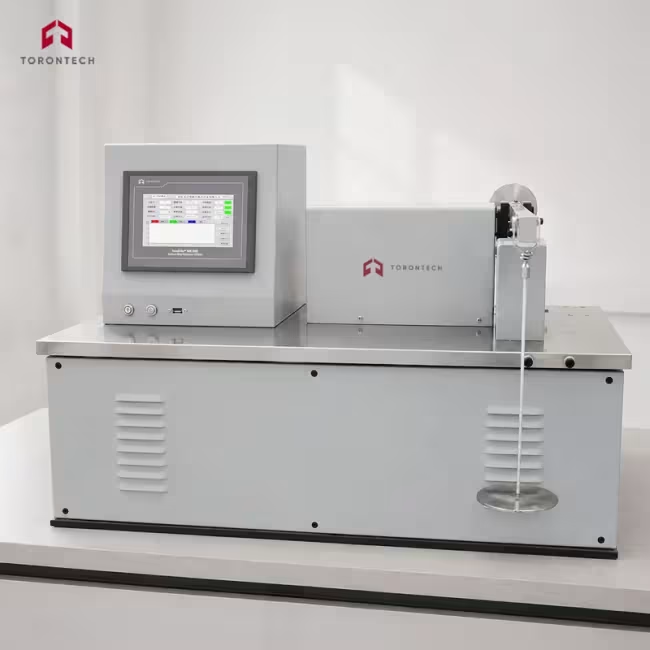
Block-on-Ring Tribometer (1000N)
Block-on-Ring Tribometer (1000N) - ToronTribo™ BOR 1000
Block-on-ring tribometer ranks the sliding wear resistance of materials and coatings, serving materials laboratories, component manufacturers, and quality control teams across metal and polymer industries. The ToronTribo™ BOR 1000 presses a stationary block specimen against a rotating ring under a controlled normal force, generating a line contact that reproduces the sliding wear conditions found in bearings, bushings, and other sliding mechanical interfaces. The configuration accommodates both metallic and non-metallic materials, including plastics such as nylon, under dry or oil-lubricated conditions.
The tester applies normal force from 10 to 1000 N with a maximum friction torque of 4 N·m, and drives the ring at spindle speeds from 100 to 1000 rpm. Time control ranges from 1 second up to 99,999 seconds or minutes, and revolution counting extends up to 999,999,999, supporting both short screening tests and extended wear-life evaluations. A 1.1 kW motor powers the spindle drive, and the compact 860 x 400 x 660 mm footprint suits standard laboratory bench space.
Materials laboratories, bearing and bushing manufacturers, and polymer component producers use the ToronTribo™ BOR 1000 to compare candidate materials, coatings, and lubrication strategies before committing to full-scale component testing. Because the test ranks materials relative to one another under consistent conditions, it supports material selection decisions across both metal-on-metal and polymer-on-metal sliding contact scenarios.
Block-on-Ring Tribometer (1000N) - ToronTribo™ BOR 1000 Applications
The ToronTribo™ BOR 1000 supports sliding wear evaluation for materials and coatings used in bearing, bushing, and general sliding contact applications.
- Bearing and Bushing Material Selection: ranks candidate metals and polymers for sliding wear resistance in bearing and bushing applications
- Engineering Plastic and Polymer Testing: evaluates wear resistance of nylon, plastic, and other polymer materials under dry sliding friction
- Coating and Surface Treatment Comparison: compares wear resistance of coated versus uncoated materials under identical sliding contact conditions
- Lubricant Effectiveness Screening: measures how dry friction and oil-lubricated conditions each affect wear rate for a given material pair
- Metal-on-Metal Sliding Wear Ranking: assesses adhesive and sliding wear compatibility between different metal material combinations
- Quality Control and Incoming Material Verification: confirms that material or coating batches meet expected wear resistance before production use
- Materials Science and Product Development Research: supports comparative studies of new material formulations and surface treatments under controlled sliding contact
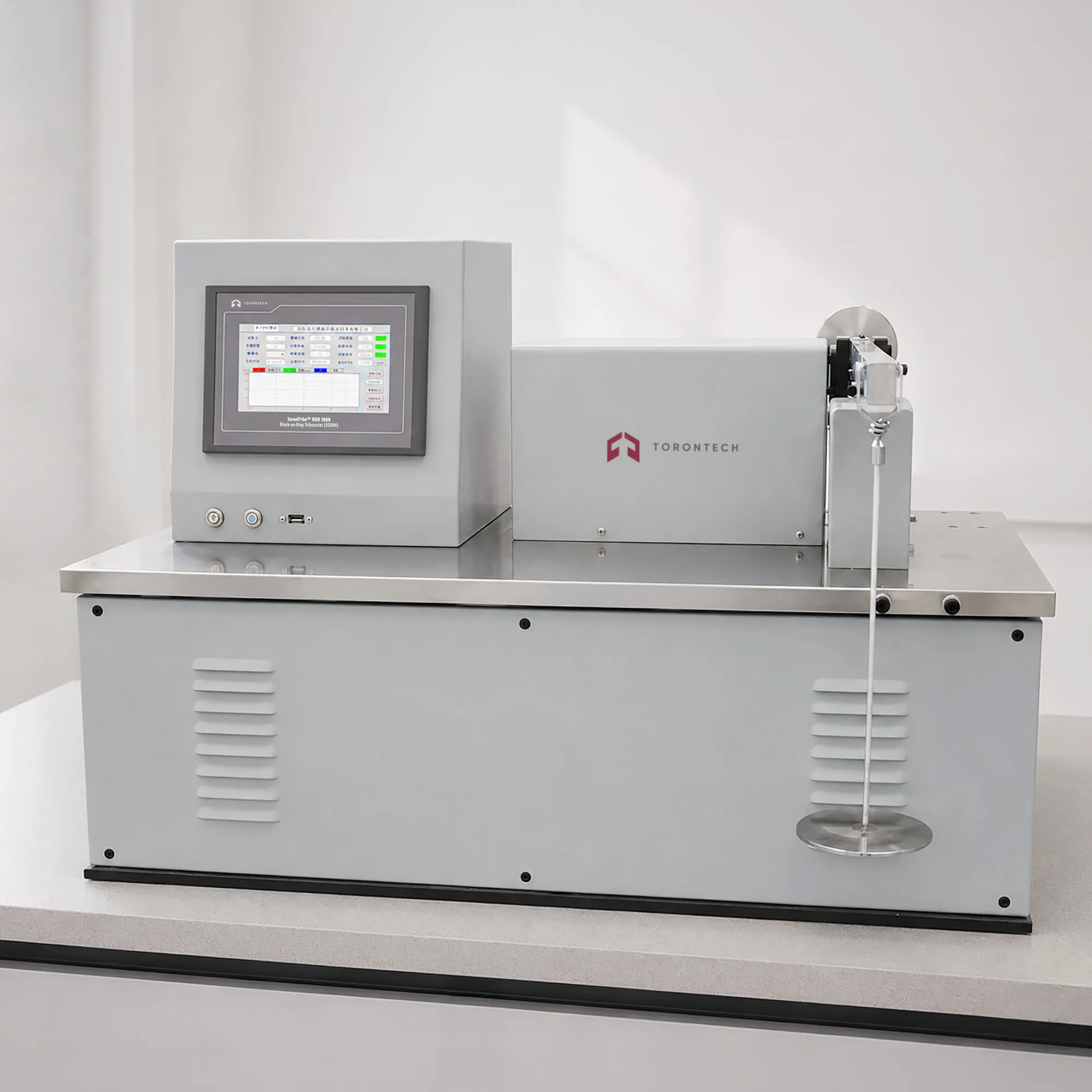
Block-on-Ring Tribometer (1000N) - ToronTribo™ BOR 1000 Key Features
The ToronTribo™ BOR 1000 combines a line-contact block-on-ring configuration with adjustable load and speed control for sliding wear evaluation.
- Wide Load Range: applies 10 to 1000 N of normal force, covering both light and moderately heavy sliding wear test conditions
- Metal and Polymer Material Compatibility: tests both metallic and non-metallic materials, including nylon and other engineering plastics
- Dry and Lubricated Testing: runs under dry friction or oil-lubricated conditions to match different service environments
- Adjustable Spindle Speed: operates from 100 to 1000 rpm to match different sliding velocity requirements
- Extended Time and Revolution Control: programs test duration up to 99,999 seconds or minutes, with revolution counting up to 999,999,999 for long-duration wear studies
- Compact Laboratory Footprint: fits standard bench space at 860 x 400 x 660 mm
Theory and Method
Block-on-ring wear testing evaluates sliding wear resistance by pressing a stationary block specimen against a rotating ring specimen at a right angle to the ring's axis of rotation. As the ring rotates under a constant applied load, the resulting sliding contact generates friction at the block-ring interface, and material is progressively removed from both the block and the ring through wear. Because the contact geometry and applied load remain constant throughout the test, the resulting wear scar and material loss provide a direct, repeatable basis for comparing different material pairs.
The ToronTribo™ BOR 1000 applies this principle through a spindle-driven ring and a loaded block holder, with a torque sensor measuring the resulting friction force as the test proceeds. Running the same test duration and load across different candidate materials produces comparable wear volume and friction coefficient data, letting engineers rank materials by sliding wear compatibility rather than relying on single-material test results in isolation. Because sliding wear rarely progresses linearly with distance, tests typically run to a fixed number of revolutions rather than a fixed time, so total sliding distance stays comparable across different test runs.
Lubrication condition strongly influences the wear result, since a lubricant film at the block-ring interface can substantially reduce direct asperity contact compared to dry sliding. Running the same material pair under both dry friction and oil-lubricated conditions on the ToronTribo™ BOR 1000 shows engineers how sensitive a given material combination is to lubrication, information directly relevant to bearing, bushing, and component design decisions where lubrication may not always be guaranteed throughout service life.
Block-on-Ring Tribometer (1000N) - ToronTribo™ BOR 1000 Technical Specifications
| Parameter | Specification |
|---|---|
| Normal Force Loading Range | 10 to 1000 N |
| Maximum Friction Torque | 4 N·m |
| Spindle Speed Range | 100 to 1000 rpm |
| Time Display and Control Range | 1 to 99,999 seconds or minutes |
| RPM Display and Control Range | 0 to 999,999,999 |
| Rated Power of the Main Unit | 1.1 kW |
| Friction Medium | Dry friction, oil lubrication |
| External Dimensions (L x W x H) | 860 x 400 x 660 mm |