
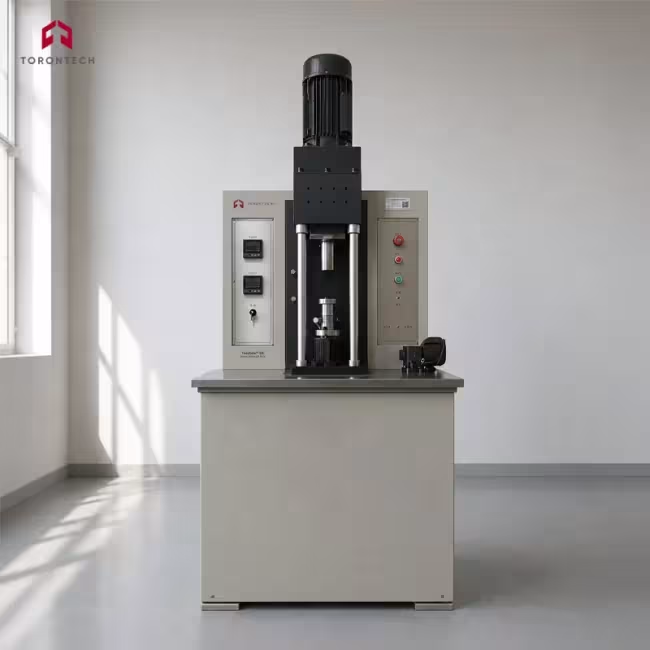
Bearing Fatigue Life Tester
Bearing Fatigue Life Tester - ToronTribo™ BFL
Rolling Bearing Fatigue Life Tester determines how long a bearing survives under sustained rolling contact stress, serving bearing manufacturers, materials laboratories, and quality assurance teams across industries that depend on bearing reliability. The instrument mounts complete bearing samples and applies a controlled axial load while driving the bearing at a set speed and temperature, running contact fatigue tests until flaking or another failure mode develops on the raceway or rolling elements.
The tester covers a spindle speed range of 200 to 10,000 rpm with speed error held to within ±3 percent, and applies axial loading force from 200 to 10,000 N with loading error held to within ±1 percent. Temperature control extends from room temperature up to 200°C, with temperature error held to within ±2°C, giving engineers precise control over the combined load, speed, and thermal conditions that drive bearing fatigue.
Bearing manufacturers, materials researchers, and quality assurance laboratories use this tester to establish fatigue life data for candidate bearing designs, materials, and heat treatments. Because bearing fatigue life varies statistically even among identical bearings tested under identical conditions, this tester supports the multi-sample testing programs needed to generate meaningful L10 life data rather than relying on a single test result.
Bearing Fatigue Life Tester - ToronTribo™ BFL Applications
This tester supports rolling bearing fatigue life evaluation for manufacturers and researchers across industries where bearing reliability directly determines equipment performance and service life.
- Bearing Design Validation: determines fatigue life of new bearing designs before release to production
- Bearing Material and Heat Treatment Qualification: compares fatigue life across different steel grades, surface treatments, and heat treatment processes
- Manufacturing Process Impact Studies: evaluates how manufacturing processes such as grinding, hard turning, or deep rolling affect bearing fatigue life through residual stress changes
- Lubricant and Grease Life Factor Testing: assesses how different lubricants and greases influence bearing fatigue life under controlled load and speed conditions
- Aerospace and Rail Bearing Qualification: supports fatigue life testing for bearings used in aerospace, rail transportation, and other high-reliability applications
- Wind Turbine Bearing Testing: evaluates fatigue life of bearings intended for wind turbine main shaft and gearbox applications under sustained cyclic loading
- Failure Mode and Root Cause Research: investigates flaking location and failure progression to understand fatigue failure mechanisms in specific bearing designs
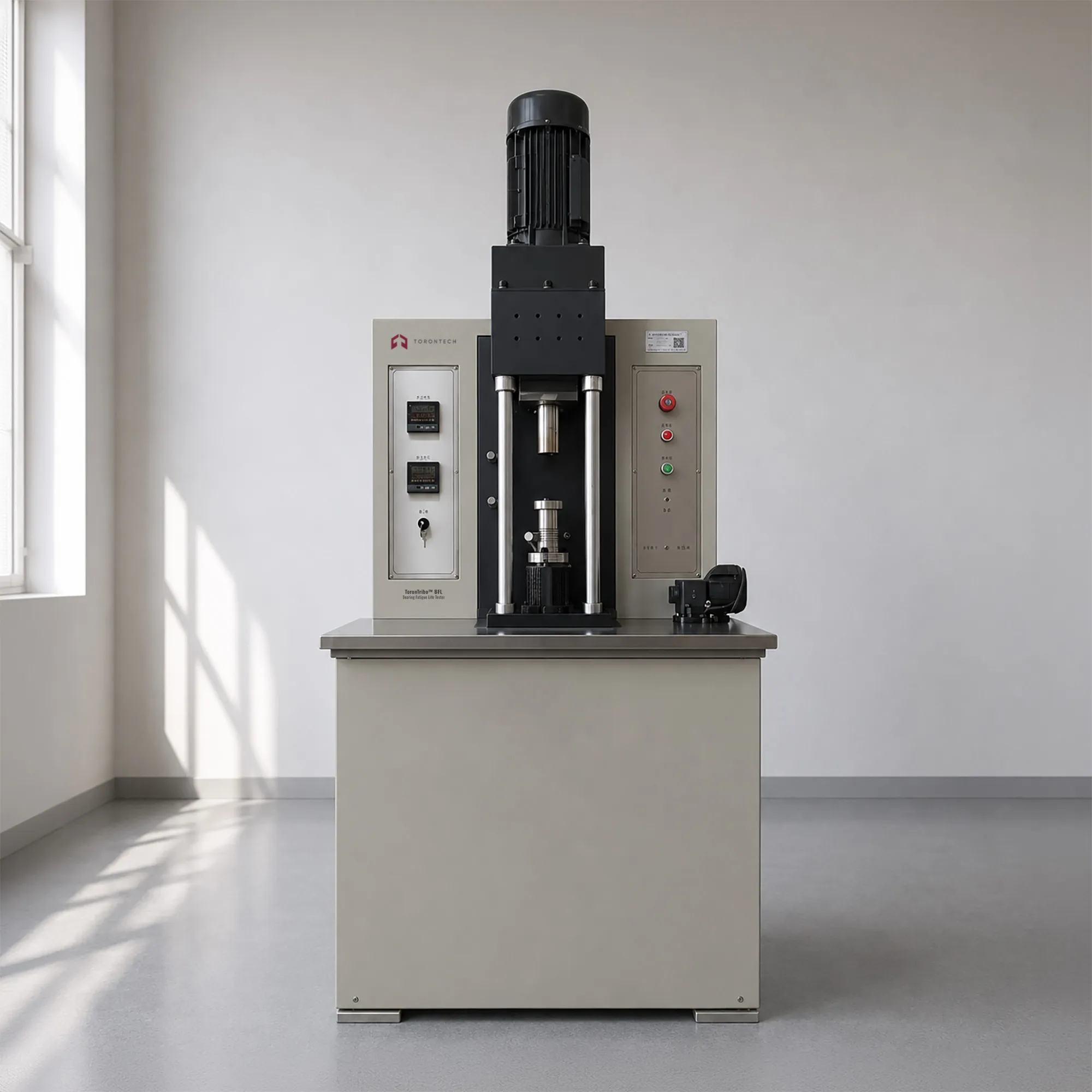
Bearing Fatigue Life Tester - ToronTribo™ BFL Key Features
This tester combines precise load, speed, and temperature control for generating reliable rolling bearing fatigue life data.
- Wide Speed Range: covers 200 to 10,000 rpm with speed error held to within ±3 percent for consistent test conditions
- High-Capacity Axial Loading: applies 200 to 10,000 N of axial force with loading error held to within ±1 percent
- Precise Temperature Control: maintains test temperature from room temperature to 200°C with error held to within ±2°C
- Complete Bearing Sample Testing: accommodates different types of complete bearing samples rather than simplified test specimens, testing the actual assembled component
- Multi-Parameter Test Control: adjusts load, speed, temperature, and time together to simulate a wide range of actual bearing operating conditions
- Support for Multi-Sample Test Programs: enables the repeated testing across multiple bearing samples needed to establish statistically meaningful L10 fatigue life data
Theory and Method
Rolling bearing fatigue develops from repeated subsurface shear stress cycles as rolling elements pass over the same point on a raceway again and again under load. Even though a single load cycle produces stress well below the material's static strength, the cumulative effect of millions of cycles eventually initiates a fatigue crack below the surface, which propagates until it reaches the surface and produces the characteristic flaking or spalling failure associated with bearing fatigue.
The Lundberg-Palmgren theory, developed in the 1940s, established the statistical framework still used to characterize this failure mode, introducing the concept of L10 life: the number of revolutions or hours at which 90 percent of a population of identical bearings, tested under identical conditions, are expected to survive without fatigue failure. Because individual bearings within an identical batch show considerable scatter in actual failure time, establishing a reliable L10 life requires testing multiple samples rather than relying on any single bearing's result. This tester supports that requirement by allowing repeated, controlled tests across multiple bearing samples under consistent load, speed, and temperature conditions.
Because full-scale bearing fatigue testing at actual service loads can take an impractically long time, accelerated testing at elevated load, speed, or temperature is common practice for generating fatigue data within a reasonable test duration. Running bearings at higher stress than actual service conditions shortens test time, but requires careful interpretation to extrapolate results back to real operating conditions. Precise control over load, speed, and temperature, as this tester provides, is what makes that extrapolation possible, since even small variations in test conditions can significantly affect the resulting fatigue life data.
Bearing Fatigue Life Tester - ToronTribo™ BFL Technical Specifications
| Parameter | Specification |
|---|---|
| Spindle Speed | 200 to 10,000 rpm |
| Spindle Speed Error | ± 3% |
| Axial Loading Force | 200 to 10,000 N |
| Relative Error of Loading Force | ≤ ± 1% |
| Temperature | Room temperature to 200°C |
| Temperature Error | ± 2°C |