
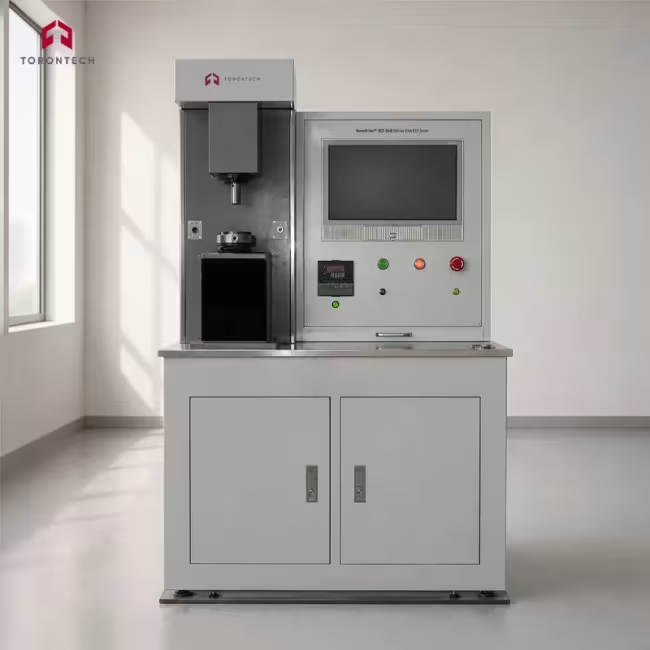
Ball-on-Disk RCF Tester
Ball-on-Disk RCF Tester - ToronTribo™ RCF BoD
Ball-on-disk RCF tester evaluates contact fatigue performance and failure behavior in point-contact components, serving bearing manufacturers, materials laboratories, and lubricant developers. The ToronTribo™ RCF BoD loads a steel or ceramic ball against a rotating thrust plate to simulate rolling, sliding, or combined rolling-sliding motion, reproducing the point-contact stress that ball bearings and similar components experience in service. Operators adjust temperature, load, speed, and friction pair material to evaluate how a candidate material or surface treatment performs under repeated contact stress.
The system covers a load range of 20 to 2000 N with 1 N display resolution, and a speed range of 300 to 3000 rpm held to within ±1 percent of full scale. Temperature control extends from ambient up to 200°C, and test duration is programmable from 1 to 99,999 minutes, supporting both short screening tests and extended fatigue-life studies under oil lubrication. Automatic control monitors and records test data throughout each run without requiring constant operator attention.
Bearing manufacturers, lubricant developers, and materials research laboratories use the ToronTribo™ RCF BoD to determine how long steel balls, ceramic balls, and thrust plate materials resist pitting and fatigue cracking under point-contact rolling and sliding stress. The test accommodates thrust plate samples of 35 mm or 52 mm diameter and ball diameters from 5 to 12.7 mm, matching common bearing component sizes.
Ball-on-Disk RCF Tester - ToronTribo™ RCF BoD Applications
The ToronTribo™ RCF BoD supports rolling contact fatigue evaluation for point-contact components and materials used in bearings and precision mechanical systems.
- Ball Bearing Material Qualification: evaluates fatigue life and pitting resistance of bearing steel and ceramic balls under simulated point-contact rolling stress
- Thrust Bearing and Washer Testing: assesses contact fatigue performance of thrust plate materials used in axial load-bearing applications
- Lubricant and Additive Screening: compares how different oils and additive formulations influence point-contact fatigue life under controlled load and speed conditions
- Surface Coating and Heat Treatment Evaluation: quantifies fatigue resistance improvements from surface treatments, carburizing, or coatings applied to ball or disk components
- Ceramic Bearing Component Research: tests fatigue behavior of ceramic balls against steel or ceramic thrust plates for hybrid and full-ceramic bearing applications
- Precision Instrument and Actuator Development: evaluates wear and fatigue life of small point-contact components used in precision mechanisms
- Materials Science and Failure Analysis Research: investigates fatigue crack initiation and pitting mechanisms under repeated point-contact rolling and sliding stress
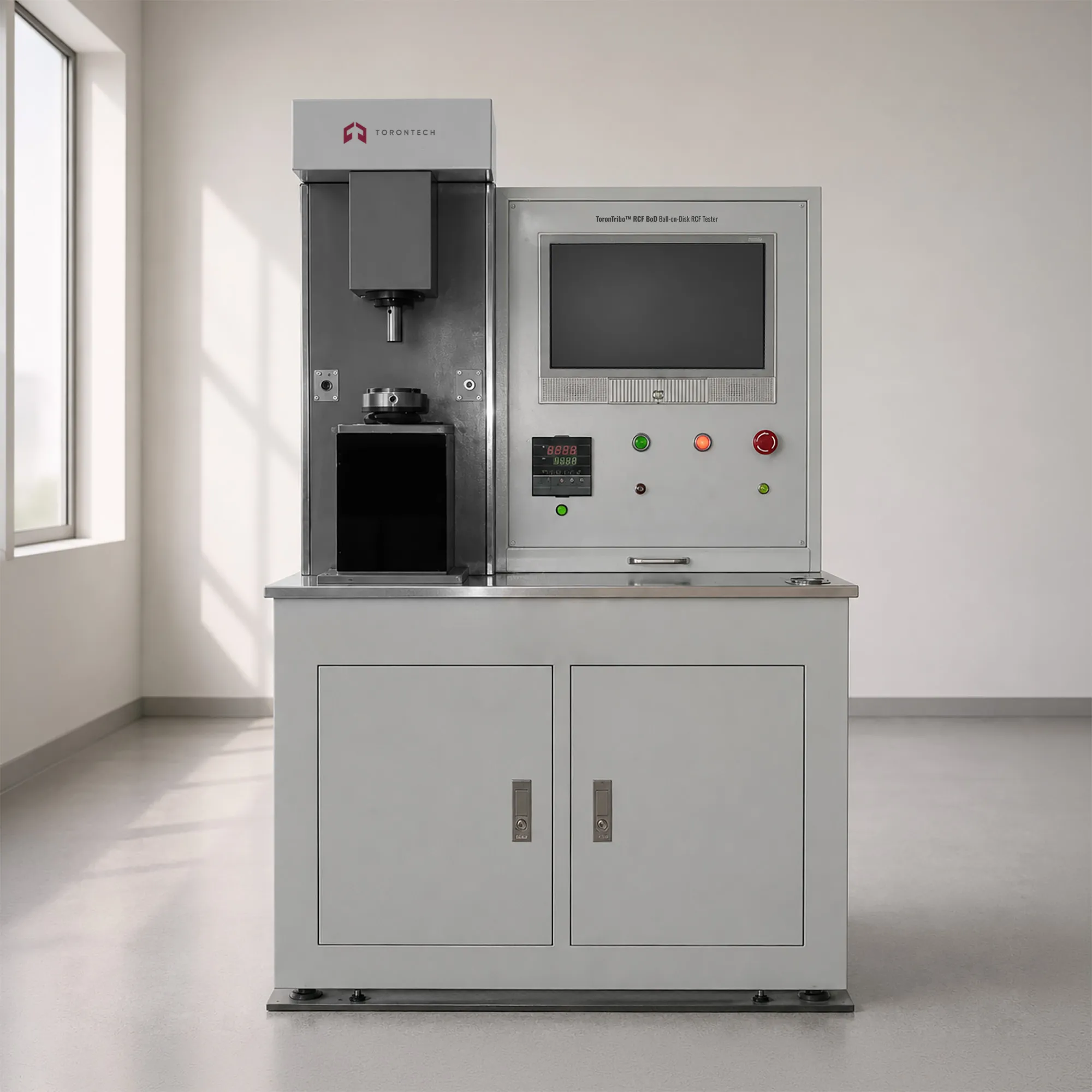
Ball-on-Disk RCF Tester - ToronTribo™ RCF BoD Key Features
The ToronTribo™ RCF BoD combines precise load and speed control with automated monitoring for point-contact fatigue testing.
- Wide Load Range: covers 20 to 2000 N with 1 N display resolution for precise control over point-contact stress
- High-Speed Testing: operates from 300 to 3000 rpm, held to within ±1 percent of full scale for consistent test conditions
- Elevated Temperature Testing: reaches up to 200°C, allowing fatigue evaluation under mild thermal conditions relevant to bearing service
- Extended Time Control: programs test duration from 1 to 99,999 minutes, supporting both short screening tests and long-duration fatigue studies
- Automatic Monitoring and Recording: logs test data continuously under automatic control, reducing the need for constant operator supervision
- Flexible Sample Compatibility: accepts thrust plate samples of 35 mm or 52 mm diameter and ball diameters from 5 to 12.7 mm, including steel and ceramic balls
- Oil-Lubricated Testing: runs under oil lubrication to reproduce the film conditions typical of real bearing operation
Theory and Method
Point-contact rolling fatigue develops when a ball loaded against a flat or curved surface generates a small, concentrated contact area that carries the full applied load. Unlike the line contact of a roller-on-roller test, this point contact produces higher local stress for a given load, concentrating subsurface shear stress beneath the contact zone. Repeated loading as the ball rolls across the same track on the thrust plate causes this subsurface stress to cycle, and over enough cycles, fatigue cracks initiate below the surface and propagate upward, eventually producing surface pitting.
The ToronTribo™ RCF BoD reproduces this mechanism by pressing a ball against a rotating thrust plate under a controlled normal force while the plate rotates at a set speed. Depending on how the ball and plate speeds relate to each other, the contact experiences pure rolling, pure sliding, or a combination of both, allowing engineers to match the test to the actual kinematic condition found in the target bearing or component design. Oil lubrication at the interface forms a thin film that can partially separate the ball and plate surfaces, reducing direct asperity contact and extending fatigue life compared to unlubricated point contact.
Because pitting fatigue life is highly sensitive to contact stress, engineers use this test to rank candidate ball and plate materials, surface treatments, and lubricants under controlled, repeatable point-contact conditions before committing to full-scale bearing testing. Comparing cycles-to-failure across different test conditions produces the fatigue life data needed to predict how a material or lubricant choice will perform in actual bearing service.
Ball-on-Disk RCF Tester - ToronTribo™ RCF BoD Technical Specifications
| Parameter | Specification |
|---|---|
| Load Range | 20 to 2,000 N |
| Test Force Display Resolution | 1 N |
| Speed Adjustment Range | 300 to 3,000 rpm |
| Speed Control Accuracy | ±1% F.S. |
| Temperature Range | Room temperature to 200°C |
| Time Range | 1 to 99,999 min |
| Control Mode | Automatic control with automatic monitoring and recording |
| Thrust Plate Sample Size | φ35 mm or φ52 mm |
| Ball Diameter Range | φ5 to φ12.7 mm (steel or ceramic) |
| Lubricating Medium | Oil |