
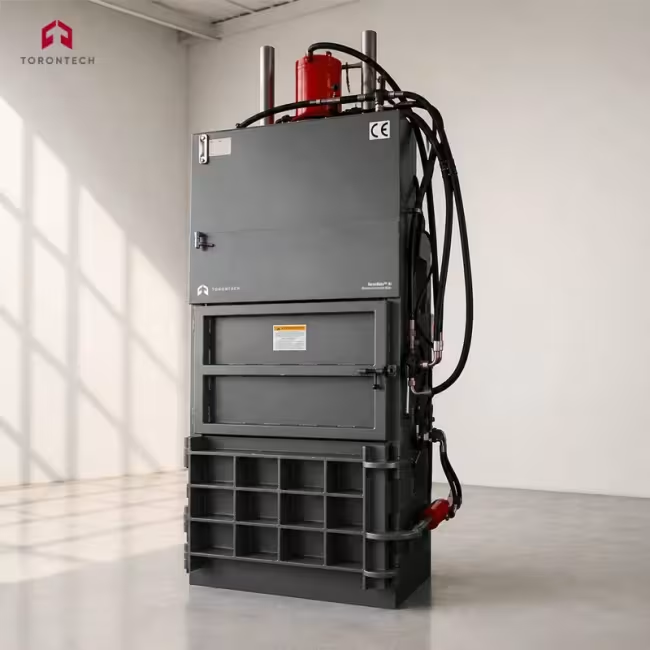
Aluminum Extrusion Baler - ToronBale™ Al
Aluminum extrusion baler compacts profiles, window frames, and structural sections into bales sized for transport to secondary smelters. Torontech offers the ToronBale™ Al at 120 tons and 150 tons, producing bales of 80 kg to 250 kg. Feed openings measure 1,200 mm and 1,500 mm wide, taking uncut extrusion lengths that would otherwise need sawing before they fit a chamber. Machine weights are 4,500 kg and 5,500 kg.
Loose extrusion occupies far more space than its weight suggests. Hollow profiles carry air inside every chamber, and straight lengths refuse to nest. A container therefore fills to volume long before it approaches payload. Baling collapses that void and turns an awkward stream into stackable units priced by the ton.
Front and rear doors both open. Operators pass strapping through the chamber rather than reaching around a single face. A chain ejector then discharges the tied bale without manual handling. Extruders, window and curtain wall fabricators, and non-ferrous scrap dealers use the ToronBale™ Al to handle profile offcuts and recovered frames.
Aluminum Extrusion Baler - ToronBale™ Al Applications
The ToronBale™ Al suits operations generating aluminum profile, sheet, and frame scrap in regular volumes.
- Aluminum Extrusion Plants: bales press offcuts, die start-up scrap, and out-of-tolerance lengths for return to the cast house
- Window and Door Fabrication: compacts frame cut-offs and rejected units, with glazing and thermal break strips removed beforehand
- Curtain Wall and Facade Contractors: handles mullion and transom offcuts generated on site and in the shop
- Non-Ferrous Scrap Dealers: densifies purchased extrusion and frame scrap into units that ship economically to smelters
- Solar Module Recycling: bales the aluminum frames stripped from end-of-life photovoltaic panels
- Demolition and Building Strip-Out: consolidates recovered window frames, cladding rails, and trim from renovation projects
- Appliance and Furniture Manufacturing: compacts aluminum trim, rails, and structural sections from production lines
- Ladder, Scaffold, and Truck Body Builders: handles offcuts from fabrication using extruded aluminum sections
- HVAC and Refrigeration Manufacturing: bales aluminum fin stock offcuts and coil frame sections
Standards
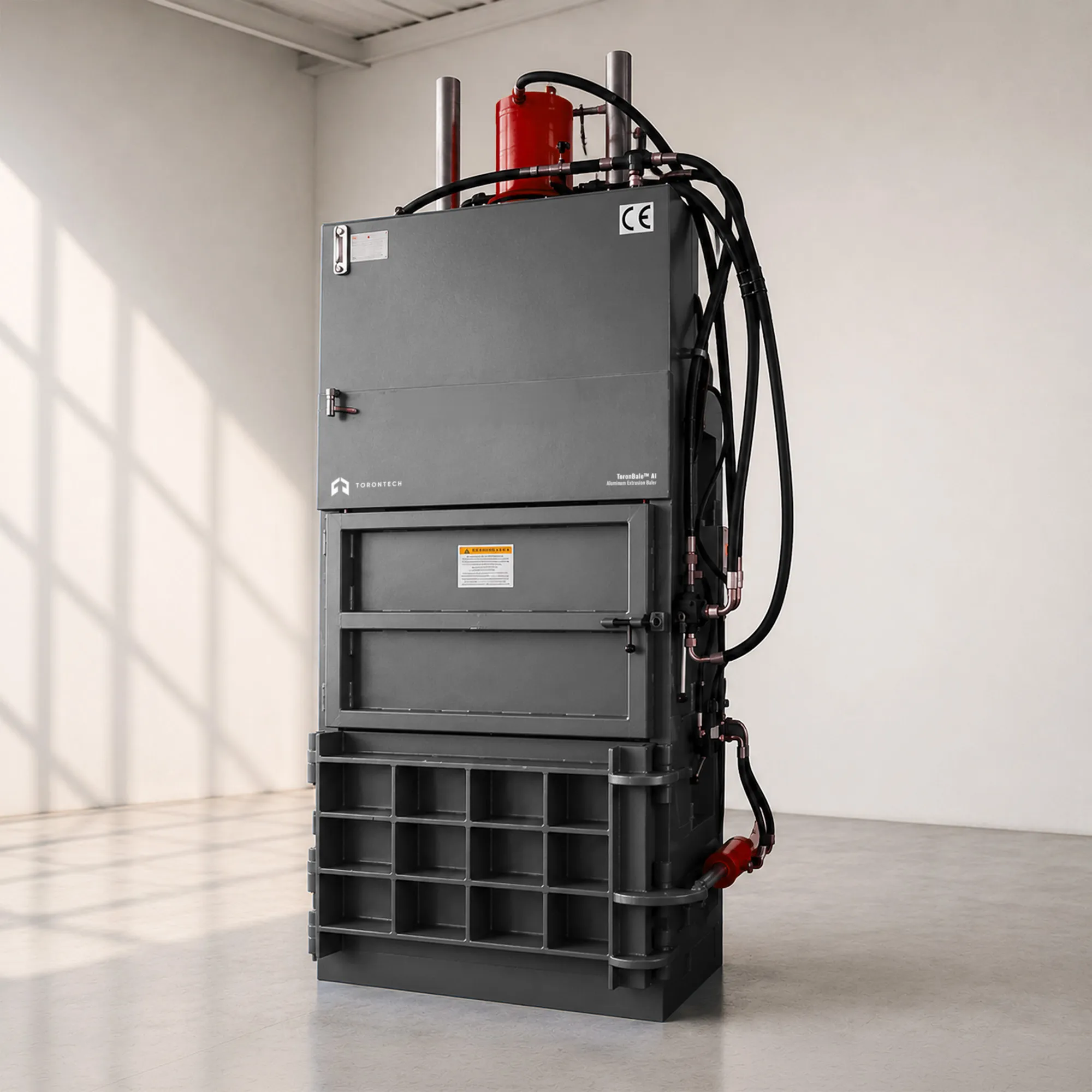
Torontech builds the ToronBale™ Al to the safety conventions expected in North American and European facilities. The design uses an anti-rebound gate structure aligned with European and U.S. baler safety practice, a feed-gate interlock that halts platen travel, and an independent emergency stop mounted separately from the main controls. Confirm applicable certification marks and local code requirements with Torontech before installation, since safety documentation varies by destination market and configuration.
Aluminum Extrusion Baler - ToronBale™ Al Key Features
The ToronBale™ Al combines the force needed for structural aluminum with an opening wide enough to load profiles uncut.
- 120 or 150 Ton Press Force: sized to buckle and fold extruded aluminum sections without the excess tonnage a ferrous press requires
- Feed Openings to 1,500 mm: accepts long uncut extrusion lengths and assembled window frames, removing a sawing step before baling
- Front and Rear Opening Doors: strapping passes through the chamber from both faces, cutting the awkward reaching that single-door machines require
- Automatic Chain Bale Ejector: discharges the tied bale from the chamber on command, removing manual handling of the finished unit
- Anti-Rebound Gate Structure: built to European and U.S. safety practice, holding compressed material in place and blocking uncontrolled door movement
- Feed Gate Ram Interlock: stops downward platen travel the moment the loading gate opens, keeping hands clear of the compaction zone
- Independent Emergency Stop: a dedicated, prominently mounted circuit cuts hydraulic function apart from the main control system
- Reinforced Ram Guides: maintain a square platen face when long profiles bridge unevenly across the chamber, protecting cylinder seals from side loading
- Wide Bale Height Range: bale height sets between 400 and 1,000 mm on both models, letting operators match bale size to smelter or container requirements
- Direct-Coupled Motor and Pump: a cross-connected direct drive holds full concentricity between motor and pump, replacing conventional couplings and extending pump service life
- NOK Hydraulic Seals: Japanese-sourced sealing components extend service intervals and reduce seal replacement downtime
- A.M.C. Oil Pipe Joints: Japanese-made fittings hold hydraulic connections leak-free across thermal cycling and vibration
- Heavy Structural Frame: 4,500 kg and 5,500 kg build weights absorb the reaction loads produced when profiles collapse suddenly under the platen
Theory and Method
Aluminum yields at a fraction of the stress steel requires, and extrusion profiles fail in a specific way. Load concentrates at the thin walls of hollow chambers, which buckle locally before the section as a whole gives way. The profile then folds like a collapsing tube. The 6000 series alloys used for architectural frames are ductile enough to fold rather than crack, so fragments stay connected and the bale holds together. Both models apply roughly 1.25 MPa across the bale face, tuned to that behavior.
Density explains the numbers on the specification table. Aluminum weighs about a third of what steel does for the same volume, so an aluminum bale filling the same chamber as a ferrous one weighs proportionally less. A buyer comparing this machine against a steel-focused press on bale weight alone will read the difference as weakness. It reflects the material, not the equipment.
Bale density matters more for aluminum than tonnage alone suggests. Thin-walled scrap entering a furnace loses metal to oxidation across its exposed surface, and a denser bale presents less surface for the same mass. Smelters therefore pay attention to how tightly a supplier bales, particularly on lighter gauge material. Ram guides hold the platen square through the stroke, since long profiles bridge unevenly and load the platen off-center.
Aluminum Extrusion Baler - ToronBale™ Al Technical Specifications
| Parameter | ToronBale™ Al-120 | ToronBale™ Al-150 |
|---|---|---|
| Press Force | 120 tons (approx. 1,177 kN) | 150 tons (approx. 1,472 kN) |
| Feed Opening Size (L × H) | 1,200 × 500 mm | 1,500 × 600 mm |
| Baling Chamber Height | 1,500 mm | 1,600 mm |
| Bale Size (L × W × H, H adjustable) | 1,200 × 800 × (400 to 1,000) mm | 1,500 × 760 × (400 to 1,000) mm |
| Bale Weight | 80 to 200 kg | 100 to 250 kg |
| Motor Power | 15 kW | 18.5 kW |
| Machine Weight | 4,500 kg | 5,500 kg |
| Overall Dimensions (L × W × H) | 1,700 × 1,100 × 3,600 mm | 2,200 × 1,300 × 3,800 mm |
| Bale Ejection | Automatic chain ejector | Automatic chain ejector |
| Chamber Access | Front and rear opening doors | Front and rear opening doors |
| Materials Handled | Aluminum alloy frames, extrusion profiles, non-ferrous sections | Aluminum alloy frames, extrusion profiles, non-ferrous sections |