
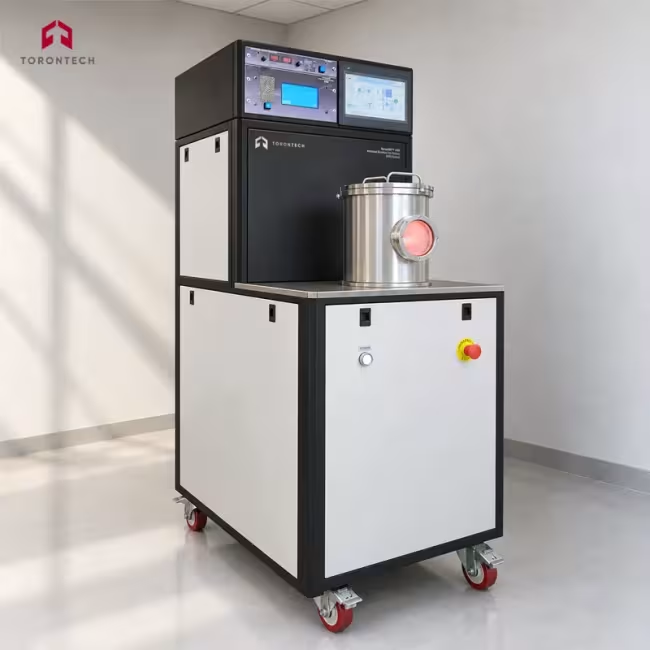
Advanced Reactive Ion Etching (RIE) System
Advanced Reactive Ion Etching (RIE) System - ToronRIE™ 400
ToronRIE™ 400 is an advanced reactive ion etching system supporting 3-inch and 4-inch wafer configurations with fluorine-based chemistry for etching Si, SiOx, SixNy, dielectrics, and metals. A turbomolecular pump reaches 10⁻⁷ mbar base pressure; the process pressure range of 2×10⁻³ to 100×10⁻³ mbar supports stable plasma conditions. A 300 W auto-matching RF supply at 13.56 MHz and an optimized showerhead electrode deliver etch rate non-uniformity below 4%. High DC self-bias capability enables enhanced anisotropic etching profiles.
An HMI touchscreen with recipe-based automatic processing supports reliable automation and repeatable results across semiconductor research and production workflows. Built-in interlocks provide safe operation during all process stages, and PLC-controlled architecture manages the complete etch sequence through pump-down and process execution. Up to 8 gas lines accommodate flexible chemistry configurations for different etch chemistries, with precise pressure control maintained independently throughout. Photoresist stripping and descum etching are supported alongside the primary dielectric and silicon etch processes.
The mechanically clamped chuck with substrate cooling maintains stable substrate temperature and position during etching, with sample heating options also available for specific process requirements. An adjustable chuck-to-electrode distance supports fine-tuning of etch parameters for different chemistries and substrate geometries. A compact system footprint with a large observation window enables visual inspection of the plasma and substrate during processing. The 10-inch HMI touchscreen provides an accessible graphical interface for both process development and routine production runs.
Advanced Reactive Ion Etching (RIE) System - ToronRIE™ 400 Applications
The ToronRIE™ 400 addresses advanced semiconductor research and MEMS fabrication programs where fluorine-based dry etching, high-vacuum process conditions, and wafer-scale uniformity below 4% are required in a compact, cleanroom-compatible platform. Its fluorine chemistry and 8-line gas configuration support a broader process range than basic non-corrosive RIE systems.
- Silicon and Silicon Dioxide Dry Etching: fluorine-based plasma etching of Si and SiO₂ layers for transistor gate patterning, trench definition, and contact via formation in semiconductor device research
- Silicon Nitride Etch for MEMS and Device Isolation: precise SixNy layer removal for isolation structures, etch-stop applications, and suspended element fabrication in MEMS device programs
- Metal Thin Film Etching: plasma etching of aluminum, titanium, and related metal films for metallization patterning in semiconductor and advanced materials device fabrication
- Photoresist Descumming and Stripping: oxygen plasma removal of photoresist residues and scum layers on 3-inch and 4-inch wafers without wet chemical processing
- Dielectric Patterning for Advanced Structures: fluorine-based etching of SiO₂ and SixNy gate dielectrics and inter-layer dielectrics for MOS, bipolar, and MEMS device research programs
- High-Anisotropy Silicon Feature Etching: high DC self-bias operation for deep anisotropic silicon etch profiles in trench capacitors, shallow trench isolation, and MEMS microstructure fabrication
- Advanced Semiconductor and University Research: recipe-controlled multi-step etch platform for silicon, oxide, nitride, and metallic material systems in academic and industrial research programs
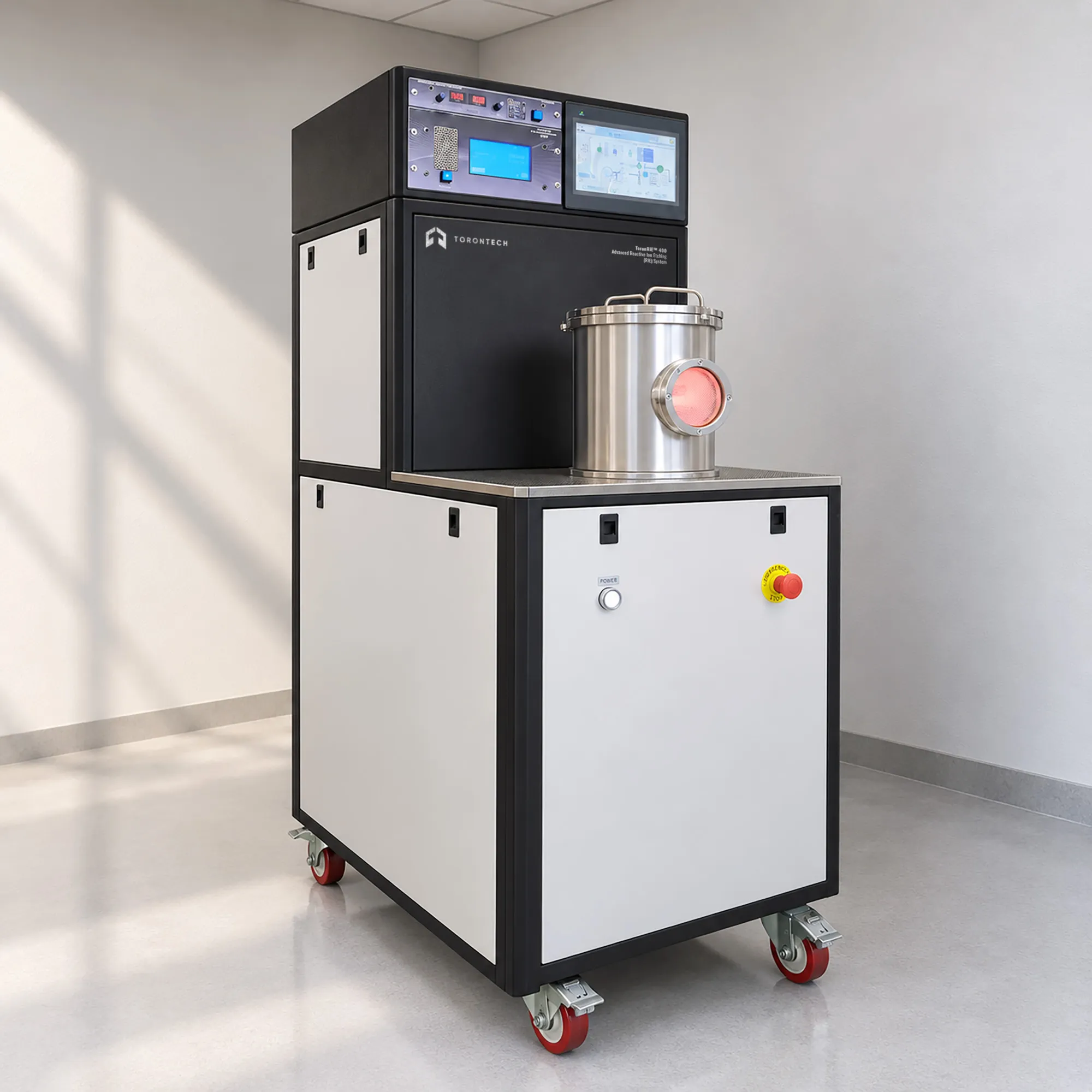
Advanced Reactive Ion Etching (RIE) System - ToronRIE™ 400 Key Features
The ToronRIE™ 400 integrates fluorine-compatible chemistry, turbomolecular vacuum, showerhead gas distribution, high DC self-bias, and recipe-based HMI automation in a compact parallel-plate RIE platform for 3-inch and 4-inch semiconductor and MEMS research.
- 3-Inch and 4-Inch Wafer Configuration Support: dual wafer size compatibility for versatile processing across standard semiconductor research and production substrate formats
- Fluorine-Based Chemistry for Si, SiOx, SixNy, Dielectrics, and Metals: process capability for fluorine etch chemistries including CF₄, SF₆, and related gases for silicon and dielectric material patterning beyond non-corrosive-only RIE systems
- Optimized Showerhead Electrode Design: uniform gas distribution across the substrate reduces concentration gradients and supports consistent etch rate and chemistry throughout the process zone
- Etch Rate Non-Uniformity Below 4%: demonstrated etch uniformity across 3-inch and 4-inch wafers, confirmed by etch rate uniformity mapping data
- High DC Self-Bias Capability: high self-bias voltage enhances ion energy at the substrate for anisotropic etch profiles with vertical sidewalls in Si and dielectric films
- Turbomolecular Vacuum System, 10⁻⁷ mbar Base Pressure: deep base vacuum reduces residual gas contamination for high-quality plasma etch processes across fluorine and oxygen chemistries
- Process Pressure Range 2×10⁻³ to 100×10⁻³ mbar: broad pressure range with precise independent control supports a wide variety of plasma etch process conditions
- Up to 8 Gas Lines for Flexible Chemistry: extensive gas line capacity accommodates complex multi-species process chemistries and sequential etch step gas configurations
- 300 W Auto-Matching RF Power Supply (13.56 MHz): automatic impedance matching maintains stable RF power delivery across the full range of plasma conditions and gas chemistries
- 10-Inch HMI Touchscreen Interface: large-format graphical user interface for intuitive process control, real-time monitoring, and recipe management
- Recipe-Based Automatic Processing: stored process recipes enable one-touch execution of multi-step etch sequences without manual parameter adjustment between steps
- PLC-Controlled Architecture for Reliable Automation: PLC management of all system functions supports repeatable results across semiconductor research and production workflows
- Built-In Safety Interlock System: comprehensive interlocks monitor RF, vacuum, and gas system status and halt the process automatically in unsafe conditions
- Mechanically Clamped Chuck with Substrate Cooling: positive clamping and active cooling protect temperature-sensitive substrates and photoresist masks during extended etch cycles
- Sample Cooling and Heating Options: temperature-controlled chuck supports cooling for sensitive samples and heating for process chemistries requiring substrate temperature elevation
- Adjustable Chuck-to-Electrode Distance: fine-tuning of the electrode gap optimizes etch parameters for different process chemistries and target film configurations
- Photoresist Stripping and Descum Etching: oxygen plasma cleaning and photoresist removal capability alongside the primary fluorine etch processes
- Compact Footprint with Large Observation Window: compact laboratory footprint with a direct visual window into the chamber for plasma and substrate monitoring during development
Theory and Method
Reactive ion etching combines chemical selectivity and directional ion bombardment, achieving anisotropy that wet chemical etching cannot produce. A 300 W RF source at 13.56 MHz generates plasma between the showerhead electrode and substrate, producing reactive fluorine species from fluorine-containing gases. Fluorine radicals react with Si, SiO₂, and SixNy to form volatile etch products that the turbomolecular system removes. Simultaneous ion bombardment enhances directionality, producing the vertical profiles needed for semiconductor and MEMS device patterning.
The optimized showerhead electrode distributes process gases uniformly across the substrate, reducing concentration gradients that cause etch non-uniformity. The turbomolecular vacuum system reaches 10⁻⁷ mbar base pressure, and the 2×10⁻³ to 100×10⁻³ mbar process range maintains stable plasma conditions throughout the etch. These conditions contribute to etch rate non-uniformity below 4% across 3-inch and 4-inch wafers. Up to 8 gas lines accommodate complex multi-species chemistries under PLC control.
High DC self-bias accelerates ions with sufficient energy for anisotropic etching of vertical sidewalls in Si, SiO₂, and dielectric films. The mechanically clamped chuck with substrate cooling removes ion-bombardment heat, and an optional heating configuration extends the accessible substrate temperature range. Recipe-based processing through the 10-inch HMI touchscreen manages multi-step sequences without operator intervention between steps. Built-in interlocks monitor vacuum, RF, and gas system status to maintain safe operation throughout the etch process.
Advanced Reactive Ion Etching (RIE) System - ToronRIE™ 400 Technical Specifications
| Parameter | Specification |
|---|---|
| Supported Wafer Sizes | 3-inch and 4-inch |
| RF Power Supply | 300 W, auto-matching |
| RF Frequency | 13.56 MHz |
| Base Pressure | 10⁻⁷ mbar (turbomolecular pump) |
| Process Pressure Range | 2×10⁻³ to 100×10⁻³ mbar |
| Etch Rate Non-Uniformity | Below 4% |
| DC Self-Bias | High self-bias capability |
| Gas Lines | Up to 8 |
| Electrode Type | Optimized showerhead |
| Compatible Chemistries | Fluorine-based (CF₄, SF₆, etc.) and oxygen-based |
| Material Applications | Si, SiO₂, SixNy, metals, photoresist, polymers |
| Chuck | Mechanically clamped; water-cooled |
| Chuck Temperature Control | Cooling standard; heating available as option |
| Electrode Gap | Adjustable |
| Control System | PLC with 10" HMI touchscreen |
| Operating Mode | Manual and recipe-based automatic |
| Safety | Built-in interlock system (RF, vacuum, gas) |
| Pressure Control | Precise; independent from gas flow |