
Why Archemicals Chose Our Flash Point Tester (TT-93Z)
Can a clean fuel refinery scale daily batch output while cutting testing overhead and guaranteeing audit-ready compliance on every single run?
At Torontech, we see forward-thinking biofuel producers addressing this challenge directly. In Tagoloan, Misamis Oriental, Archemicals Corp converts regional coconut harvests into high-grade Coconut Methyl Ester (CME), bio-based chemicals, and refined plant oils under Republic Act No. 9367 (the Philippine Biofuels Act). To supply national fuel distribution networks with total confidence, commercial refining operations require automated flash point testing that satisfies strict standard parameters while optimizing capital expenditure.
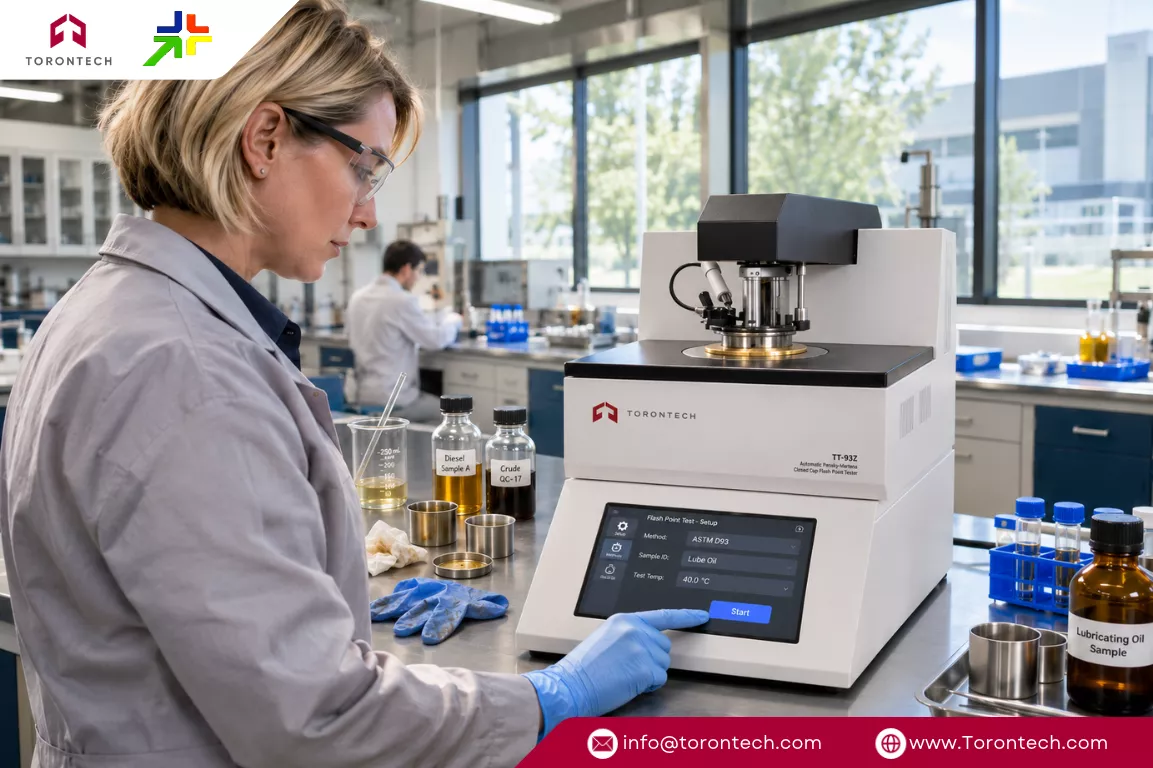
The Torontech TT-93Z Automatic Pensky-Martens Closed Cup Flash Point Tester was selected to deliver hands-off precision, dependable batch verification, and cost-effective compliance for the Archemicals Corp quality control laboratory.
ASTM D93 Procedure C: Flash Point Verification
Producing clean biodiesel requires reacting raw coconut oil fats with methanol and chemical catalysts to generate methyl esters and glycerin. The primary technical hurdle during purification is that if residual unreacted methanol slips through, the finished fuel’s flash point takes an immediate, steep dive.
For commercial Coconut Methyl Ester, where the standard minimum flash point is specified well above the 40 degrees Celsius lower operating limit of the TT-93Z, precise closed-cup thermal tracking within the instrument 40 to 360 degrees Celsius measurement range is essential to verify complete alcohol stripping.
Methanol catches fire at relatively low temperatures. If a production batch flashes below standard thresholds, you are looking at a serious fire hazard inside bulk storage tanks, road tankers, and marine cargo holds. Fuel buyers, commercial blenders, and regulatory auditors will halt that shipment without hesitation.
Meeting verification standards requires following ASTM D93 Procedure C. This protocol is not like running a quick check on light diesel fuels (Procedure A) or heavy, viscous lubricating oils (Procedure B). Procedure C is built specifically for biodiesel (FAME/CME), and its operating rules are remarkably strict:
- It requires heating the sample upward at a steady 3.0°C ± 0.5°C per minute (no accelerating ahead, no falling behind).
- It insists on continuous stirring between 90 and 120 rpm so thick, syrupy vegetable oil fractions heat thoroughly without hot spots.
- It demands dipping the ignition source into the trapped vapor space at exact temperature intervals without disturbing the vapor equilibrium.
From our perspective, expecting laboratory technicians to run Procedure C on older manual or semi-automated hardware introduces unnecessary friction. Standing over a hot sample cup, manually adjusting heating dials, visually guessing whether a faint blue flicker was a genuine flash, and scribbling air pressure adjustments on scrap paper is a recipe for shift-to-shift discrepancies.
TT-93Z Testing Workflow at Archemicals Corp
At Torontech, our view is simple: serious testing hardware should be straightforward, dead-on accurate, and reasonably priced.
Here is how the TT-93Z establishes a smooth, walk-away routine for standardizing Coconut Methyl Ester analysis at the Archemicals Corp facility:
Sample Setup and Protocol Selection
The laboratory technician dispenses the Coconut Methyl Ester sample into the standardized closed test cup and sets it into the heating well. With a quick tap on the full-color touchscreen, the technician selects the pre-programmed ASTM D93 Procedure C routine.
For non-standard refining fractions or unknown incoming feedstocks, operators can also utilize the built-in quick detection mode to estimate the approximate flash temperature range before initiating a certified testing cycle.
Thermal and Stirring Automation
Once started, the motorized arm lowers the lid and seals the closed cup securely. The TT-93Z manages the entire run automatically:
- A dedicated stepper motor drives the stirring assembly, keeping sample agitation locked within the required 90 to 120 rpm window.
- The 0.5 kW electric heating system raises the liquid temperature smoothly along the mandated 3.0°C per minute curve.
- A platinum resistance thermometer (PT100 sensor) monitors liquid temperatures with high-resolution consistency.
Flash Detection and Pressure Correction
As the warm CME sample approaches its expected flash point, the igniter dips in automatically. The instrument accommodates either electric or gas ignition, fitting directly into existing facility utilities.
The exact microsecond a flash occurs, an ultra-responsive miniature thermocouple registers the sudden heat rise electronically. That removes human bias and eliminates debates over visual observations. At that exact moment, an internal barometric sensor normalizes the final reading to standard sea-level air pressure (101.3 kPa). The verified, audit-ready result displays clearly on screen.
Operational Safety Systems
Testing flammable hydrocarbon vapors demands complete control. The TT-93Z incorporates sensible safety protections, including user-configured temperature cutoffs, enclosed testing hardware, and automatic gas shut-offs if the facility experiences an electrical interruption.
Operational and Compliance Impact
Deploying the Torontech TT-93Z delivers clear operational advantages for Archemicals Corp:
- Strict Standard Defensibility: Every batch of Coconut Methyl Ester receives certified, defensible ASTM D93 Procedure C test documentation, satisfying Philippine National Standards checks and commercial fuel audits.
- Operational Workflow Efficiency: Because the testing sequence runs through an automated cycle including programmed heating, stirring, and electronic detection, technicians can manage concurrent laboratory duties rather than providing continuous manual oversight at the bench during the ASTM D93 Procedure C heating cycle.
- Standardized Measurement Repeatability: Replacing manual ignition timing, visual flash observation, and manual barometric calculations with digital PT100 temperature monitoring, electronic thermocouple sensing, and automatic barometric compensation removes operator-dependent timing variances in strict accordance with ASTM D93 repeatability criteria.
- Cost-Effective Compliance: Industrial biofuel producers require testing solutions that balance regulatory compliance with sensible capital allocation. By deploying the Torontech TT-93Z, testing laboratories can integrate automated ASTM D93 Procedure C compliance at a competitive total cost of ownership compared to higher-priced legacy alternatives.
Torontech Biofuel Testing Solutions
Commercial clean-fuel refiners like Archemicals Corp benefit directly from reliable, hands-off automation. Torontech supplies testing instruments built to satisfy strict global standards while keeping capital spending sensible.
Explore how the TT-93Z Automatic Pensky-Martens Closed Cup Flash Point Tester can streamline testing schedules, protect laboratory technicians, and secure full ASTM compliance across your refining operations.
Contact our technical team today to review full specifications or request a direct quotation.