
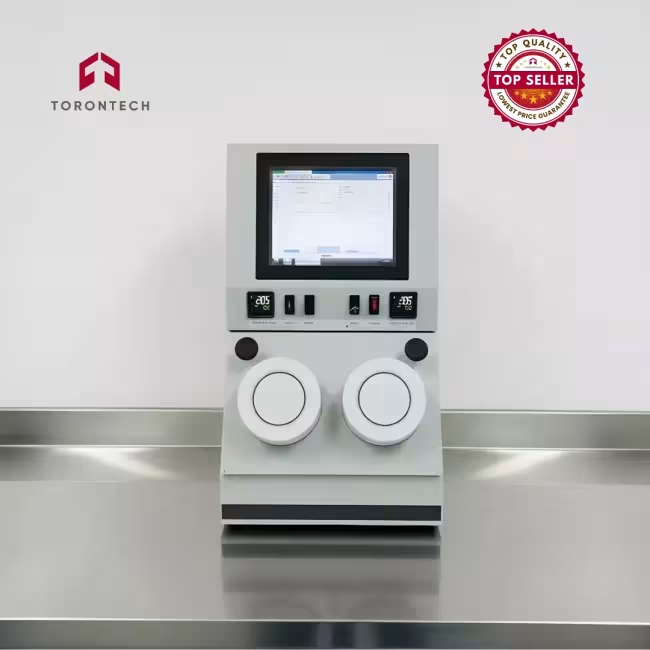
Metal Bath Oxidation Stability Tester
Metal Bath Oxidation Stability Tester TT-OXIDATE
Metal Bath Oxidation Stability Tester TT-OXIDATE conforms to ASTM D2272, ASTM D2112, ASTM D7098, and ASTM D4742.
Metal Bath Oxidation Stability Tester TT-OXIDATE determines oxidation stability by placing the test material in a stainless steel pressure chamber, where it is exposed to oxygen at a specific test temperature and pressure.
The primary application of the Metal Bath Oxidation Stability Tester TT-OXIDATE is to determine the oxidation stability of new and in-service lubricating oils and greases. Using a Rotating Pressure Vessel Oxidation Test (RPVOT) method, the instrument complies with several key standards:
- ASTM D2272 & ASTM D2112: For steam turbine and insulating oils.
- ASTM D4742: For gasoline engine oils.
- ASTM D7098: For lubricating greases.
The test accelerates the aging process by exposing the sample to oxygen under heat and pressure, measuring the time it takes for the oil or grease to oxidize. This provides a critical indication of the lubricant's remaining useful life.
Key Industries
- Power Generation: This is a cornerstone industry for this test. Power plants use the RPVOT method (ASTM D2272) to monitor the remaining oxidative life of their in-service steam turbine oils, which is essential for predictive maintenance and preventing costly, unplanned outages.
- Lubricant Manufacturing: Lubricant blenders use this instrument for quality control and to evaluate the performance of their antioxidant additive packages in a wide range of products, including engine oils and greases, to ensure they meet performance specifications.
- Third-Party Testing Laboratories (In-Service Oil Analysis): These commercial labs provide routine predictive maintenance services to various industries. The RPVOT test is a standard part of their in-service oil analysis programs, helping clients determine when to change their lubricants and avoid equipment failure.
- It can test new and in-service oils, lubricating oils used in gasoline engine service, and lubricating grease.
- The metal chamber reduces the unpleasant odor emitted by the medium oil during the test and eliminates potential dangers from long-duration tests.
- The instrument can automatically perform detection, calculation, and control, requiring no personnel supervision due to its high degree of automation. It features real-time communication with the main unit computer, with a simple and reliable connection method.
- The benchtop design is compact, and the metal bath does not require bath liquid.
- Simple ventilation eliminates the need for a fume hood, as exhaust gases and odors can be easily discharged through plastic pipes.
- It can conduct two tests simultaneously.
- The apparatus allows calibration of temperature and pressure to ensure accurate measurements.
- Utilizing a Windows microcomputer platform, it offers better scalability. It automatically records data and test results during testing, allowing for historical queries and comparisons. The pressure change curve can be printed, and the system can automatically detect the pressure inflection point and end the test.
- The software allows selection of all corresponding standards (ASTM D2272, ASTM D2112, ASTM D7098, and ASTM D4742).
1. Rated voltage: 220V ±10% (110V also available)
2. Heating power: 2500W
3. Pressure transmitter range: 0~1.6MPa, precision: ±0.2%
4. Temperature control range: Ambient to 200°C, continuously adjustable
- Commonly used temperature: 150°C
5. Temperature control precision: ±0.1°C
6. Rotating speed: 100 ±5 RPM
7. Angle between the oxygen bomb and the horizontal: 30°