Thermogravimetric Analyzer in the UAE for Batch-Level Compound Verification
A cable compound arrives at your plant with a supplier certificate and nothing else. A cladding core claims a specific mineral filler loading. Without your own mass loss data, you are trusting paperwork instead of measurement.
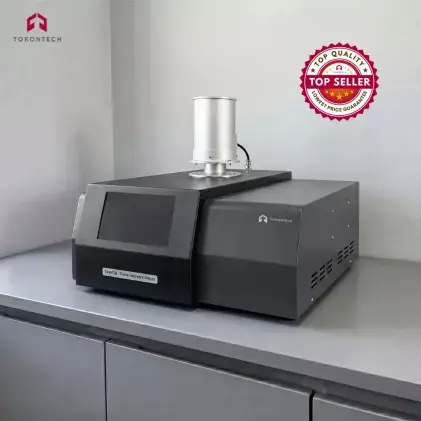
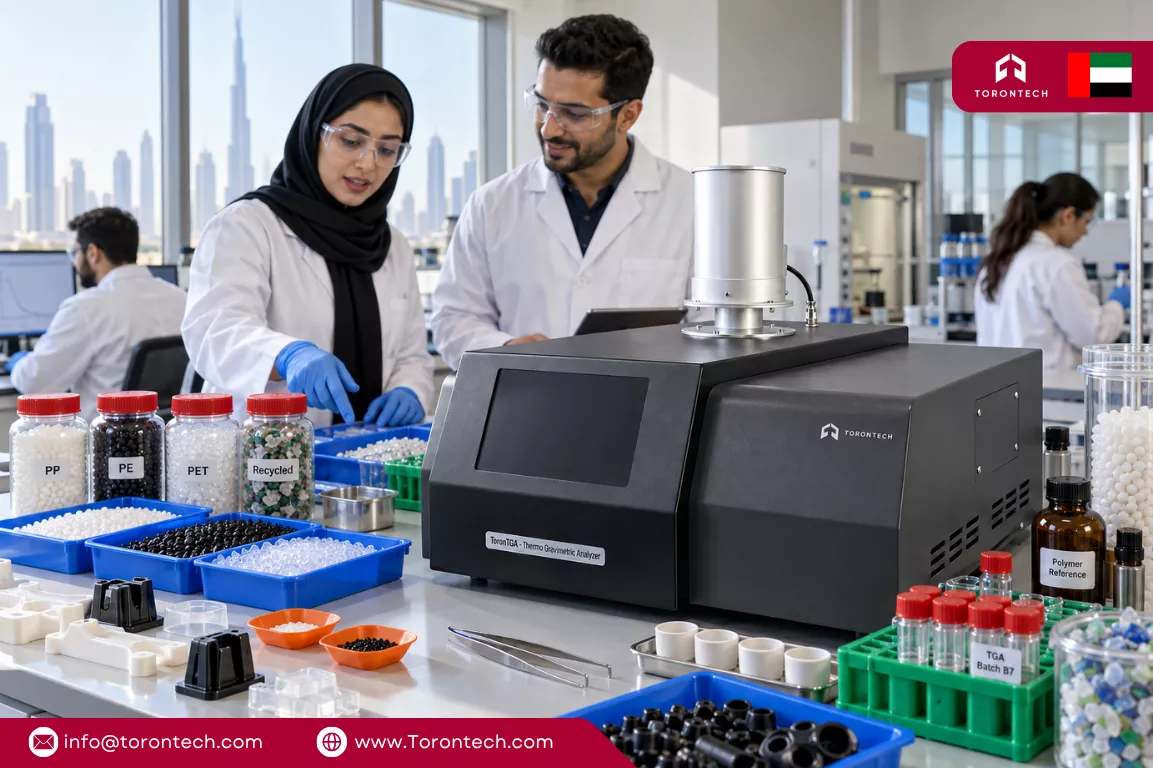
A thermogravimetric analyzer in the UAE settles those questions in a single run. Torontech supplies the ToronTGA thermogravimetric analyzer, which tracks sample mass during heating, isothermal holds, and cooling to expose composition and thermal stability.
Why UAE Manufacturers Track Mass Loss
Three national programs are pushing thermal analysis demand higher across the Emirates. Each one puts a different material under scrutiny, and each one rewards labs that verify composition in house.
Ruwais anchors the first. Borouge 4 lifts polyolefin capacity by 1.4 million tonnes and adds a cross-linkable polyethylene plant that doubles XLPE output to roughly 200,000 tonnes per year.
Compounders serving that stream check carbon black loading, filler content, and decomposition onset before extrusion. High-voltage cable jackets fail expensively, so incoming material data carries real weight.
Fire safety drives the second. The UAE Fire and Life Safety Code of Practice requires cladding panels to be tested and certified for combustibility, and it bars foamed plastic cores.
Facade fabricators and testing houses therefore use mass loss curves to confirm that each batch of mineral-filled core matches the formulation that earned certification.
Recycling drives the third. The UAE Circular Economy Policy 2021-2031, together with the nationwide single-use plastic ban that took effect in January 2026, pushes recyclate into more finished products.
Recyclate composition shifts from batch to batch. A short ash and volatiles run tells a converter whether those pellets will hold their properties through processing.
| UAE Sector | What the TGA Confirms |
|---|---|
| Polyolefin and cable compounding | Filler and carbon black loading, decomposition onset |
| Facade and cladding supply | Mineral core content, organic fraction |
| Plastics recycling and converting | Ash residue, moisture, volatile matter |
| Pharmaceutical and catalyst labs | Solvent loss, moisture, oxidation behavior |
What a Mass Loss Curve Tells You
The instrument holds a sample on a microbalance inside a furnace and records weight against temperature or time. Every step down in the curve marks a real physical event.
Moisture and residual solvent leave first. Polymer chains break down next. Whatever survives at the top of the ramp is inorganic filler, ash, or carbon residue.
The software plots TG and DTG curves together, so you read both the total loss and the rate of loss. That pairing separates decomposition steps that would otherwise overlap.
Choosing a Thermogravimetric Analyzer in the UAE
Furnace range decides most purchases. The ToronTGA series covers three levels, and each suits a different class of material:
- ToronTGA-101: room temperature to 1250 degrees C, suited to polymers, elastomers, and coatings
- ToronTGA-103: room temperature to 1350 degrees C, adding headroom for heavily filled compounds
- ToronTGA-105: room temperature to 1550 degrees C, reaching ceramics, catalysts, and inorganic residues, and shipping with a tablet press
All three share a microbalance with 0.01 mg sensitivity. The measuring range spans 0.01 mg to 3 g and expands to 30 g when larger specimens matter.
Heating rates run from 0.1 to 100 degrees C per minute under multi-stage PID control. As a result, you can program staged ramps and constant-temperature holds inside a single method.
Method scope deserves equal attention. ASTM E1131 and ISO 11358 describe compositional and general thermogravimetry, and UAE specifications frequently point to them. Ask Torontech to confirm the configuration against the method your lab reports against.
Specifying for Gulf Lab Conditions
Equipment that suits a European lab does not always land well in the Emirates. Power supply, gas handling, and ambient heat all shape how a thermal analyzer behaves day to day.
The ToronTGA ships as standard on AC 220V at 50 Hz, which matches UAE mains directly. A 110V build is also available, so multinational sites can standardize either way.
Purge gas handling matters just as much. An automatic two-way gas switch shortens transitions between inert and oxidative atmospheres, while a separate protective gas inlet shields the balance.
Heat management protects the data itself. Torontech splits the power supply, the heat dissipation unit, and the main system into separate modules, which limits thermal drift and vibration at the microbalance.
Operators then run methods from a 7 inch color touchscreen or from a connected computer. Results export over standard USB, and crucible options cover ceramic, aluminum, and lidded formats.
Talk to the Torontech Team in Dubai
UAE labs rarely buy thermal analysis equipment for a single material. A compounding lab today becomes a recycling QC line next year, and the instrument has to follow that shift.
Torontech ME FZE supports GCC customers from Meydan Grandstand, 6th Floor, Meydan Road, Nad Al Sheba, Dubai. The team advises on furnace range, crucible selection, and gas supply planning. Because the ToronTGA is customizable, the build can match your reporting needs rather than a catalog default.
Send your material list and target temperature range to me@torontech.com, or call +971 488 19252. You can also reach the Torontech team to request a quotation for a thermogravimetric analyzer in the UAE.