Thermogravimetric Analyzers for Canada's Materials and Battery Labs
A cathode powder carrying too much residual moisture can wreck cell performance. A polymer compound with the wrong filler ratio cracks in the field. For Canadian manufacturers, unverified material composition is an expensive risk.
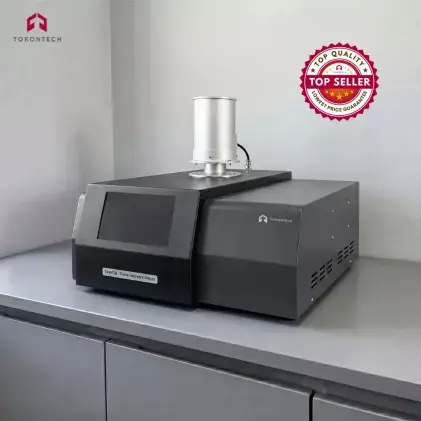
A thermogravimetric analyzer in Canada delivers the mass-loss data that confirms composition, moisture, and thermal stability. Torontech supplies the ToronTGA thermogravimetric analyzer with a microbalance sensitive to 0.01 mg and furnace temperatures up to 1,550°C.
Canada's Battery Supply Chain Raises the Stakes
Over the past five years, Canada has committed tens of billions of dollars to an electric vehicle battery supply chain. Plants such as NextStar Energy in Windsor and Volkswagen's PowerCo gigafactory in St. Thomas anchor the buildout.
Battery materials demand tight thermal characterization. Cathode active materials, graphite anodes, and separators undergo mass-loss testing for moisture, binder content, and decomposition temperature. A TGA confirms that each batch meets specification before it reaches a cell line.
Honda's $15 billion Ontario supply chain and the GM and POSCO cathode plant in Bécancour, Quebec extend the chain from raw mineral to finished cell. Each stage adds a material that a quality lab must verify before it moves downstream.
Upstream, the Critical Minerals Strategy backs lithium, graphite, and nickel processing with $3.8 billion in funding. The sector added roughly $40 billion to GDP in 2023. Mineral labs use thermogravimetry to measure loss on ignition, ash content, and purity.
Graphite illustrates the point. As the anode material in lithium-ion cells, it must hit strict purity targets. Projects like Nouveau Monde Graphite's Matawinie mine in Quebec rely on thermal testing to confirm grade.
Industries That Depend on Mass-Loss Data
A thermogravimetric analyzer in Canada rarely serves just one industry. Across manufacturing and research, the technique answers the same question in different forms: what is this material made of, and how does it behave under heat?
Canadian laboratories apply thermogravimetric analysis across several sectors:
| Sector | What TGA Measures | Canadian Driver |
|---|---|---|
| Plastics and polymers | Filler content, additives, decomposition | Domestic compounding and recycling |
| Pharmaceuticals | Moisture, solvent loss, ingredient stability | Generic and contract manufacturing |
| Mining and minerals | Loss on ignition, ash, graphite purity | Critical minerals processing |
| Rubber and composites | Carbon black, polymer fractions | Automotive and aerospace supply |
In pharmaceutical work, thermogravimetry measures water and solvent content and flags ingredient degradation. That data supports stability and shelf-life decisions across generic and contract manufacturing.
Polymer compounders read the same curve to verify filler and additive loading batch after batch. The instrument's automatic dual-gas switching runs a sample in inert nitrogen, then introduces air to burn off carbon in one program.
Aerospace suppliers near Montreal apply the same method to composite parts, measuring resin and fiber fractions before components enter an aircraft program.
Test Methods and Accreditation in Canadian Labs
Canadian quality programs lean on international test methods rather than a single national code. Common protocols include ASTM E1131 for compositional analysis, ASTM D6370 for rubber, ISO 11358 for polymer thermogravimetry, and ASTM D6375 for evaporation loss of lubricating oils.
Petroleum and lubricant labs in Alberta apply that last method to qualify base oils. Each protocol turns a controlled heating run into a documented, repeatable result.
Most accredited labs operate under ISO/IEC 17025, the standard for testing and calibration competence. In Canada, the Standards Council of Canada and the Canadian Association for Laboratory Accreditation grant this accreditation.
These programs require documented calibration and measurement traceable to SI units. The ToronTGA includes a reference standard material, and its multi-stage PID control holds temperature within ±0.1°C to support repeatable results.
Choosing a Thermogravimetric Analyzer in Canada
Selecting the right unit comes down to your samples, your temperature ceiling, and your throughput. The ToronTGA line offers three furnace ranges to match different workloads.
Key decision points for Canadian buyers:
- Temperature range: the ToronTGA-101 reaches 1,250°C, the -103 reaches 1,350°C, and the -105 reaches 1,550°C for high-temperature minerals and ceramics
- Balance sensitivity: 0.01 mg resolution across a 0.01 mg to 3 g range, expandable to 30 g for larger specimens
- Atmosphere control: a built-in flow meter with two-way gas switching handles inert and oxidative runs
- Stable microbalance: separate power and heat-dissipation modules reduce thermal and vibration noise
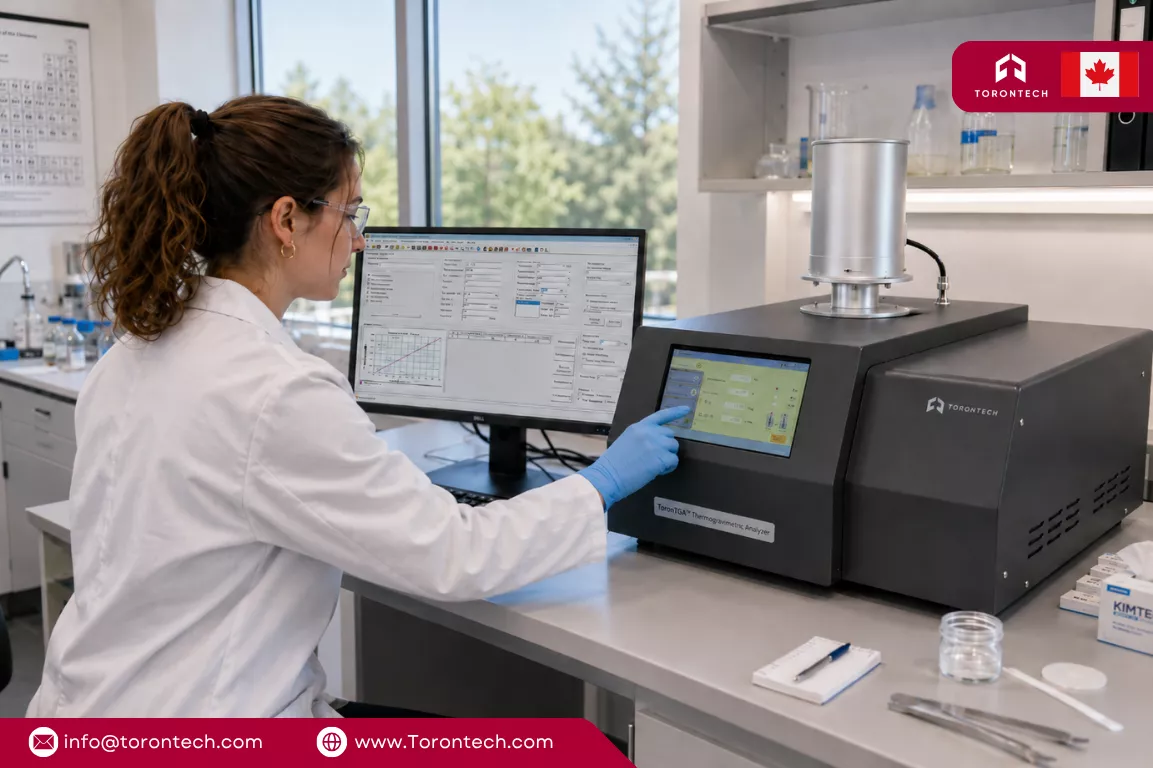
Operators run the instrument from a 7-inch color touchscreen or a connected computer. The software records TG and DTG curves and switches between mass and percentage views for faster interpretation.
A heating rate adjustable from 0.1 to 100°C/min lets one thermogravimetric analyzer serve quick screening and detailed kinetic studies alike.
Equip Your Canadian Lab With Confidence
Canada's push into batteries, critical minerals, and advanced polymers has raised the pressure on material testing. Reliable thermal data now sits at the center of quality control from Windsor to Bécancour.
Torontech configures each ToronTGA to the work in front of it, from crucible selection to atmosphere setup, and backs Canadian customers with local support and customizable options. From a single quality bench to a multi-instrument lab, the platform scales with your testing volume.
To match a thermogravimetric analyzer in Canada to your samples and standards, reach out to the Torontech team. Call the Toronto office at +1 416 368 2721 or email sales@torontech.com to begin.