Stop Ozone Cracking Before Rubber Ships: Ozone Test Chamber in UAE
A rubber seal that looks flawless on the line can develop hairline cracks within months of Gulf sun and outdoor service. For UAE manufacturers shipping seals, hoses, and cable jackets, ozone damage often surfaces after delivery, when it is costly to fix.
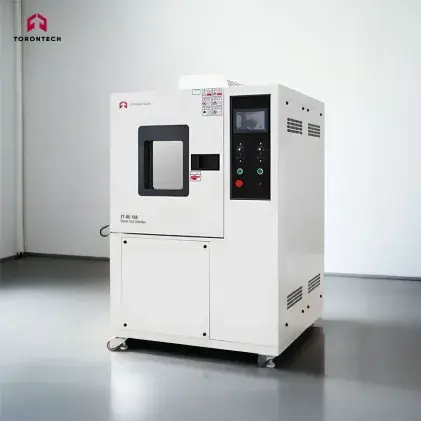
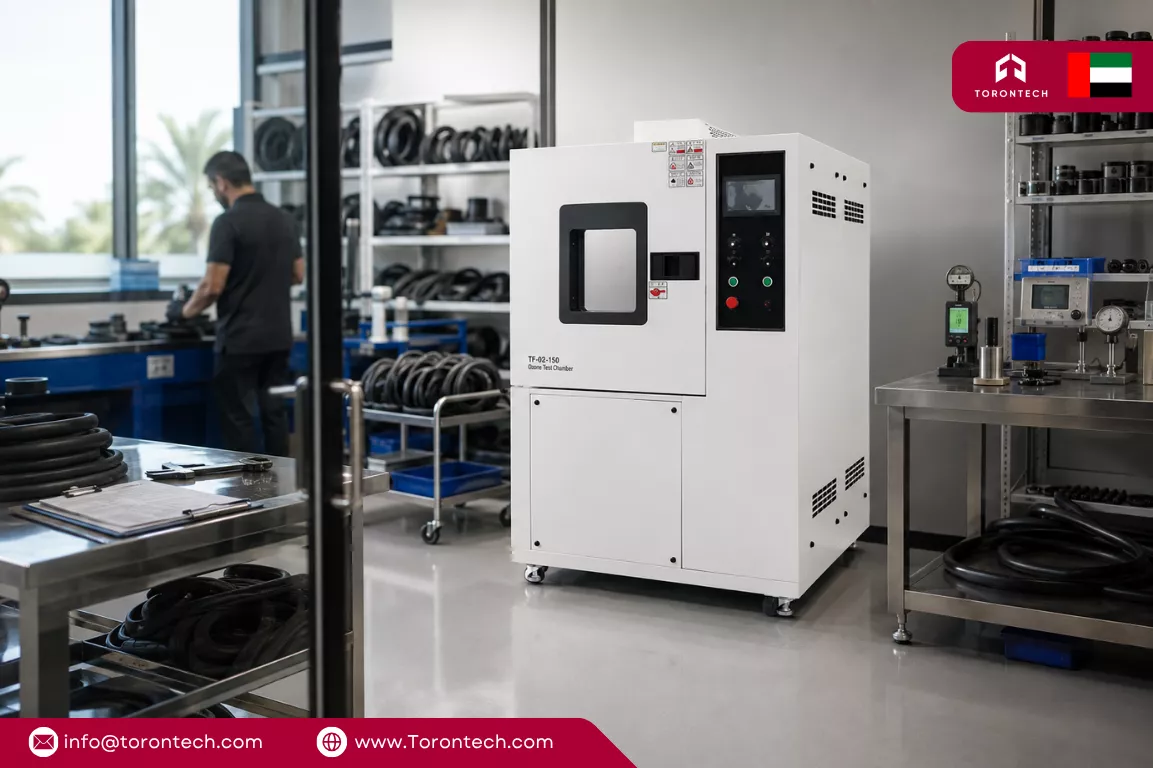
An ozone test chamber in UAE laboratories exposes those compounds to concentrated ozone before they leave the plant. Torontech supplies the TT-OC-150 ozone test chamber so quality teams catch cracking early, not in the field.
The Ozone Threat in the UAE's Operating Environment
Ozone attacks the carbon-carbon double bonds in unsaturated rubbers such as natural rubber, SBR, and neoprene. Under tensile strain, the broken chains open into surface cracks that run across the direction of stress.
The Emirates' intense sunlight, high ambient temperatures, and outdoor installations speed this reaction. Components rated for milder climates can fail early here. That makes documented ozone resistance a genuine procurement concern for regional buyers.
Concentrating ozone far above ambient levels compresses years of outdoor exposure into a test cycle of hours or days. Laboratories then compare antiozonant additives and compound batches under identical, repeatable conditions.
Where Emirati Industries Rely on Ozone Testing
Rubber and plastics rank among the priority sectors under the UAE's Operation 300bn industrial strategy. As local production scales, manufacturers need in-house data to qualify compounds and satisfy customer audits.
Several sectors depend on this testing before parts reach the market:
| Sector | Typical Components | What Ozone Testing Confirms |
|---|---|---|
| Wire and cable | Rubber jackets, insulation sheaths | Resistance to cracking in outdoor runs |
| Automotive parts | Seals, hoses, weatherstripping | Durability under hood and sun exposure |
| Oil and gas | O-rings, gaskets, valve seals | Sealing life in demanding service |
| Construction | Roofing membranes, expansion seals | Weathering performance on exposed roofs |
Cable makers such as Ducab operate materials laboratories in Dubai and Abu Dhabi. For rubber-sheathed and flexible cables, ozone exposure testing verifies that insulation survives years of outdoor duty without embrittlement.
Oil and gas operators across the UAE rely on elastomeric seals in pumps, valves, and wellhead equipment. Ozone-driven cracking in these parts risks leaks and downtime, so operators demand verified aging data from their suppliers.
Tire and molded rubber goods matter too. Retreaded tires fall under UAE technical regulation, so producers check sidewall and tread compounds before sale. Aerospace and defense programs in Abu Dhabi test O-rings and seals for the same assurance.
Standards and Conformity UAE Labs Work To
UAE laboratories run ozone aging evaluations to recognized methods, including ASTM D1149, ISO 1431-1, ISO 1431-3, and IEC 60811-403 for cable insulation. Each method fixes the ozone concentration, temperature, and strain a specimen must endure.
Regulation adds another layer. The Ministry of Industry and Advanced Technology, formerly ESMA, runs the Emirates Conformity Assessment Scheme. Regulated goods such as automotive parts and retreaded tires need a certificate of conformity before sale.
Reliable in-house ozone data helps manufacturers support these submissions and answer customer audits. The TT-OC-150 delivers the adjustable ozone concentration and controlled temperature these evaluations call for.
Many UAE laboratories also pursue ISO/IEC 17025 accreditation for their test methods. Equipment that holds ozone concentration and temperature steady across long cycles supports the traceable, repeatable results that accreditation bodies expect.
Choosing an Ozone Test Chamber in UAE
The chamber holds concentration using UV-based ozone detection and a gas stream that flows parallel to the specimen for even exposure. Consistent conditions keep results comparable between runs and across compound formulations.
Specifying an ozone test chamber in UAE facilities comes down to your materials, throughput, and the concentrations your test method requires. Key decision points guide the choice:
- Ozone concentration: an adjustable 0 to 1500 pphm range, with deviation held at or below ten percent, suits both standard and aggressive test profiles.
- Temperature control: operation from room temperature to +60°C separates thermal aging from ozone-specific cracking.
- Specimen visibility: the four-layer tempered glass window with an anti-fog heating wire lets technicians track cracking without opening the chamber.
- Build and components: a welded SUS304 stainless interior with Schneider Electric, Carlo Gavazzi, and Mitsubishi parts supports continuous laboratory use.
Review the full TT-OC-150 specification to match chamber capacity and window size to your workload. The team can also advise on tension jigs and specimen racks for the parts you test most.
Bring Ozone Testing In-House Across the GCC
Across the Emirates, rubber and cable producers face the same pressure: prove ozone resistance with real data, not assumptions. Concentrated, repeatable exposure testing turns months of uncertainty into a documented result. For producers exporting across the GCC and Africa, that record shortens qualification and builds buyer confidence.
Torontech supports the region through Torontech ME FZE, its GCC and Africa base in Dubai. The team helps labs specify ozone range, chamber capacity, and observation options suited to local materials and testing volumes.
To configure a TT-OC-150 for your application, reach out to the Torontech team. You can also contact Torontech ME FZE directly at me@torontech.com or +971 488 19252, Meydan Grandstand, Dubai.