ASTM D1003 Haze Meter in USA for Film and Glazing QC
A customer rejects a pallet of film because it looks cloudy. Your operator held a sheet up to the light last week and passed it. Without a number on the certificate, that argument has no winner.
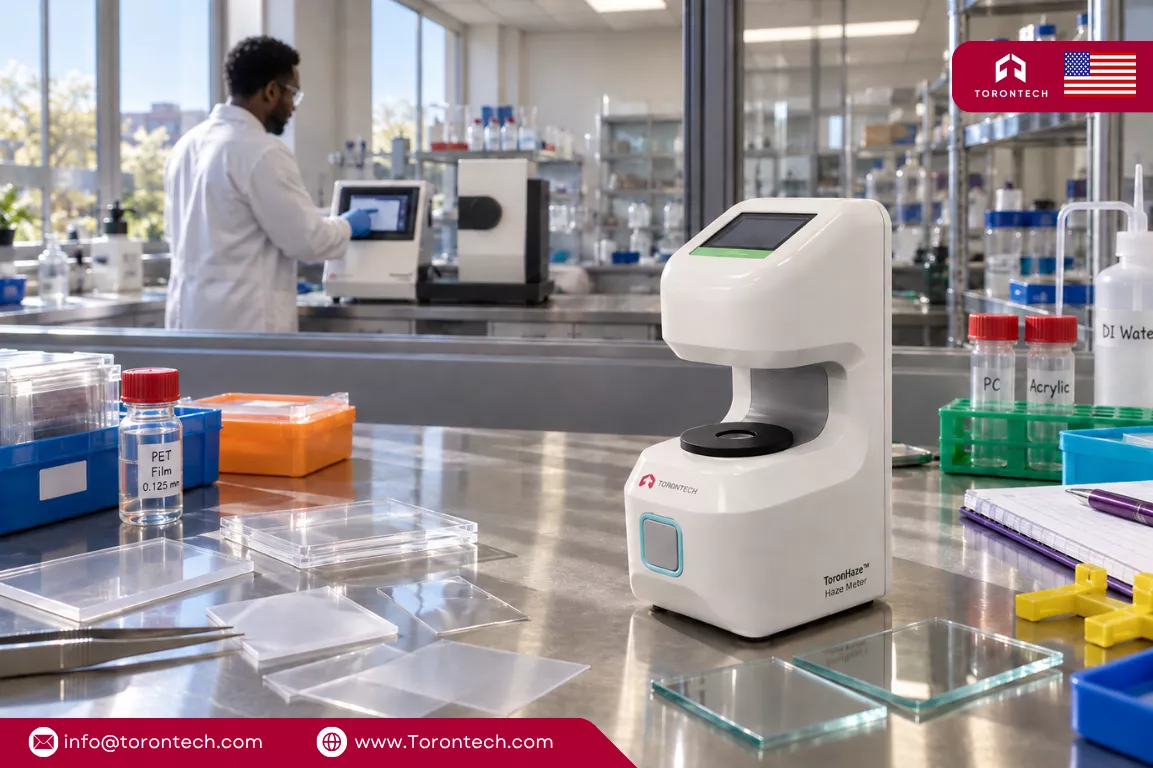
A haze meter in USA production settings replaces the judgment call with a repeatable percentage. Torontech supplies ASTM D1003 instruments that report haze and total transmittance in seconds, either on the bench or beside the line.
Federal Rules That Put a Number on Optical Quality
American glazing and window film manufacturers cannot treat clarity as a matter of taste. FMVSS No. 205 governs glazing materials on new motor vehicles, and NHTSA enforces it.
The federal standard incorporates ANSI/SAE Z26.1, which requires at least 70 percent luminous transmittance for glazing in areas requisite for driving visibility. Z26.1 also uses a hazemeter in its abrasion resistance test, where rising haze signals surface damage.
State law then adds a second layer. States regulate how darkly tinted glazing may be on vehicles operating in their jurisdictions, so film converters check transmittance against several state limits before a roll ships.
Torontech instruments do not carry FMVSS or Z26.1 qualification. They measure to ASTM D1003 and ASTM D1044, the methods American labs use to generate the underlying haze and transmittance data.
ASTM D1003 remains the reference procedure across most US quality assurance work. It defines luminous transmittance and wide-angle light scattering for transparent plastics, and it treats any material above 30 percent haze as diffusing.
Domestic Manufacturing Is Widening the Customer List
Solar changed who buys optical test equipment. SEIA and Wood Mackenzie reported 65.5 GW of US module manufacturing capacity online, with output reaching roughly 70 percent of 2025 installations.
That build-out followed federal manufacturing incentives, including the Section 45X advanced manufacturing production credit. SEIA counts 146 new solar and storage manufacturing facilities in production since 2022, with more under construction.
Every module stacks encapsulant, front glass, and backsheet. Each layer carries a transmittance target, because light scattered or absorbed before it reaches the cell never returns as generated power.
Flexible packaging converters answer to a different pressure. Retail buyers judge shelf appeal through the film, so haze drift from a resin lot change or die buildup arrives as a complaint rather than as scrap.
Display and touch panel work forms a third stream. Cover lenses, optical films, and hard coats all need clarity data before assembly, and most of that testing happens at incoming inspection.
Buying a Haze Meter in USA? Start With the Test Method
Two procedures dominate specification sheets. ASTM D1003 runs uncompensated and remains the default across American QA labs. ISO 13468 applies the compensation method, and exporters generally need results under both.
Match the instrument to the method your customers demand, then to your sample geometry:
| Your Requirement | Model Family | What You Get |
|---|---|---|
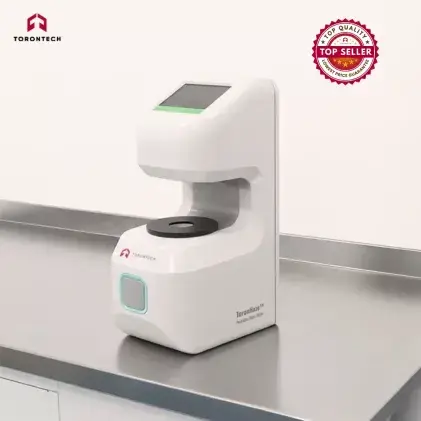
| ASTM checks at the line | ToronHaze TTH-10 | Single 21 mm aperture, 1.13 kg, USB power |
| ASTM plus ISO, mixed samples | ToronHaze TTH-12 or TTH-13 | Two or three apertures, lithium battery |
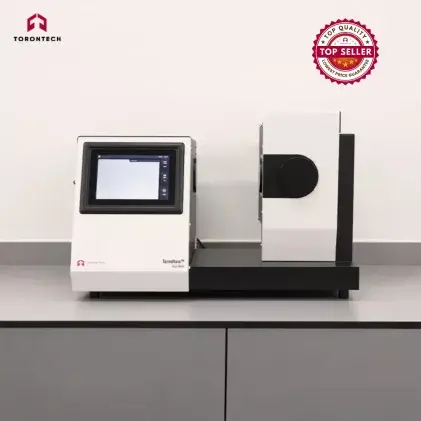
| Benchtop haze and transmittance | ToronHaze-09, -100, -110 | Repeatability to 0.05, 5 or 7 inch display |
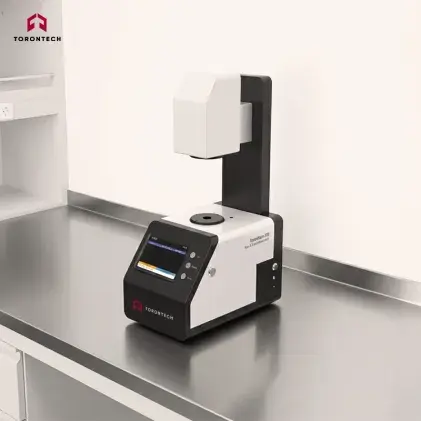
| Haze with color and yellowness | ToronHaze-700 or -720 | Spectral transmittance, CIE Lab, YI, clarity |
Sample size drives the rest of the decision. The benchtop haze and transmittance meters accept parts up to 145 mm thick through an open measuring area, while the portable units handle material to 40 mm.
Details That Decide the Purchase Order
Specifying a haze meter in USA facilities eventually comes down to logistics rather than optics. Procurement teams raise the same practical questions on every quote, and the specifications below answer most of them:
- Line voltage: benchtop models ship at 220V, and 110V is available, so confirm the configuration at order
- Documentation: portable units include a calibration certificate and qualified certificate as standard
- Throughput: measurement takes about three seconds, with no warm-up after calibration
- Light sources: CIE-A, CIE-C, and CIE-D65 cover the illuminants different standards call for
- Data handling: Haze QC software ships with the benchtop instruments for reporting and trend tracking
Field auditing is where the portable ToronHaze TTH-Series earns its place. At 1.25 kg with a carrying case, it travels to a converter, a job site, or a supplier audit without a bench.
Talk to Torontech North America About Your Application
Optical clarity failures rarely announce themselves early. They surface as a returned shipment, a warranty claim, or a customer who quietly moves volume to another supplier.
Torontech North America LLC works with plants and laboratories across the United States from Miami, so quoting, documentation, and after-sales support stay in your time zone. Our team helps match aperture size, repeatability, and parameter set to the standards your buyers actually audit against.
Tell us which methods your certificates reference and what you measure most often. Then reach out to the Torontech team at +1 866 383 7919 or info@torontech.com, and we will configure the right instrument for your samples.