Differential Scanning Calorimeters for Mexico's Export Manufacturers
A resin lot that shifts its melting point by a few degrees can jam an injection line and fail an OEM audit. A composite prepreg that cures short leaves a laminate weak. For plants shipping into US supply chains, unverified thermal behavior is a costly gamble.
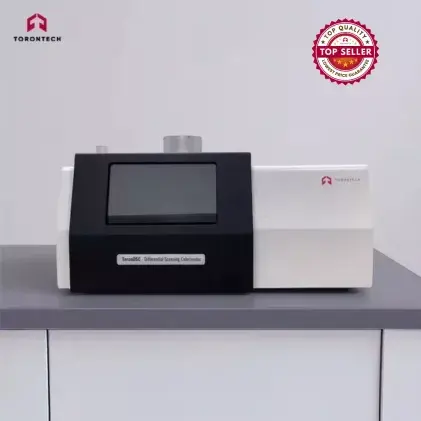
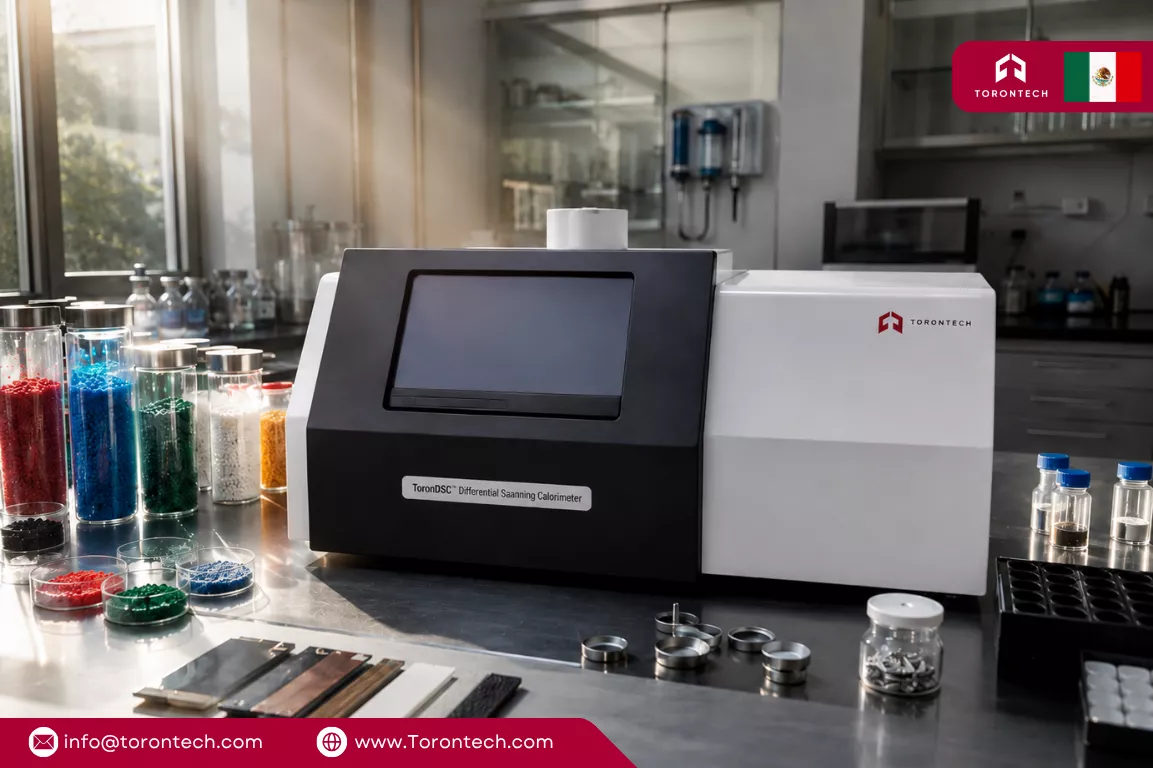
That is why a differential scanning calorimeter in Mexico now sits on the quality-control bench as standard equipment. The ToronDSC differential scanning calorimeter measures heat flow and specific heat, giving Mexican labs the transition data their customers demand.
Industries Driving Thermal Analysis Demand in Mexico
Nearshoring has turned Mexico into a manufacturing hub, and every downstream sector must prove how its materials behave under heat. Thermal analysis anchors quality control across several fast-growing industries.
The plastics sector produces over $20 billion each year, with roughly $12 billion in exports tracked by ANIPAC. Processors verify glass transition, crystallization, and melting behavior before resin reaches automotive and packaging lines.
Automotive plants add pressure. With auto-parts output near $127 billion and lightweighting pushing polymers toward a third of vehicle materials, suppliers confirm each grade's thermal history before molding.
Aerospace raises the bar further. The Querétaro Aerocluster, home to Safran, Airbus, and GE programs, depends on cure and out-life data for the prepregs feeding the A321XLR and LEAP engine ramps.
Pharmaceutical makers registering with COFEPRIS run DSC to study polymorphism, purity, and excipient compatibility through formulation and stability work.
Medical device manufacturers extend the same demand. Mexico hosts roughly 2,500 device firms, concentrated in Baja California, where producers validate polymer components and packaging films for thermal stability before export.
| Industry | Typical DSC Measurement |
|---|---|
| Plastics and packaging | Glass transition, melting, crystallization |
| Automotive polymers | Thermal history, processing window |
| Aerospace composites | Cure reaction, crosslink density |
| Pharmaceuticals | Polymorphism, purity, oxidation onset |
What a Differential Scanning Calorimeter Measures
DSC compares the heat flow into a sample against a reference as both follow a controlled temperature program. Peaks and baseline shifts reveal endothermic and exothermic events and quantify the enthalpy behind each transition.
From that curve, a lab reads glass transition temperature, cold crystallization, melting, oxidation induction time, and curing reactions. Those markers tell engineers whether a material will hold up in service or on the line.
The ToronDSC line supports this work with capabilities suited to both daily QC and research:
- Metal furnace with indirect conduction heating for a stable baseline
- Dual atmosphere flow system for inert or oxidative testing
- Heating and cooling rates from 0.1 to 100°C per minute
- DSC accuracy of 0.01mW, with resolution to 0.001°C on the 300 series
- Programmable multi-stage control through a 7-inch touchscreen
This balance of a stable baseline and flexible atmosphere control fits Mexico's mix of polymer, composite, and pharmaceutical testing.
Standards and Accreditation for Mexican Laboratories
Mexican labs operate within a layered framework. Voluntary NMX standards often mirror ISO methods, while the Entidad Mexicana de Acreditación (EMA) accredits laboratories against ISO/IEC 17025 for demonstrated competence and traceable results.
For thermal analysis, technicians usually follow international test methods rather than a single national norm. Common references include:
- ASTM D3418 and ISO 11357 for transition temperatures of plastics
- ASTM E1356 for glass transition assignment
- ASTM D3895 for oxidation induction time of polyolefins
- FEUM and pharmacopeial methods for pharmaceutical thermal studies
These methods define how a test runs; the instrument supplies the heat-flow measurement behind them. Labs pursuing EMA accreditation need equipment with documented calibration and repeatable performance to defend their results under audit.
Trade programs reinforce this discipline. USMCA rules of origin and IMMEX duty relief only reward plants that can back their material claims with data, which keeps thermal testing central to export operations.
How to Choose a Differential Scanning Calorimeter in Mexico
Selecting a differential scanning calorimeter in Mexico depends on your materials and the temperature window your tests require. Cooling capability is usually the deciding factor.
- Ambient and above: the ToronDSC-100A covers room temperature to 600°C for routine polymer and QC work
- Sub-zero transitions: the ToronDSC-300C reaches -40°C for elastomers and low-Tg materials
- Deep cryogenic range: the ToronDSC-300L extends to -170°C for advanced research and specialty polymers
Testing volume, atmosphere requirements, and software integration round out the decision. A lab running mixed automotive and aerospace samples benefits from the wider range and finer resolution of the 300 series. Buyers preparing for EMA accreditation should also weigh calibration documentation and long-term repeatability alongside the raw specifications.
Equip Your Lab for Mexico's Manufacturing Demands
Mexico's export momentum rewards suppliers who can document material performance on demand. From Bajío polymer plants to the Querétaro composites cluster, thermal data has moved from nice-to-have to contractual requirement.
Torontech configures each ToronDSC system around your material classes, temperature range, and throughput, then supports installation and calibration across the Americas. Our team helps match furnace range and atmosphere options to the methods your customers expect.
To specify the right ToronDSC differential scanning calorimeter for your application, reach out to the Torontech team or email sales@torontech.com to discuss configuration and lead times.