How to Choose a LA Abrasion Machine: Key Criteria
Ready to give your materials laboratory a competitive edge on major infrastructure tenders? We believe dependable aggregate testing is your best asset for proving long-term pavement quality.
High-grade drum hardware guarantees smooth project approvals and repeatable accuracy across every single run. This los angeles abrasion machine buying guide provides the essential technical benchmarks you need to make a winning capital investment.
Key Takeaways
- Standard Alignment: Apparatus selection must match your contract specifications: ASTM C131 for aggregates under 37.5 mm or ASTM C535 for 19 mm to 75 mm stone and ballast. Both methods specify the same drum geometry, but C535 doubles the cycle duration to 1,000 revolutions.
- Heavy-Duty Build: Current ASTM C131 and EN 1097-2 standards demand a cylinder wall thickness of at least 12mm, internal dimensions of 710mm×510mm(±5mm), and an interior shelf rigid enough to resist deformation.
- Consistent Spin Rate: The drive assembly must maintain a steady rotation speed between 31 to 33 RPM under full sample load.
- Workplace Safety: Plan for a 340kg machine securely bolted to a level concrete floor, an optional 110kg acoustic cabinet to meet workplace noise limits, and power specified at order time (standard 220V 50Hz/60Hz, or 110V optional configuration).
- Complete Testing Package: Budgeting requires securing essential companion equipment, including drying ovens, high-capacity precision balances, and analytical sieves.
Testing Standards and Aggregate Gradations
Selecting an abrasion testing apparatus requires matching the internal drum geometry and operating parameters to the exact aggregate gradations specified in your project contracts.
In our view, purchasing equipment that complies with only a single regional protocol restricts operational scope. We believe materials laboratories gain much better value from hardware capable of supporting both North American and international test frameworks.
Small Aggregates: ASTM C131 and AASHTO T 96
ASTM C131 specifies testing protocols for aggregate particles with a nominal top size under 37.5 mm (1.5 in). This test represents the baseline benchmark for asphalt paving mixtures, structural concrete, and road surface courses.
In the United States, state transportation agencies evaluate materials either through AASHTO T 96 or state-specific adaptations such as California Test 211 and Texas Test Method Tex-410-A, both of which align with ASTM C131 apparatus specifications. In Canada, provincial highway agencies like the Ministry of Transportation Ontario (under OPSS specifications) enforce equivalent testing to approve coarse aggregates for public roadways.
In many North American jurisdictions, agencies now pair the Los Angeles test with the Micro-Deval test (ASTM D6928 / AASHTO T 327; MTO LS-618 in Ontario). It is critical to recognize that these are separate testing mechanisms: the Los Angeles machine evaluates resistance to mechanical impact and dry fragmentation, whereas the Micro-Deval apparatus evaluates wet abrasion and slaking resistance in water. Because an LA abrasion machine cannot perform wet abrasion testing, laboratories bidding on contracts that cite both standards must budget for two distinct pieces of hardware.
Large Aggregates: ASTM C535 and Rail Ballast
When project specifications call for coarse aggregate fractions between 19 mm and 75 mm, testing shifts to ASTM C535. Under standard testing rules, ASTM C535 uses the exact same Los Angeles machine geometry defined in ASTM C131. However, the operating parameters differ: it tests a larger 10,000 gram sample over 1,000 revolutions instead of 500. This doubles the continuous operational runtime and places significantly higher cumulative wear on the internal shelf and rolled steel drum walls.
International Standards: EN 1097-2 Harmonization
For testing laboratories managing overseas infrastructure contracts, equipment must satisfy European specifications. EN 1097-2 (and BS EN 1097-2) defines resistance to fragmentation for construction aggregates. Regional variants with specific mechanical parameters include NF P18-573, UNE 83 114, UNI 8520-19, and CNR NO. 34.
Test Mechanics and Degradation Limits
Under ASTM C131, aggregate test batches (typically 5,000 g) are separated into Gradings A, B, C, or D based on particle size distribution. Standards require an abrasive charge count specifically matched to the selected aggregate grading, requiring 12 spheres for Grading A, 11 for Grading B, 8 for Grading C, and 6 for Grading D. Laboratories must maintain the appropriate 12-piece inventory from which the required operational charge is selected:
- Standard ASTM and CNR Inventory: 12 abrasive charges comprising 1.13/16” (7 pcs) and 1.7/8” (5 pcs) (Part 42-5305/01A1).
- EN 1097-2 Inventory: 12 abrasive charges measuring 1.7/8” (Part 42-5305/01A2).
Standard quality assurance testing requires exactly 500 drum revolutions for ASTM C131 and EN 1097-2, though specialized research studies on sediment rounding have experimentally evaluated extended cycles up to 1,500 revolutions.
In our view, relying on manual timing or external tally devices introduces unnecessary risk of human error during certified testing. We consider an automated digital counter to be an essential baseline feature (not an optional luxury) because it presets cycle counts, displays live revolutions, and shuts down the drive system immediately upon test completion.
Once tumbling concludes, aggregate breakdown is calculated through this mass-balance equation:
Loss (%) = [(M1 - M2) / M1] * 100
Where M1 represents the initial oven-dry sample mass before testing, and M2 is the final oven-dry mass retained on the designated analytical sieve, dried to constant mass after standard dry sieving or mandatory referee washing.
Laboratories also use an intermediate 100-revolution check to evaluate material uniformity. Under ASTM C131, aggregate of uniform hardness should produce a 100-revolution loss that does not exceed approximately 0.20 of the final 500-revolution loss.
To perform this check, the technician presets the digital counter to 100 revolutions, discharges the drum into the unloading tray, dry-sieves the material without washing, records the mass, and reloads the entire sample (including all fracture dust) back into the drum for the remaining 400 revolutions. Having a digital counter that can be quickly preset and automatically stops rotation at exact intermediate targets makes this multi-step verification straightforward.
Cooperative testing historically confirmed that uniform apparatus dimensions guarantee reliable checks against established performance limits, such as the 40% wear threshold for surface treatments.
On real-world commercial contracts across North America, agencies enforce strict caps depending on the structural application:
- Airfield Pavements: Under Federal Aviation Administration specifications, coarse aggregates for surface courses such as Item P-401 asphalt and Item P-501 concrete are capped at a maximum 40% wear loss, whereas underlying aggregate base courses such as Item P-209 permit higher degradation limits up to 45%.
- Railroad Track Ballast: Under American Railway Engineering and Maintenance-of-Way Association standards (AREMA Chapter 1, Table 1-2-1), recommended maximum wear limits evaluated under ASTM C535 depend strictly on parent rock petrology: 25% for traprock, 30% for quartzite and carbonate rocks (limestone and dolomite), and 35% for granite, though individual Class I freight railroads frequently enforce tighter caps on high-tonnage corridors.
Structural Durability and Maintenance Criteria
Early multi-laboratory evaluations proved that when machine measurements remain strictly uniform, variations between separate labs average a modest 5.6%, with irregular results stemming almost entirely from deviations in abrasive charge weight and distorted shelves.
From an engineering perspective, we view the interior shelf as the mechanical focal point of the entire machine. Because shelf angles govern how aggregate drops and impacts the steel shell, routine shelf and drum checkups are a non-negotiable quality safeguard.
| Component | Inspection Parameter & Standard Benchmark | Maintenance Action |
|---|---|---|
| Internal Steel Shelf | Straightness, thickness, and drop angle geometry | Inspect regularly for bending, thinning, or warps caused by charge impacts |
| Cylindrical Drum Wall | Standard minimum wall thickness of at least 12mm; internal dimensions conforming to 710mm×510mm(±5mm) | Inspect interior surfaces for thinning below the 12mm baseline, deep gouges, or structural deformation |
| Rotational Drive System | Electric motor and speed reducer maintaining 31 to 33 RPM, satisfying both the 30 to 33 RPM requirement in ASTM C131 and the narrower 31 to 33 RPM tolerance mandated by EN 1097-2 | Verify spin rate under full material load to ensure consistent kinetic input across both standard frameworks |
| Steel Abrasive Charges | Individual sphere diameter and mass across 12-piece sets | Weigh charges on a regular schedule; discard spheres that drop below mass limits |
Facility Planning and Workplace Safety
A standard machine occupies an overall floor footprint of 942x959x948mm and places a substantial 340kg mass on your laboratory floor. Because tumbling heavy steel spheres and angular rock creates continuous rotational inertia and pounding vibrations, the unit must be bolted directly to a level, reinforced concrete floor. Providing adequate clearance around the apparatus also allows technicians to handle heavy aggregate containers and position collection pans comfortably.
While an individual 15-minute test run generates short-term noise exceeding 85 dBA, cumulative daily testing can push facility noise above the 8-hour time-weighted average action level of 85 dBA enforced by OSHA (29 CFR 1910.95) and provincial occupational health and safety regulations across Canada. Operating an open, unshielded drum in an indoor laboratory elevates ambient noise levels and can trigger mandatory hearing conservation compliance programs.
In our view, outfitting the apparatus with a heavy-duty 110kg sound-dampening cabinet (Part 42-5305/01A3) alongside the standard protect cover (Part 42-5305/01A5) represents the most effective engineering control to suppress operational sound directly at the source. For facility hookups, units operate on AC220V 50HZ/60HZ 750W, with 110V options available for standard North American low-voltage circuits.
Required Ancillary Testing Equipment
Because running a standard abrasion test involves drying aggregate, tumbling it, separating crushed fines, and washing the remaining fraction, equipment planning cannot stop at the drum alone. In our view, overlooking these supporting tools during initial procurement is a frequent planning misstep that creates operational bottlenecks. We recommend budgeting for the complete testing cell upfront:
- Analytical Test Sieves: A 1.70 mm (No. 12) wire screen for ASTM C131 or a 1.6 mm screen for EN 1097-2 to separate broken fines from retained aggregate particles.
- Thermostatically Controlled Drying Oven: A laboratory heating cabinet that maintains a steady 110 +/- 5 degrees Celsius for dry sample preparation and post-wash drying.
- Precision Balance: A heavy-duty bench balance reading cleanly down to 1 g, with sufficient capacity for samples weighing at least 5,000 g for ASTM C131 testing, or at least 10,000 g (10 kg) if your laboratory also processes ASTM C535 aggregate samples.
- Specimen Unloading Tray: A purpose-built steel collection tray (Part 42-5305/01A4) that fits beneath the drum opening to catch aggregate, keeping samples intact and containing airborne dust.
Torontech Solution: ToronLA™ C131
Academic studies define the mechanics of impact wear, but commercial operations require dependable, heavy-duty production machinery. We believe that testing laboratories should never have to choose between strict standard compliance and capital budget limits. That philosophy guides our focus on delivering cost-effective testing equipment built to endure continuous testing cycles in quality control facilities across North America and worldwide.
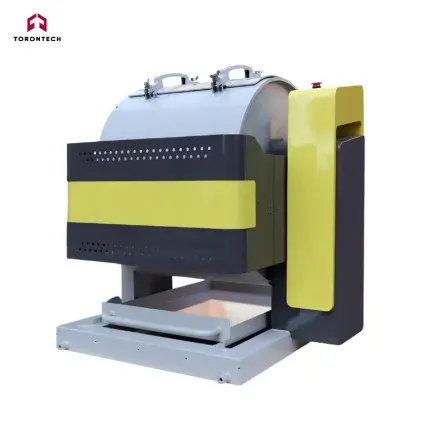
Our ToronLA™ C131 Los Angeles Abrasion Tester delivers consistent test precision and full compliance with industry standards:
- All-Around Standard Match: Fully compliant with ASTM C131, EN 1097-2, NF P18-573, UNE 83 114, UNI 8520-19, and CNR NO. 34.
- Heavy Steel Fabrication: Built with a 12mm thick rolled steel drum, a rigid structural base frame, and a protective powder-coated exterior finish.
- Controlled Mechanical Drive: Driven by a steady 750W motor paired with a speed reducer maintaining a consistent 31 to 33 RPM.
- Automated Cycle Management: Features a digital revolution counter to preset cycle targets and automatically stop rotation upon completion.
- Complete Modular Accessories: Integrates with standard ASTM/CNR charges (Part 42-5305/01A1), EN charges (Part 42-5305/01A2), a specimen unloading steel tray (Part 42-5305/01A4), a protect cover (Part 42-5305/01A5), and an optional 110kg noise reduction and safety cabinet (Part 42-5305/01A3).
Equip Your Lab for Success with Torontech Hardware
Outfitting your testing facility with cost-effective, code-compliant aggregate equipment safeguards testing accuracy and keeps commercial approvals on schedule. Contact our engineering team today to review technical specifications, discuss laboratory layout requirements, or request a quotation for the ToronLA™ C131.
References (Click to expand)
- Kuzmanić, T., Lebar, K., & Mikoš, M. (2023). Comparison of Different-Energy-Level Abrasion in Los Angeles and Micro-Deval Apparatuses Using Mass Loss and Rounding of Sediment Particles. Applied Sciences.
- Woolf, D. O., & Crandell, J. (1937). RESULTS OF COOPERATIVE TESTS USING THE LOS ANGELES ABRASION MACHINE.
- Woolf, D. O., & Runner, D. (1935). THE LOS ANGELES ABRASION MACHINE FOR DETERMINING THE QUALITY OF COARSE AGGREGATE.