ASTM D2699 Octane Testing: RON MON Engine Setup Guide
Distributing off-spec fuel is an expensive disaster that triggers punishing refinery re-blends and steep regulatory fines. Evaluating knock resistance against certified reference mixtures remains the definitive benchmark that keeps commercial supply chains honest.
At Torontech, we supply cost-effective products in our Petrol & Gasoline Testing Equipment lineup to deliver certified accuracy across both RON and MON methods without bloated capital budgets. Below, we outline what is needed to run ASTM D2699 octane testing so your testing facility gets set up right from day one.
Key Takeaways
- North American rules demand dual-method testing under US FTC (16 CFR Part 306) and Canadian CGSB 3.5 guidelines to stamp the legal Anti-Knock Index (AKI) on retail dispensers.
- A complete setup calls for an authorized variable-compression unit, binary reference fuels (PRFs), toluene verification blends (TSFs), and rock-solid air conditioning gear.
- Under the RON method (ASTM D2699), our TT-300R handles fuel cocktails packing up to 25% v/v ethanol, with one sample tank capable of accepting an external cooling jacket to prevent light fractions in volatile winter blends from boiling off.
- Electronic displacement gauges and rotary encoders take over for old-school mechanical dial gauges, taking human eye strain out of the equation and linking straight to laboratory LIMS.
- Scrubbing out combustion chamber deposits (carbon blasting) and pouring single-grade crankcase oil (SAE 30) are non-negotiable to maintain calibration stability within standard ASTM tolerance bands.
What Is Needed to Run ASTM D2699 Octane Testing
Nailing down certified Research Octane Number values under ASTM D2699 demands an entire working ecosystem: an approved variable-squeeze engine, dedicated detonation electronics, certified reference chemicals, and tightly regulated room infrastructure.
1. Engine Hardware and Knock Detection Gear
Historically, official guidelines laid out a Cooperative Fuel Research (CFR) single-cylinder setup sporting a variable-compression cylinder head.
In legacy CFR test benches, spotting knock meant bolting a D-1 magnetostrictive detonation pickup into the cylinder head and wiring it to an analog Model 501-C detonation meter. Laboratory researchers frequently examine high-frequency piezoelectric crystal sensors to track acoustic wave spikes, but official referee sign-offs still demand standard knock-meter behavior, plain and simple.
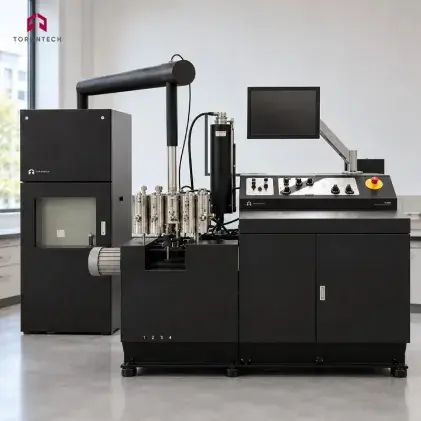
From an engineering angle, we think leaning on prehistoric analog needles and spinning manual micrometer barrels invites avoidable reading mistakes. Our TT-300R replaces those legacy manual CFR workflows with a solid DW iron block and digital sensing architecture, covered in detail in the specifications section below.
To keep daily testing moving without friction, the standard equipment package arrives with:
- Main Unit test engine platform (1 set)
- Specialized fuel test cup (1 piece)
- Ignition trigger igniter (1 piece)
- Dedicated micro printer (1 set)
- Electrical circuit protection fuse Ф5×20 10A (1 piece)
2. Reference Fuels and Calibration Standards
Running this test means stacking an unknown fuel straight up against pure chemical yardsticks. The whole scale rests on binary mixes of Primary Reference Fuels: ultra-pure 2,2,4-trimethylpentane (iso-octane, tagged at an even 100 ON) and clean n-heptane (pegged at 0 ON). The exact percentage of iso-octane in the twin blend that matches your fuel gives you the certified grade across that classic 0 to 100 scale.
To satisfy auditing requirements, your crew must also keep Toluene Standardization Fuels (TSFs) ready on the shelf. Blended up from toluene, n-heptane, and iso-octane, TSFs are legally required to verify that the combustion bowl and knock electronics behave properly across every squeeze ratio. For high-octane fuels exceeding 100 octane, standard ASTM D2699 referee procedures specify blending dilute tetraethyl lead (TEL) into iso-octane.
We view modern unleaded TSF recipes as a massive step forward for testing safety, proving in published research that clean blends can verify numbers all the way up to 113 RON without handling hazardous lead compounds.
3. Fuel Handling, Biofuel Blends, and Vapor Control
Pinpointing the octane value means sweeping fuel-air mixtures until the knock needle hits its peak intensity. Tracking that peak requires multi-bowl fuel plumbing so technicians can shift between the raw sample and reference blends without dumping lines between runs. The Torontech TT-300R packs four separate fuel bowls to make managing test liquids completely seamless, lining up with current North American fuel realities.
Across the US and Canada, renewable fuel rules dictate refinery planning. Down in the States, the EPA Renewable Fuel Standard (RFS) established E10 nationwide and continues to drive the market spread of E15. Up in Canada, Clean Fuel Regulations and provincial rules (like Ontario mandating 10% to 15% clean ethanol) mean alcohol-heavy gasoline is here to stay. We think any testing rig without flexible fuel hardware is practically obsolete out of the crate.
Under the RON method (ASTM D2699), the TT-300R readily handles regular gasoline and alcohol blends containing up to 25% v/v ethanol. Academic test bench trials show that ethanol pulls substantial heat out of the air-fuel charge as it vaporizes, changing cylinder temperatures and autoignition timing during intake.
On top of that, Canadian and northern US refiners blend winter batches with elevated Reid Vapor Pressure (RVP) so vehicles start smoothly in freezing conditions. Because those volatile light ends evaporate quickly at room temperature, one of the TT-300R sample tanks accepts an external chilling jacket.
In our assessment, active fuel chilling is the most dependable way to stop vapor lock, bubbling, and fuel fraction loss during rating sweeps.
4. Environmental Utilities and Shop Infrastructure
ASTM D2699 sets uncompromising room conditions that testing cells must follow.
Air humidity entering the intake has to sit strictly between 3.56 and 7.12 g of water per kg of dry air (that is 25 to 50 grains per pound). You adjust intake air heat ahead of the carburetor to match prevailing barometric pressure, but the air-fuel mix downstream of the jet stays totally unheated. Meanwhile, the engine jacket boils along at a steady 100 °C equilibrium.
Your physical facility plumbing needs to be just as disciplined. The exhaust pipe must dump into a dedicated surge tank to absorb pressure thumps that could distort knock readings. In addition, your electrical service needs clean, reliable delivery to feed the 8.0 kW total motor rating.
Dual-Method Operations: RON MON Engine Principles
While drivers across Europe and Asia see straight RON numbers at the pump, fuel testing teams in the United States and Canada operate under a different regulatory framework. In the US, the Federal Trade Commission (FTC) enforces the Octane Posting Rule (16 CFR Part 306), requiring yellow dispenser labels to show the Anti-Knock Index (AKI):
AKI = (RON + MON) / 2
Across the border in Canada, commercial fuel grades follow Canadian General Standards Board guidelines (CGSB 3.5) specifying Regular (minimum 87 AKI), Mid-grade (minimum 89 AKI), and Premium (minimum 91 AKI), alongside proprietary commercial 94 AKI retail offerings (like Ultra 94).
We are firm believers in this two-part testing rule: neither number tells the whole story on its own! Testing both yields a far truer picture of how fuel handles stop-and-go acceleration versus hauling up a highway grade. That is why any serious North American lab relies on a dual-method RON MON engine that alternates between ASTM D2699 and ASTM D2700 standards without missing a beat.
While both procedures share the same basic single-cylinder frame, their operating harshness sits worlds apart:
| Operational Parameter | Research Octane Number (RON) | Motor Octane Number (MON) |
|---|---|---|
| Standard Test Reference | Governing Standard | ASTM D2699 |
| ASTM D2700 | ASTM International | Engine Speed |
| 600±6 r/min | 900±9 r/min | Rockstroh et al.; Zhou et al. |
| Intake Air Temperature | Adjusted by barometric pressure | Fixed at 38 °C |
| Rockstroh et al.; Kolodziej & Wallner | Mixture Temperature | Uncontrolled (varies by vaporization) |
| Heated to 149 °C | Rockstroh et al.; Zhou et al. | Ignition Timing |
| Fixed at 13° bTDC | Variable with compression ratio | Kolodziej & Wallner; Schlichting et al. |
| Coolant Temperature | 100 °C | 100 °C |
| Rockstroh et al.; Kolodziej & Wallner | Simulated Severity | Mild thermal stress, city driving |
| High thermal stress, highway load | Prakash et al.; Remmert et al. |
The mathematical spread between these two figures represents fuel sensitivity:
S = RON - MON
For Primary Reference Fuels, RON and MON match up identically by definition, leaving fuel sensitivity at zero (S = 0). But real commercial fuel straight from the refinery is full of aromatics, olefins, and oxygenates that create a clear positive sensitivity.
Combustion Dynamics: Octane Sensitivity in Modern Engines
That sensitivity figure matters more than ever, because modern direct-injection spark-ignition (DISI) automotive motors run under thermodynamic conditions that look nothing like a slow-running single-cylinder test engine.
Injecting fuel straight into the combustion chamber produces serious evaporative charge cooling, bringing unburnt end-gas temperatures well below classic test conditions.
Automotive researchers evaluate real-world knock limits using the Octane Index:
OI = RON - K * S
Here, K is an engine-specific operating factor. Back when fuel testing standards were originally drafted, vehicle engines produced K values sitting around 0.5 to 1.0, tracking MON or typical pump AKI. But in modern downsized turbo engines, K regularly shifts into negative values under heavy boost.
When K turns negative, higher fuel sensitivity (S) or a lower MON at the same RON actually resists knock better, allowing engine controllers to advance spark timing for maximum brake torque. In one published evaluation on a 2.3-L turbocharged DISI motor, Ling et al. recorded a 10.8% decrease in drive-cycle fuel consumption simply by switching from 91 to 95 RON during hot-weather towing tests.
Change the conditions to extreme under-hood heat, and K shifts back above 1.0. Meanwhile, high-speed two-stroke utility motors produce K factors around 0.59, matching retail pump AKI. Because consumer engines have such varying appetites for knock across different loads, refiners cannot rely on one single number.
While university laboratories continue to explore computer simulations and chemical kinetic models, physical engine testing remains the mandatory baseline whenever commercial certification and legal compliance are on the line.
Standard Testing Protocols: Bracketing and Calibration
Under ASTM D2699, putting a hard number on the Research Octane rating follows a strict, step-by-step routine:
Engine Warmup
The engine runs for approximately one hour under standard non-knocking warm-up conditions until oil temperature and coolant jacket equilibrium are fully established.
Knockmeter Calibration
The technician tunes the meter spread until it swings 12 to 15 knock marks per octane number right around a middle reading of 50 knock units.
Air-Fuel Ratio Sweep
With test fuel loaded, the operator shifts the carburetor bowl across an air-fuel sweep (lambda approximately 0.8 to 1.0) to isolate the exact ratio that generates peak knock intensity.
Compression Ratio Adjustment and Bracketing
The technician adjusts cylinder height to establish standard knock intensity.
With the compression ratio locked in place, two reference blends are introduced, differing by no more than 1.0 octane number for samples below 100 RON, or up to 2.0 octane numbers for ratings exceeding 100 RON. Each reference fuel is independently adjusted to its fuel-air ratio of maximum knock intensity before recording knockmeter readings.
Interpolation, Precision, and Lab QC
The operator logs knock readings as the engine runs between the sample and tuned reference fuels, settling the official RON through linear interpolation. Across the 90.0 to 100.0 RON range under standard bracketing and compression ratio procedures, the ASTM D2699 test method itself establishes a repeatability limit of 0.2 octane numbers and a reproducibility limit of 0.7 octane numbers.
To prove ongoing fit-for-use status after commissioning, most US testing labs enroll their unit in the ASTM National Exchange Group (NEG) or a recognized interlaboratory crosscheck program and track daily check-fuel results on ASTM D6299 statistical control charts.
Torontech TT-300R Specifications and Engineering
The Torontech TT-300R builds full CFR referee compliance right into a dependable DW engine platform built to exact manufacturing tolerances:
- Measurement Range: 40~120
- Cylinder Inner Diameter: 82.55 mm
- Piston Stroke: 114.3 mm
- Compression Ratio Range: 4:1~18:1
- RON Engine Rotation Speed: 600±6 r/min (ASTM D2699)
- MON Engine Rotation Speed: 900±9 r/min (ASTM D2700)
- Total Motor Rating: 8.0 kW
- Ethanol Blending Capability (RON Method): Up to 25% v/v ethanol
- Console Circuit Protection: Fuse Ф5×20 10A (Instrument Control Electronics)
Operating an old CFR rig used to mean wrestling with fussy mechanical dial calipers, stubborn distributor gears, and drifting analog gauges. We think nobody managing a busy commercial testing laboratory should have to struggle through outdated mechanics just to satisfy the rulebook. That is why we engineer cost-effective products that remove labor-intensive adjustments while protecting testing compliance.
Our electronic displacement sensor measures cylinder height digitally, allowing the system software to calculate geometric compression ratios while eliminating manual micrometer parallax error. A digital rotary encoder monitors crankshaft position continuously for straightforward timing verification.
When a knock sensor needs replacement, our drop-in pickup locks into place without bench alignment. Paired with a modular architecture that isolates sub-circuits for painless servicing, the TT-300R sends test data directly to your facility LIMS with zero manual transcription hassle.
For high-volume fuel terminals and refinery blending manifolds, optimizing testing throughput is just as critical as maintaining referee accuracy. Many facilities pair their laboratory engine with our Portable Octane and Cetane Tester for quick field spot-checks at storage tanks and receiving docks. This allows technicians to verify incoming fuel batches in seconds, reserving the stationary TT-300R engine for formal ASTM D2699 certification and legally binding referee runs.
Routine Maintenance and Preventative Care
Keeping an octane test engine running on spec means treating combustion deposits as an ongoing priority. In our view, a disciplined maintenance routine is the real secret behind long-term rating stability.
Soot and carbon accumulate across the combustion chamber, altering heat transfer rates and shrinking clearance volume. Removing the cylinder head for carbon blasting and touching up valve seats on a regular schedule is essential to stop calibration from drifting off course.
The lower crankcase demands just as much care. Scheduled oil drain cycles using heavy-duty single-grade oil (like SAE 30) protect connecting rod and main bearings from the heavy mechanical stress of continuous detonation. Keeping a reliable inventory of consumable parts on hand (spare test cups, igniters, copper head gaskets, and spark plugs) ensures routine service never turns into an unscheduled facility shutdown.
Build a Compliant Octane Testing Lab with Torontech
Selecting an ASTM D2699 test engine is a major capital decision that directly governs your analytical turnaround, certification credibility, and operational uptime. Whether qualifying commercial gasoline, high-blend biofuels, or seasonal winter fuels, Torontech provides compliant machinery, facility planning support, and dependable technical backup.
Contact our technical applications team today to evaluate your testing volume, review laboratory layout needs, or request a formal quotation on our TT-300R testing system.
References (Click to expand)
- ASTM International. (2018). Standard Specification for 100 Research Octane Number Test Fuel for Automotive Spark-Ignition Engines (ASTM D8076-18).
- ASTM International. (2021). Test Method for Research Octane Number of Spark-Ignition Engine Fuel (ASTM D2699-21).
- Brock, C., & Stanley, D. L. (2012). The Cooperative Fuels Research Engine: Applications for Education and Research.
- Hoth, A., & Kolodziej, C. (2021). Effects of knock intensity measurement technique and fuel chemical composition on the research octane number (RON) of FACE gasolines: Part 1 - Lambda and knock characterization. Fuel, 120722.
- Hoth, A., Manchiraju, R., Andretti, C., Sinur, R., & Kolodziej, C. (2020). Towards Developing an Unleaded High Octane Test Procedure (RON>100) Using Toluene Standardization Fuels (TSF). SAE Technical Paper Series.
- Kolodziej, C., & Wallner, T. (2017). Combustion characteristics of various fuels during research octane number testing on an instrumented CFR F1/F2 engine. Combustion Engines, 171.
- Ling, Z., Slaymaker, J., Zhou, Z.-B., Yang, Y., Brear, M. J., Leone, T. G., Anderson, J. E., & Shelby, M. (2024). Impact of octane numbers on combustion performance and driving cycle fuel consumption of turbocharged direct-injection spark-ignition engine. Fuel.
- Rockstroh, T., Kolodziej, C., Jespersen, M., Goldsborough, S., & Wallner, T. (2018). Insights into Engine Knock: Comparison of Knock Metrics across Ranges of Intake Temperature and Pressure in the CFR Engine. SAE International Journal of Fuels and Lubricants, 11, 545-561.
- Wang, C.-M., Prakash, A., Aradi, A., Cracknell, R., & Xu, H.-M. (2017a). Significance of RON and MON to a modern DISI engine. Fuel, 209, 172-183.
- Zhou, Z.-B., Kar, T., Yang, Y., Brear, M., Xu, J.-R., Lacey, J., Leone, T., Anderson, J. E., Shelby, M., & Curtis, E. (2021). Mapping K factor variations and its causes in a modern, spark-ignition engine. Fuel.