
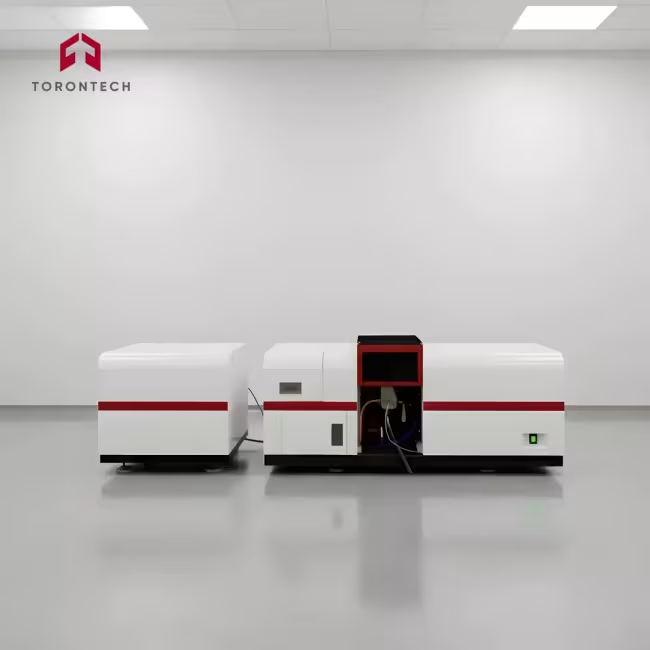
AAS for Testing Lead in Gasoline
AAS for Testing Lead in Gasoline TT-3237
AAS for Testing Lead in Gasoline TT-3237 conforms to ASTM D3237 Standard Test Method for Lead in Gasoline by Atomic Absorption Spectroscopy.
This AAS covers the determination of the total lead content in gasoline within the concentration range of 0.010 to 0.10 g of lead/U.S. gal (2.5 to 25 mg/L). This tester compensates for variations in gasoline composition and is independent of the type of lead alkyl.
The product includes a flame, graphite furnace, and hydride generation system, which can be equipped with various accessories. Its flexible configuration can meet different customer demands. The TT-3237 atomic absorption spectrometer is capable of analyzing complex samples, offering fully automatic multifunctionality with various analysis methods that can switch automatically, allowing for unmanned automatic analysis.
The primary application of the AAS for Testing Lead in Gasoline TT-3237 is the precise determination of the total lead content in gasoline, in compliance with the ASTM D3237 standard. Although leaded gasoline is largely phased out in many parts of the world, this test remains critical for specific applications, such as aviation gasoline (Avgas), and for monitoring contamination or illegal adulteration in unleaded fuels. The instrument uses atomic absorption spectroscopy to provide a highly accurate and sensitive measurement of lead concentration.
Key Industries
- Petroleum Refining: Refineries producing specialized fuels like aviation gasoline must use this instrument for strict quality control to ensure the lead content meets the required specifications for octane rating and performance. It is also used to test unleaded gasoline streams to certify that they are free from lead contamination.
- Aerospace and Aviation: This is a crucial end-user industry. The lead content in Avgas is a critical performance parameter, and fuel suppliers, fixed-base operators (FBOs), and regulatory bodies must verify it to ensure the safe and reliable operation of piston-engine aircraft.
- Third-Party Testing Laboratories and Regulatory Agencies: These independent labs and government bodies (like environmental or customs agencies) use this highly accurate method to enforce fuel quality regulations, test for contamination, and investigate cases of illegal fuel blending or adulteration.
High Precision Automatic Optical System
- 1800/mm reticle (dispersion rate) large area grating monochromator with new self-collimation. All lenses have a quartz coating, broadening the detection range and stability to ensure precise analysis.
- Automatic 6-socket configuration with six independent lamp power supplies, allowing for preheating.
Polymer Spray Chamber
- Made from corrosion-resistant polymer materials, resistant to acids and alkalis, including hydrofluoric acid. It provides the highest sensitivity and stability for both organic and inorganic solutions.
Titanium Burner
- Features a titanium burner with optional 50mm and 100mm burners, air cooling, and pre-mixed type. It is corrosion-resistant and high salt-resistant, greatly improving the analysis efficiency and accuracy of the flame.
Automatic Analysis
- Automatically performs safe ignition, extinction, and switching with a reliable structure and low fault rate, ensuring the sensitivity and reproducibility of the flame method.
- The light source system includes automatic six-lamp conversion and supports high-performance hollow cathode lamps, enhancing flame sensitivity. It automatically adjusts power supply parameters, beam position, wavelength scanning, and peak searching.
Software Function
- High-intelligence software with powerful functionality and a user-friendly English interface. Supports automatic instrument control, automatic switching between flame and graphite furnace modes, automatic optimization, automatic dilution, mouse operation, automatic setup menu data, and correction methods.
Graphite Furnace Temperature Control
- Features dual temperature control (internal and external) with 20-step linear or nonlinear heating to ensure maximum sensitivity of the measured elements. The furnace can enrich up to 20 times, monitoring the graphite tube wall temperature longitudinally, with a maximum temperature of 3000 degrees Celsius.
High Technology Index
- The TT-3237 atomic absorption spectrophotometer meets international best levels for element test sensitivity, with a sensitivity of ≤0.015 μg/mL/1%. Baseline drift is less than 0.003 Abs/30 min, and stability is better than 0.005 Abs/4 hours.
Background Correction System
- Utilizes advanced deuterium hollow cathode lamp and self-absorption background deduction for background correction, eliminating molecular absorption interference in low content determination. It reduces deuterium lamp noise emission, prolongs service life, and offers excellent stability. The deuterium lamp background signal is 1A, with a background correction capability of >50 times.
Intelligent Analysis
- Highly intelligent and user-friendly design, with automatic switching between flame and graphite furnace atomizers, automatic optimization of the graphite furnace atomizer, automatic flame height adjustment, ignition, and horizontal position optimization. The system automatically sets the gas flow and activates safety protection in case of power failure, misoperation, or acetylene leakage.
Automatic Sampler
- Integrative design of the graphite furnace, using a high precision syringe with a minimum sample size of 0.5 μL, and featuring intelligent online dilution and concentration functions.
Model | AA-1800C |
Light Source | ≤6 lamps automatic turret, automatic alignment |
Power Supply | 110/220V (+5% ~ -10%), 60/50Hz; 5000VA |
Lamp Current | Pulsed power supply |
Optical System | Large 1800 /mm grating ruling, full closed optical system |
Wavelength Range | 180nm-900nm Automatically peak find a key optical optimization function |
Wavelength Accuracy | ≤0.15nm |
Wavelength Repeatability | ±0.1nm |
Spectral Bandwidth | 0nm, 0.2nm, 0.4nm, 1.0nm, 2.0nm (5 steps with automatic changeover) |
Baseline Stability | ≤±0.002A/30 min (Static) ≤±0.005A/30min (Dynamic) |
Absorbance Range | 0-4A |
Flame Analytical System | |
Detector | Photomultiplier tube |
Burner Head | Full titanium combustion head, 50mm or 100mm general combustion head |
Atomization Chamber | Polymer explosion-proof spray chamber |
Nebulizer | Atomizer efficient glass atomizer, can also be customized |
Ignition Type | Microcomputer control, automatic ignition |
Gas Control | Automatic gas control system |
Detection Limits(Cu) | 0.002μg/mL |
Precision | RSD≤0.5% |
Graphite Furnace Analytical System | |
Heating Mode | Vertical heating |
Temperature Control Method | Vertical optical temperature monitoring graphite tube wall temperature |
Temperature Range | Room temperature to 3000℃ |
The Program | Automatic temperature control up to 20 order |
Temperature Control | The furnace enriched up to 20 times |
Characteristics Volume | 0.5 × 10⁻¹²g (Cd) |
Detection Limit | 0.4 × 10⁻¹²g (Cd) |
Precision | RSD≤3% |
The Cooling Water | Can choose cooling water circulation system |
Safety | the graphite tube damage, water flow air pressure and other alarm temperature overheating protection |
Autosampler Graphite Furnace | |
Sample Tray | 70 sample cups, 6 reagent cup |
Sample Volume | 1-100μl |
The Smallest Lincrement | 0.1 μl |
The Volume of Sample | Better than 1%(at the time of 10mL-100mL) |
Repeatability Volume Repeated Sampling Frequency | up to 99 Times |
Cleaning and Waste Container Volume | Each 500mL |