
Torque Tester for Guidewires and Catheters
Precision Instrument for Testing Torsional Strength, Constant Torque, and Angle Performance of Intravascular Devices
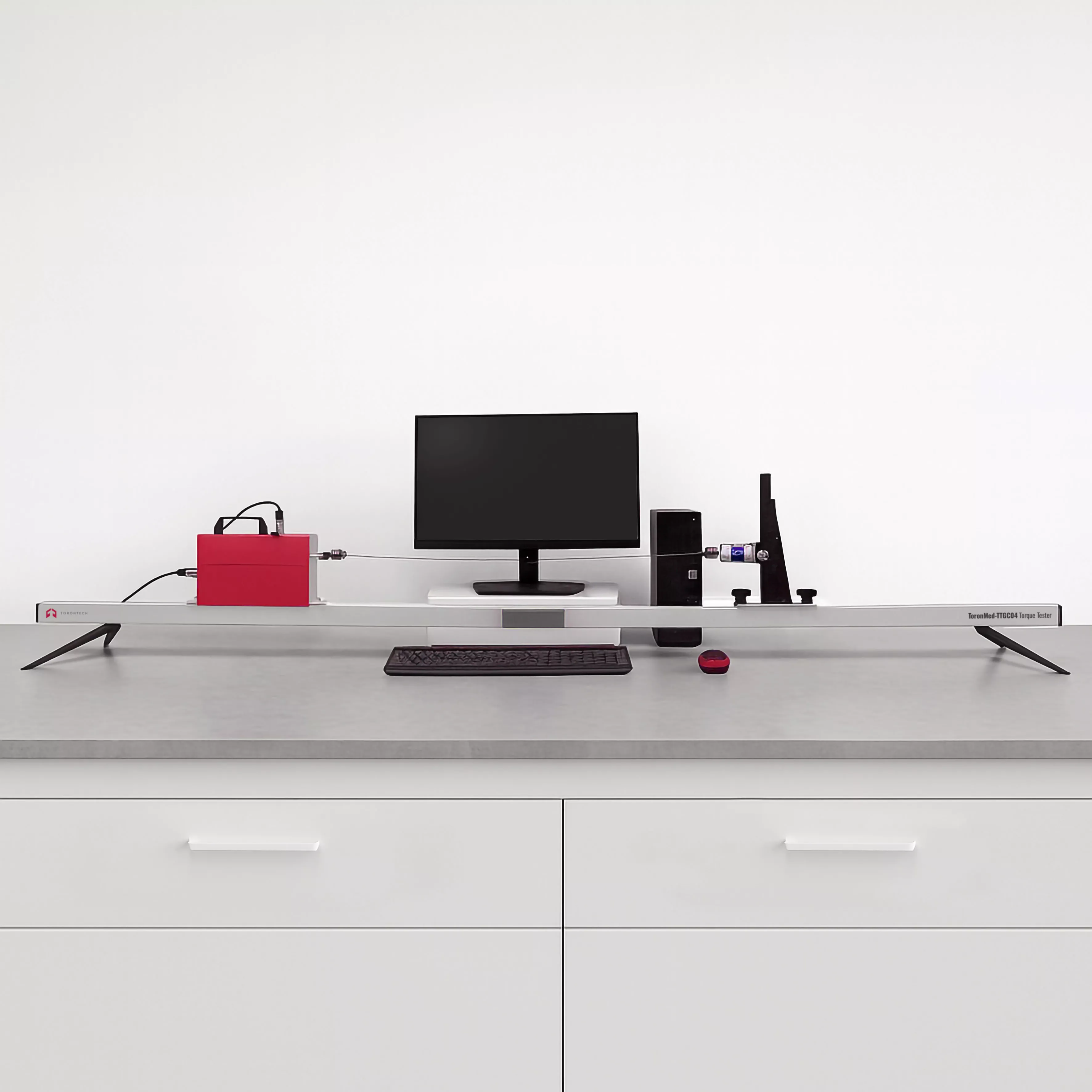
ToronMed™ TTGC04 Torque Tester is engineered for the determination of torque to failure, constant torque, and constant angle performance at the critical welding or joint points of intravascular guidewires, catheters, and related tubular devices. With its millinewton-level precision, the system is ideal for both R&D and quality assurance applications.
The tester is equipped with advanced torque sensors, flexible fixture systems, and professional PC software for real-time torque monitoring, curve analysis, and automatic data logging, making it compliant with modern testing standards for interventional medical devices.
Special Capabilities
- Ideal for low-torque testing applications, including micro guidewires and fragile catheter joints
- Software-controlled test modes:
- Constant torque
- Constant angle
- Torque to failure (torsional strength)
- Tests both rotational stiffness and yield point of catheter and guidewire assemblies
- Suitable for single-use and multiple-use catheter technologies
Applications
Primary Use Cases | Extended Use Cases |
|---|---|
| Intravascular Guidelines | Other medical tubing |
| Interventional Catheters | Bars and tubular components |
| Welded Joint Evaluation | Flexible or coiled shafts |
Standards Compliance
The ToronMed™ TTGC04 conforms to leading industry standards, including:
- ASTM F 2394-2007 – Standard Guide for Measuring Securement of Balloon-Expandable Vascular Stent Mounted on Delivery System
- Specialized for torque to failure and constant torque testing of guidewires and catheters
- Maintains peak torque value automatically for post-test analysis
- Overload protection, automatic zeroing, power-off memory, and fault detection ensure safe operation
- Real-time monitoring of torque curves, with local data storage and optional report printing
- High-accuracy torque sensor with resolution up to 0.01 mN·m
- Supports proximal and distal torque tests, as well as constant angle assessments
- Standard RS232 interface for PC connectivity and test automation
- Customizable fixtures and software configurations to match diverse testing needs
Test Principle
The sample is clamped onto a fixed mounting plate. Torque is applied and measured via a sensitive inline torque sensor. The system captures torque data in real time, enabling analysis of failure points, angle of twist, and constant torque behavior under dynamic or static loading conditions.
Specification | Value |
|---|---|
| Model | ToronMed™ TTGC04 |
| Test Range | 0–500 mN·m (customizable) |
| Accuracy | ±0.5% FS |
| Resolution | 0.01 mN·m |
| Clamping Range | 0.3–4 mm diameter |
| Statistical Count Range | 1–99,999 cycles |
| Test Modes | Constant torque / constant angle / torsional failure |
| Dimensions | 2010 mm (L) × 400 mm (W) × 300 mm (H) |
| Voltage | AC 220V 50Hz / AC 120V 60Hz |
| Net Weight | 15 kg |
Standard Configuration
- Torque tester with integrated torque sensor
- Test fixture assembly
- PC software with communication cable
- User manual and quick-start guide