
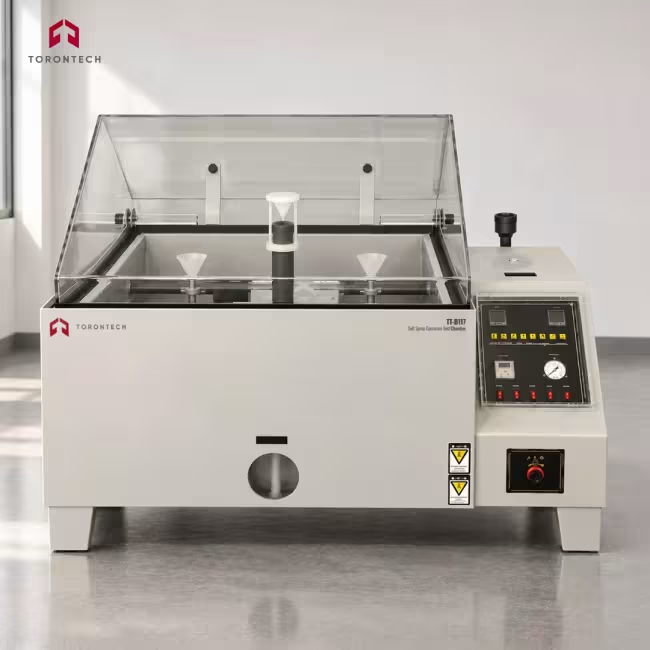
Salt Spray Corrosion Test Chamber TT-B117
Salt Spray Corrosion Test Chamber TT-B117 is an environmental testing apparatus primarily utilized to replicate salt spray conditions for assessing the corrosion resistance of products or metal materials.
- The neutral salt spray test stands as one of the most widely utilized accelerated corrosion testing methods. It uses a 5% sodium chloride solution with a solution pH value within the neutral range (6 to 7) as the spray solution. Test conditions include a temperature of 35 degrees Celsius, with a salt spray deposition rate ranging between 1 and 2 ml/80 cm2 per hour.
- The acetate spray test involves the addition of acetic acid to a 5% sodium chloride solution.
- The copper accelerated acetic acid salt spray test is a newly developed rapid salt fog corrosion test utilized abroad. Conducted at a temperature of 50 degrees Celsius, it involves the addition of a small quantity of copper salt and copper salt solution, inducing corrosion more aggressively. This test proceeds approximately 8 times faster than the NSS test.
- The alternating salt spray test serves as a comprehensive salt spray testing method.
The primary application of the Salt Spray Corrosion Test Chamber TT-B117 is to perform accelerated corrosion testing on a wide variety of products and materials. It creates and maintains a controlled salt fog environment to evaluate the corrosion resistance of samples in a much shorter time frame than natural exposure.
It can perform several types of tests, including:
- Neutral Salt Spray (NSS) as per ASTM B117
- Acetic Acid Salt Spray (AASS)
- Copper-Accelerated Acetic Acid Salt Spray (CASS)
This testing is essential for product development, quality control, and verifying that coatings and materials will meet their expected service life.
Key Industries
- Automotive: This is a critical industry for salt spray testing. Automakers and their suppliers use it to test the corrosion resistance of everything from body panels and fasteners to under-hood components and plated trim, ensuring vehicles can withstand road salt and harsh environmental conditions.
- Paints, Coatings & Finishing: Companies that manufacture and apply protective coatings (e.g., paint, powder coating, electroplating, galvanizing) rely on this chamber for quality control and to prove that their finishes provide the required level of corrosion protection as specified by their customers.
- Aerospace and Defense: This sector uses salt spray testing to ensure the durability and reliability of aircraft components, military hardware, and naval equipment, which are often exposed to highly corrosive marine or industrial environments.
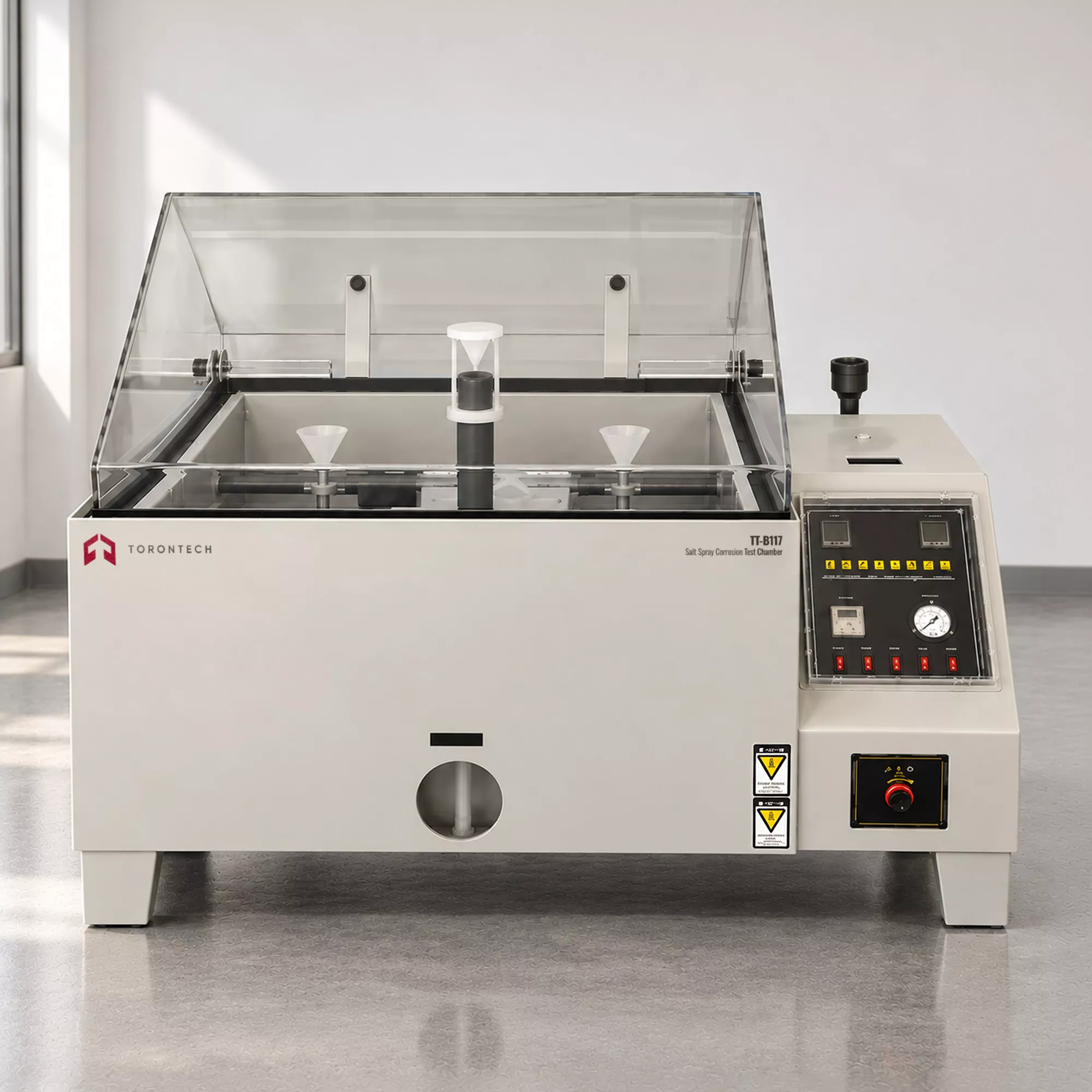
Standards Comply:
1. BS 3900 F12 (ISO 7253): British salt spray test method
2. ASTM B117: Salt spray test method
Test method can be done:
Salt spray test (SS test) for neutral salt spray test (NSS test)
Salt spray test (ASS test)
Copper accelerated acetic acid test
Test temperatures:
- Neutral salt spray test:
- Test Room: 35 ± 1°C
- Saturated air barrel: 47 ± 1°C
- Acid corrosion test:
- Test Room: 50 ± 1°C
- Saturated air barrel: 63 ± 1°C
These temperatures can be adjusted according to JIS and CNS standards.