

Valve Working Reliability Tester - ToronFT™ VWR
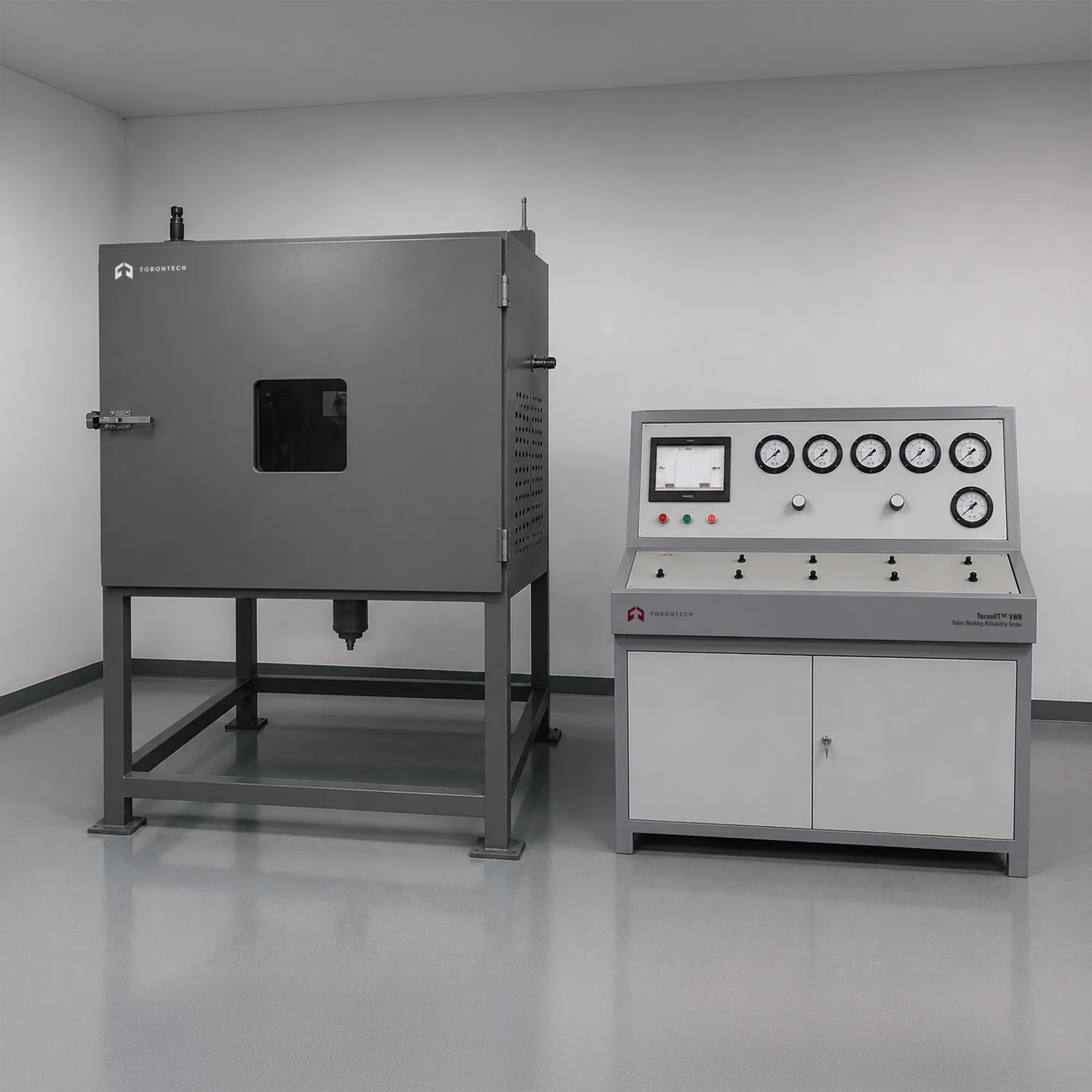
ToronFT™ VWR Valve Working Reliability Tester automates the open/close cycling test for fire dampers, smoke exhaust dampers, and air supply valves used in building ventilation and smoke control systems. The tester mounts the damper specimen on a rigid steel frame and drives it through repeated opening and closing cycles (up to 200 cycles or more) to verify that the valve mechanism operates reliably over its intended service life. A servo motor with a reducer and adjustable fork assembly rotates and unlocks the damper handle, while a pneumatic actuator provides the push-and-pull force required to close the valve.
A 7-inch touchscreen control panel guides the operator through test setup, displays the running cycle count in real time, and stores test parameters for repeatable runs. The pneumatic closing mechanism operates at 0.7 MPa supply pressure, and the 750 W servo motor delivers controlled torque to the valve’s opening linkage. The tester accommodates dampers with multiple control modes (electric, thermal-fusible, and manual) so that each mode can be tested independently and the 200-cycle total can be distributed evenly across all available actuation methods.
The system runs on single-phase 220 V AC with a total power consumption of approximately 1 kW, making it suitable for installation in fire-protection testing laboratories, third-party certification facilities, and damper manufacturing quality-control departments. The steel-frame fixture adapts to different damper sizes and mounting orientations, and all position-sensitive components are adjustable to align with the specimen’s handle and linkage geometry.
Valve Working Reliability Tester - ToronFT™ VWR Applications
The ToronFT™ VWR supports reliability and endurance testing of fire and smoke control dampers across the building safety and HVAC industries.
- Fire Damper Manufacturing QC: verifies that production fire dampers open and close reliably for the required number of cycles before shipment, catching linkage binding, spring fatigue, and latch failures at the factory.
- Smoke Exhaust Damper Testing: confirms that smoke exhaust fire dampers close within the required time at the trigger temperature and continue to function after repeated cycling, meeting the reliability requirements of fire-safety codes.
- Air Supply Valve Qualification: tests normally closed air supply valves that feed pressurized fresh air into stairwells and refuge areas during a fire event, verifying that the valve opens and closes on command over the full test cycle.
- Third-Party Certification and Type Approval: equips accredited testing laboratories with a standardized cycling rig for UL 555, EN 15650, and other fire damper certification programs, producing documented cycle counts and pass/fail records.
- Building Inspection and Compliance: supports periodic operational testing of installed fire dampers per NFPA 80 and NFPA 105, confirming that dampers continue to cycle smoothly after years of in-service exposure.
- R&D and Product Development: allows damper designers to evaluate new blade geometries, linkage mechanisms, spring materials, and actuator types under accelerated cycling conditions before committing to full production.
- Multi-Mode Actuation Validation: tests dampers that incorporate electric, thermal-fusible, and manual control modes, distributing the cycle count across each mode to verify that all actuation paths function reliably.
Valve Working Reliability Tester - ToronFT™ VWR Key Features
The ToronFT™ VWR combines servo-driven opening with pneumatic closing to replicate real-world damper operation in an automated, repeatable test cycle.
- Servo Motor Opening Mechanism: a 750 W servo motor with a reducer and adjustable fork assembly rotates and unlocks the damper handle with controlled torque, replicating the opening action of an electric actuator or manual operator.
- Pneumatic Closing Mechanism: a push-and-pull pneumatic cylinder closes the damper at 0.7 MPa supply pressure, simulating the spring-return or actuator-driven closing force that the damper experiences in service.
- 7-Inch Touchscreen Control Panel: displays the running cycle count, test parameters, and system status in real time, and allows the operator to set the target cycle count and operation period from a single interface.
- Automatic Cycle Counter: tracks up to 200 cycles (or more) with automatic stop at the target count, eliminating manual tallying errors and producing a documented cycle record for the test report.
- Rigid Steel Frame Fixture: a heavy-duty steel-profile frame holds the damper specimen securely during repeated cycling, preventing fixture-induced movement that could affect the test outcome.
- Adjustable Mounting and Fork Position: the fork assembly and fixture mounting points adjust to accommodate different damper sizes, handle locations, and linkage geometries without custom tooling.
- Multi-Mode Test Capability: supports cycling of electric-actuated, thermal-fusible, and manual control modes on the same damper, distributing the total cycle count across each actuation method per the applicable standard.
- Programmable Operation Period: the operator sets the open/close cycle time (typically 8 to 14 seconds per cycle) to match the damper type and the timing requirements of the applicable test standard.
- Low Power Consumption: the complete system operates on single-phase 220 V AC at approximately 1 kW total draw, allowing installation in standard laboratory electrical circuits without dedicated high-power feeds.
- Compact and Self-Contained: the test rig, control cabinet, and pneumatic connections are integrated into a single station, simplifying installation and reducing the floor space required in the test laboratory.
Theory and Method
Fire and smoke dampers are passive life-safety devices installed inside HVAC ductwork at fire-rated walls and floors. When a fire occurs, a thermal-fusible link melts or an electric actuator triggers, releasing a spring-loaded blade assembly that closes across the duct cross-section and blocks the passage of flames, hot gases, and smoke into adjacent compartments. The reliability of this closing action depends on the mechanical endurance of every component in the linkage chain: the blade pivot bearings, the spring, the latch, the fusible link housing, and the actuator shaft.
The cycling test subjects the damper to a prescribed number of open-and-close operations to simulate the cumulative mechanical wear it would experience over a building’s service life. The ToronFT™ VWR opens the damper by rotating the handle or linkage with a servo-driven fork mechanism, then closes the damper pneumatically using a push-and-pull cylinder that replicates the spring or actuator force. Each cycle stresses the blade pivots, linkage joints, and latch engagement surfaces.
After the cycling sequence, the operator inspects the damper for deformation, excessive wear, loosened fasteners, seal gap widening beyond 2 mm, and degraded signal feedback. The damper must still close completely from the full-open position within the required time and must latch securely. Manual operating force must remain at or below 100 N. A damper that meets all criteria after the full cycle count is classified as reliable for its intended installation. Failure at any point triggers root-cause analysis and, if the failure is representative, disqualifies the production batch.
Valve Working Reliability Tester - ToronFT™ VWR Technical Specifications
| Parameter | Specification |
|---|---|
| Valve Opening Drive | Servo motor with reducer and adjustable fork assembly |
| Servo Motor Power | 750 W |
| Valve Closing Drive | Pneumatic (push and pull modes) |
| Air Supply Pressure | 0.7 MPa |
| Cycle Counter | Built-in, minimum 200 cycles |
| Operation Period | 8 to 14 seconds per cycle (adjustable) |
| Control Interface | 7-inch touchscreen |
| Frame Construction | Steel profile frame with adjustable specimen mounting |
| Fork Position | Adjustable to suit damper handle geometry |
| Voltage | AC 220 V, single phase (110V is also available) |
| Total Power Consumption | Approx. 1 kW |
| Supported Control Modes | Electric, thermal-fusible, manual |
| Test Environment Requirements | 15 to 35 °C, ≤85% RH, no strong EMI or corrosive gases |
Pass/Fail Criteria (per applicable standard)
| Criterion | Requirement |
|---|---|
| Closing Action | Damper closes fully from open position on every cycle |
| Closing Time (thermal trigger) | ≤1 minute after thermal-fusible activation |
| Seal Gap After Cycling | ≤2 mm (measured with feeler gauge) |
| Manual Operating Force | ≤100 N to open and close |
| Signal Feedback Delay | ≤2 seconds |
| Component Condition | No deformation, excessive wear, loosening, or detachment |