
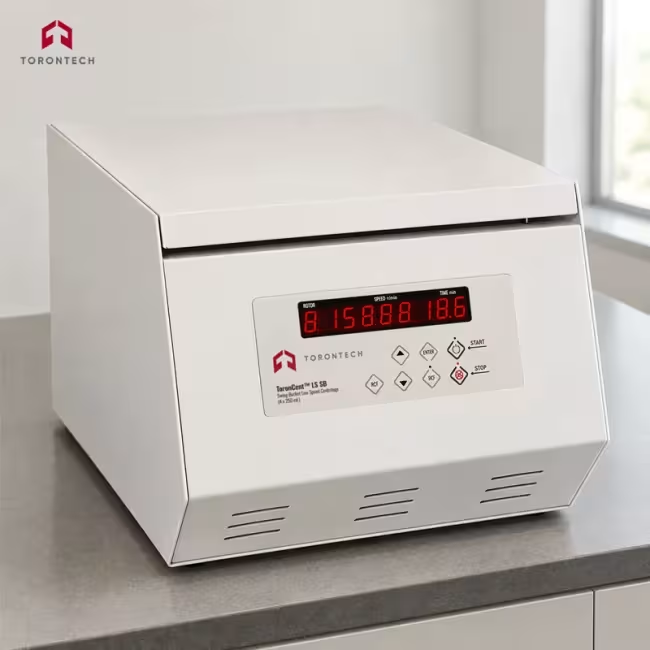
Swing Bucket Low Speed Centrifuge (4 x 250 mL) - ToronCent™ LS SB
ToronCent™ LS SB swing bucket low speed centrifuge runs an all-horizontal rotor line-up, with no fixed angle option anywhere in the range. Every rotor pivots its load flat under speed, which is what separates this model from the rest of the low speed family. Clinical laboratories, cytology units, and assay groups use it where a clean interface and a flat pellet matter more than raw g-force. Capacity reaches 4 x 250 mL and the ceiling sits at 5,000 rpm and 4,390 x g.
Three rotors cover the range. A bracket rotor carries 4 x 100 mL at 5,000 rpm, or swaps to heavier bracket sets holding 4 x 2 x 100 mL, 4 x 8 x 15 mL, or 4 x 2 x 50 mL at 4,000 rpm. A dedicated swing rotor takes 4 x 250 mL in round or rectangular buckets at 3,000 x g. A microplate rotor handles ELISA plates, deep-well plates, and filter plate reagent kits.
A microprocessor controller calculates RCF so operators work in either unit. A DC brushless motor drives the spindle with no carbon dust and no brush service. A damping structure absorbs residual rotor imbalance, which keeps a 40 kg instrument steady through repeated runs. The steel housing suits a working clinical bench rather than a protected instrument room.
Swing Bucket Low Speed Centrifuge (4 x 250 mL) - ToronCent™ LS SB Applications
The ToronCent™ LS SB suits work where sediment geometry and clean decanting drive the result.
- Cytology Sample Preparation: concentration of dilute cell suspensions out of body fluids, leaving a flat deposit that transfers cleanly to a slide
- Serum and Plasma Separation: batch processing of vacuum blood collection tubes with a sharp, level interface that resists disturbance during pipetting
- ELISA and Plate-Based Assays: spin-down of up to twelve ELISA plates per run using the microplate rotor
- Filter Plate and Deep-Well Work: driving liquid through filter plates and settling beads in deep-well formats for extraction and cleanup protocols
- Cell Washing: repeated wash and resuspension cycles across 32 tube positions in the 4 x 8 x 15 mL bracket set
- Cell Culture Harvesting: pelleting suspension cultures in 100 mL and 250 mL containers
- Urinalysis: sediment concentration in 10 mL and 15 mL tubes ahead of microscopic examination
- Clinical Chemistry: clarification of specimens across 1.5 mL microtubes through 50 mL conical tubes
- Food and Environmental Testing: sediment recovery out of large volume aqueous samples in 250 mL buckets
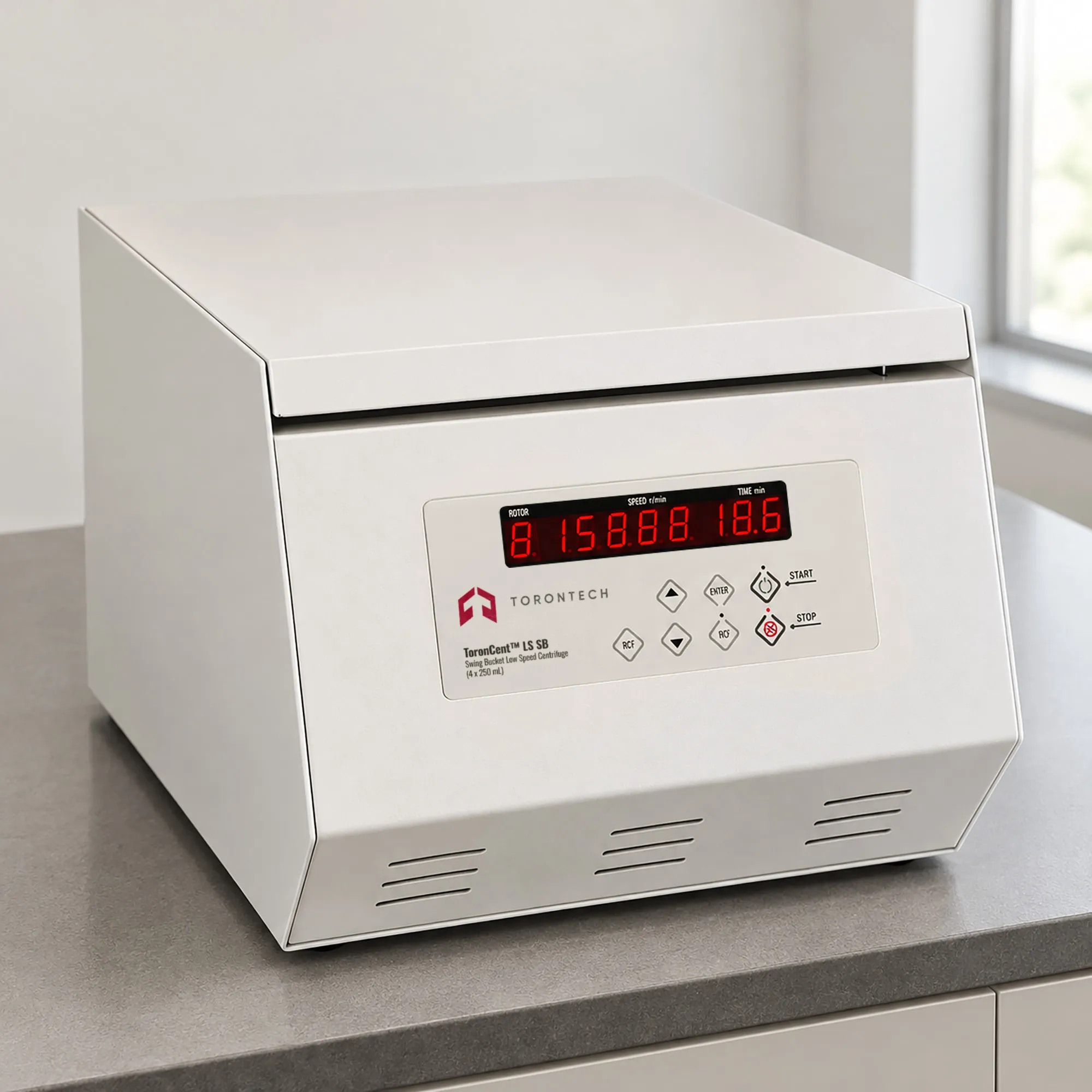
Swing Bucket Low Speed Centrifuge (4 x 250 mL) - ToronCent™ LS SB Key Features
The rotor line-up, bracket system, and mechanical build target laboratories that spin the same formats repeatedly on a busy bench.
- All-Swing Rotor Line-Up: every rotor in the range runs horizontal under load, so pellet geometry stays consistent whichever configuration the laboratory chooses
- 4 x 250 mL Maximum Capacity: handles 1 L per cycle in rectangular buckets, enough for bulk clarification without moving to a floor unit
- 4,390 x g Ceiling: the 4 x 100 mL bracket rotor reaches the top of the range at 5,000 rpm
- Interchangeable Bracket System: one rotor body accepts 4 x 100 mL, 4 x 2 x 100 mL, 4 x 8 x 15 mL, and 4 x 2 x 50 mL bracket sets, which stretches the tube formats a single rotor covers
- Round and Rectangular Buckets: the 4 x 250 mL swing rotor takes either shape, with a separate adapter set matched to each
- Microplate Rotor: carries ELISA plates, deep-well plates, and filter plate reagent kits on the same rotor
- Wide Adapter Range: covers 1.5 mL microtubes up to 250 mL containers, including conical, round, and vacuum blood collection formats
- Automatic RCF Calculation: converts between rpm and x g so protocols written in either unit run without hand conversion
- DC Brushless Motor: runs without carbon brushes, leaving no carbon dust in the chamber and no brush replacement over the service life
- Microprocessor Speed Control: holds set speed within ±30 rpm across the range
- Vibration Damping Structure: absorbs residual rotor imbalance and keeps the instrument from shifting on the bench
- Steel Housing: takes the knocks of a working clinical bench and contains rotor energy
- Second-Resolution Countdown: displays remaining time in seconds once a run drops under a minute, which matters for short spins where timing is tight
- Noise at or Below 65 dB(A): keeps a shared laboratory workable through repeated runs
Theory and Method
A swing-out rotor holds its buckets on pivots rather than fixing them in place. At rest the buckets hang vertical. As the rotor accelerates, centrifugal force acting on the loaded bucket overcomes gravity and swings it outward until it sits horizontal, roughly ninety degrees of travel. The tube now points along the direction of the applied force, so sediment travels the length of the tube rather than across it. Deceleration reverses the motion and the buckets drop back down.
That geometry changes where the pellet lands. Sediment in a fixed angle rotor strikes the tube wall partway down, slides along it, and gathers as a sloped deposit against the side. Sediment in a swinging bucket travels straight down the tube axis and settles as a flat layer on the bottom. A level pellet holds together better when the operator pours off the supernatant, and the interface above it stays sharp instead of running at an angle. Cytology and serum work both depend on that.
The same principle carries into the microplate rotor. Buckets holding plates swing flat, so liquid, cells, and beads all move toward the bottom of each well rather than toward one side of it. Filter plates need this alignment to push liquid through the membrane evenly across all ninety-six positions. The trade-off across the line is g-force: pivots and buckets add rotating mass at radius, which is why the swing rotor tops out at 3,000 x g while the lighter bracket rotor reaches 4,390 x g.
Swing Bucket Low Speed Centrifuge (4 x 250 mL) - ToronCent™ LS SB Technical Specifications
| Parameter | Specification |
|---|---|
| Maximum Speed | 5,000 rpm |
| Maximum RCF | 4,390 x g |
| Maximum Capacity | 4 x 250 mL |
| Speed Accuracy | ±30 rpm |
| Time Setting Range | 1 min to 99 min |
| Motor | DC brushless |
| Control | Microprocessor, automatic RCF calculation |
| Housing | Steel |
| Noise Level | ≤65 dB(A) |
| Voltage | AC 220 V ±22 V, 50/60 Hz (110V is also available) |
| Power Consumption | 400 W |
| Dimensions (W x D x H) | 450 x 545 x 380 mm |
| Packing Dimensions (W x D x H) | 547 x 727 x 432 mm |
| Net Weight | 40 kg |
Rotor Range
| Rotor | Type | Configuration | Maximum Speed | Maximum RCF |
|---|---|---|---|---|
| Rotor 1 | Swing-out bracket rotor | 4 x 100 mL brackets | 5,000 rpm | 4,390 x g |
| Rotor 1 | Swing-out bracket rotor | 4 x 2 x 100 mL, 4 x 8 x 15 mL, or 4 x 2 x 50 mL brackets | 4,000 rpm | 2,810 x g |
| Rotor 2 | Swing-out bucket rotor | 4 x 250 mL, round or rectangular bucket | 4,000 rpm | 3,000 x g |
| Rotor 3 | Microplate rotor | 2 x 2 x 96-well | 4,000 rpm | 2,200 x g |
Bracket, Bucket, and Adapter Options
| Rotor | Bracket or Bucket | Adapter Capacities |
|---|---|---|
| Rotor 1 | Bracket, 4 x 100 mL | 4 x 50 mL; 4 x 50 mL (conical); 4 x 30 mL; 4 x 20 mL; 4 x 15 mL; 4 x 15 mL (conical); 4 x 3 x 5 mL vacuum tube; 4 x 2 x 10 mL; 4 x 4 accretion tubes; 4 x 3 x 1.5 mL |
| Rotor 1 | Bracket, 4 x 2 x 100 mL | 4 x 2 x 50 mL; 4 x 2 x 50 mL (conical); 4 x 2 x 30 mL; 4 x 2 x 20 mL; 4 x 2 x 15 mL; 4 x 2 x 15 mL (conical); 4 x 6 x 5 mL vacuum tube; 4 x 4 x 10 mL; 8 x 4 accretion tubes; 8 x 3 x 1.5 mL |
| Rotor 1 | Bracket, 4 x 8 x 15 mL | 5 mL; 7 mL; 10 mL |
| Rotor 1 | Bracket, 4 x 2 x 50 mL | Custom configurations available on request |
| Rotor 2 | Round bucket | 4 x 1 x 100 mL; 4 x 1 x 50 mL (conical/round); 4 x 4 x 20 mL; 4 x 4 x 15 mL (conical); 4 x 6 x 15 mL; 4 x 7 x 10 mL; 4 x 10 x 5 mL; 4 x 8 x 1.5 mL |
| Rotor 2 | Rectangular bucket | 4 x 1 x 250 mL; 4 x 4 x 50 mL (conical); 4 x 7 x 15 mL (conical); 4 x 9 x 10 mL; 4 x 9 x 5 mL; 4 x 15 x 1.5 mL |
| Rotor 3 | Microplate bucket | 2 x 6 x 96 ELISA microplate; 2 x 2 x 96 deep-well plate; 2 x 1 x 96 filter plate reagent kit |
Custom bracket, bucket, and adapter configurations are available across the rotor range.