

Sprinkler Water Impact Tester - ToronFT™ SW-IT
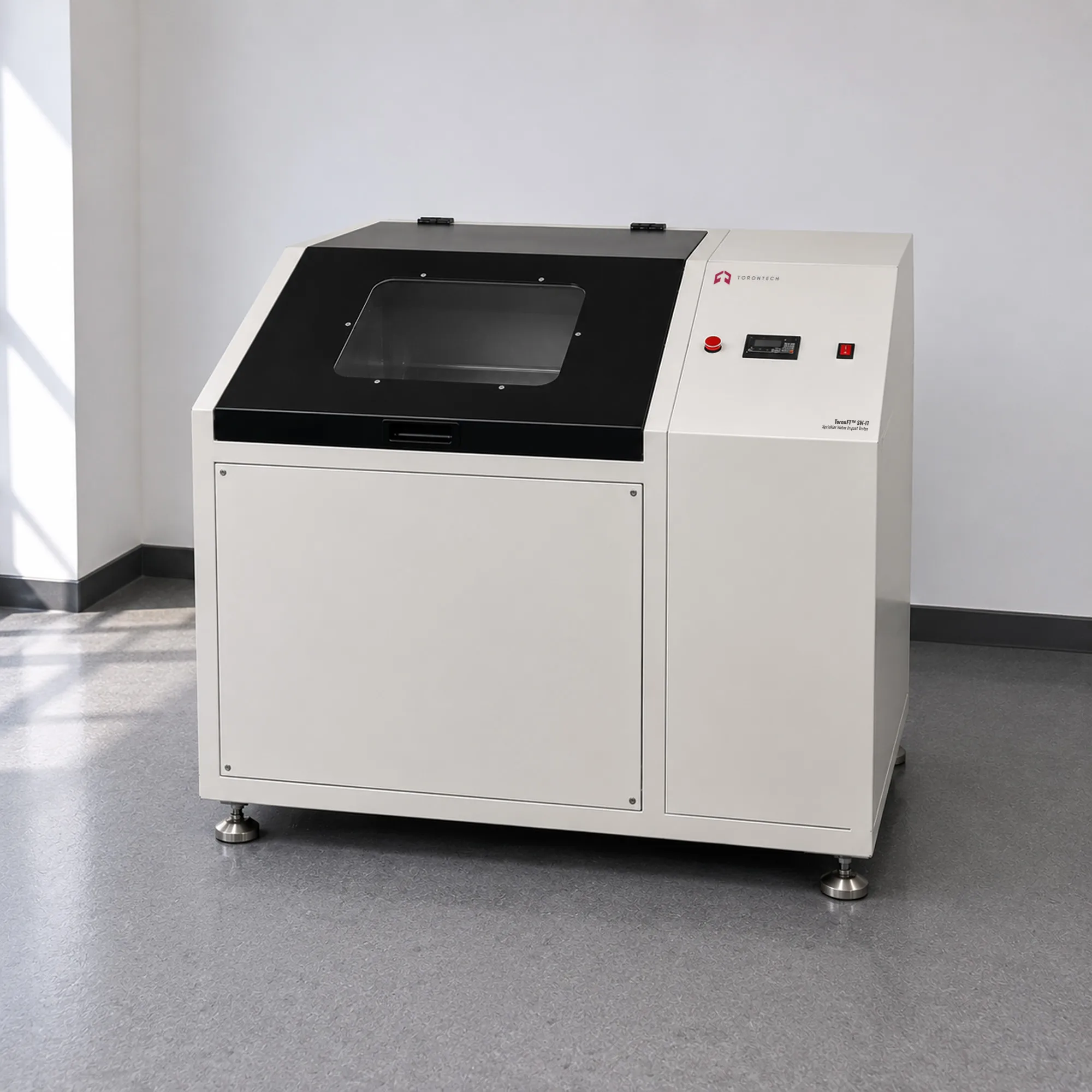
ToronFT™ SW-IT Sprinkler Water Impact Tester subjects automatic fire sprinkler heads to repeated alternating water pressure cycles that simulate the hydraulic shock (water hammer) conditions sprinklers experience over their installed service life. The tester mounts up to five sprinkler specimens in their normal working position on a pressurized test manifold, fills the circuit with water to purge all air, and then cycles the pressure between a low value of 0.4 MPa (±0.1 MPa) and a high value of 2.5 MPa (+0.5 MPa) for 3,000 consecutive cycles. After the cycling sequence, each specimen is inspected for leakage and then undergoes a functional activation test to confirm that the sprinkler still operates correctly.
A variable-frequency-driven high-pressure pump delivers up to 500 L/min through DN30 high-pressure piping, and a current-transmitter pressure sensor with 0.25% F.S. accuracy and 0.01 MPa resolution monitors the circuit pressure at intervals of less than 100 ms. The variable-frequency drive adjusts pump speed across a 0 to 50 Hz range to produce the required pressure waveform. Cycle counts are programmable from 0 to 999,999, and a computer-based control system generates the pressure-versus-time curve automatically, archives test data, and exports reports.
The test rig is enclosed in a metal safety frame with an electrostatic baked-paint finish and a blast-resistant tempered-glass observation window. The system operates on three-phase 380 V AC at 3.5 kW and uses recirculated, filtered room-temperature water (minimum 5 °C) as the test medium. Overall dimensions of the test station are approximately 1,500 × 450 × 1,650 mm, with the pump unit measuring approximately 1,950 × 850 × 1,300 mm.
Sprinkler Water Impact Tester - ToronFT™ SW-IT Applications
The ToronFT™ SW-IT supports water impact and endurance testing across the fire sprinkler manufacturing and certification industries.
- Fire Sprinkler Manufacturing QC: verifies that production sprinkler heads withstand 3,000 pressure cycles without leaking or losing activation capability before shipment, catching seal degradation, frame weakness, and fusible-link housing defects at the factory.
- Third-Party Testing Laboratories: equips accredited fire-protection test labs with a standardized, computer-controlled pressure cycling rig for sprinkler type-approval and periodic re-evaluation programs.
- Sprinkler Head R&D and Design Validation: allows engineers to evaluate new deflector geometries, seal materials, frame alloys, and thermal-response elements under accelerated water hammer conditions before committing to production tooling.
- Residential Sprinkler Qualification: tests residential sprinkler heads, which require the same leak-free and operational performance after pressure cycling.
- Water Mist Nozzle Testing: applies alternating pressure cycling to water mist nozzles, verifying that the orifice, filter, and seal assembly remain leak-free and functional after extended hydraulic shock.
- Field Sprinkler Sample Re-evaluation: supports testing of sprinkler samples removed from existing installations to assess whether aged sprinklers still meet their original performance requirements.
Sprinkler Water Impact Tester - ToronFT™ SW-IT Key Features
The ToronFT™ SW-IT combines high-pressure pumping, precision sensing, and computer automation to deliver repeatable water impact testing.
- Five-Station Test Manifold: mounts up to five sprinkler specimens simultaneously in their working position, increasing test throughput and allowing direct comparison of specimens within the same pressure cycle run.
- Variable-Frequency Pump Drive: a 0 to 50 Hz variable-frequency drive controls pump speed to generate the required alternating pressure waveform, providing smooth transitions between the low and high pressure setpoints.
- High-Pressure Pump (500 L/min): delivers up to 500 L/min at pressures up to 4.0 MPa, providing the flow capacity needed to pressurize the test circuit rapidly and maintain waveform fidelity at high cycle rates.
- Precision Pressure Sensing: a current-transmitter pressure sensor with 0.25% F.S. accuracy and 0.01 MPa resolution samples the circuit pressure at intervals below 100 ms, capturing the full shape of every pressure cycle.
- Computer-Based Control and Data Acquisition: automates cycle counting (programmable from 0 to 999,999 cycles), generates real-time pressure-versus-time curves, and archives test data with automatic report export.
- Pressure Stabilization System: a stabilization device rated to 10 MPa dampens parasitic pressure spikes and maintains waveform consistency across the full cycle count.
- Recirculating Filtered Water Supply: uses room-temperature water (minimum 5 °C) in a closed-loop circuit with a Y-type filter, reducing water consumption and preventing particulate contamination of the test specimens.
- Safety Enclosure: a metal safety frame with electrostatic baked-paint finish and blast-resistant tempered-glass observation window protects the operator from high-pressure leaks or specimen failures.
- Electric Shut-Off Valve and Manual Ball Valve: an electric shut-off valve enables automated pressure isolation, while a manual ball valve provides a secondary manual override for emergency depressurization.
- DN30 High-Pressure Piping: the test manifold uses DN30 high-pressure pipe rated for the full operating range, sized to minimize pressure drop and maintain uniform conditions across all five test stations.
Theory and Method
Water hammer is a pressure transient that occurs in a closed piping system when a valve opens or closes suddenly, or when a pump starts or stops. The rapid change in flow velocity converts kinetic energy into a pressure wave that travels through the pipe at the speed of sound in water (approximately 1,480 m/s). Each pressure spike stresses every component in the circuit: pipe joints, valve seats, gaskets, and, in fire sprinkler systems, the sprinkler head’s frame, seal, and thermal-response element.
The water impact test replicates this phenomenon under controlled laboratory conditions. The ToronFT™ SW-IT fills a closed manifold with water, purges all trapped air, and then uses a variable-frequency pump to cycle the pressure between a low baseline (0.4 MPa) and a high peak (2.5 MPa) in rapid alternation. A high-resolution pressure sensor samples the waveform at intervals below 100 ms, and the computer control system logs every cycle. Over 3,000 consecutive cycles, the cumulative stress exposes latent weaknesses in the sprinkler’s sealing surfaces, frame casting, solder joints, and fusible-link housing that a single static pressure test cannot detect.
After the pressure cycling sequence is complete, the operator visually inspects each of the five mounted specimens for dripping, weeping, or any sign of water leakage through the body or seal. The specimens then undergo a functional activation test, in which the thermal-response element is triggered to confirm that the sprinkler still opens promptly and discharges water in the intended spray pattern. A sprinkler that leaks during or after cycling, or that fails to activate within the specified response time, does not pass the test.
Sprinkler Water Impact Tester - ToronFT™ SW-IT Technical Specifications
| Parameter | Specification |
|---|---|
| Pressure Control Range | 0.4 MPa (±0.1 MPa) to 4.0 MPa |
| Standard Test Pressure Cycle | 0.4 MPa to 2.5 MPa (+0.5 MPa), 3,000 cycles |
| High-Pressure Pump Output | 0 to 4.0 MPa, 500 L/min |
| Pressure Sensor Accuracy | 0.25% F.S. |
| Pressure Resolution | 0.01 MPa |
| Pressure Sampling Interval | < 100 ms |
| Pressure Sensing Method | Current transmitter |
| Stabilization Device Rating | 10 MPa |
| Variable-Frequency Drive Range | 0 to 50 Hz |
| Number of Test Stations | 5 |
| Programmable Cycle Count | 0 to 999,999 cycles |
| Test Medium | Room-temperature water (≥5 °C), recirculated with filtration |
| Test Piping | DN30 high-pressure pipe |
| Valves | 1 electric shut-off valve, 1 manual ball valve |
| Control System | Computer with dedicated software (1 PC, 1 software suite) |
| Data Output | Automatic pressure-time curve, data archiving, report export |
| Safety Enclosure | Metal frame with electrostatic baked paint, blast-resistant tempered glass window |
| Test Station Dimensions (L × W × H) | 1,500 × 450 × 1,650 mm |
| Test Station Weight | Approx. 45 kg |
| Pump Unit Dimensions (L × W × H) | 1,950 × 850 × 1,300 mm |
| Pump Unit Weight | Approx. 330 kg |
| Voltage | AC 380 V, three-phase |
| Power Consumption | 3.5 kW |
Note: The system requires an external centralized water supply (pressure source). Contact Qualitest for compatible supply system options.