
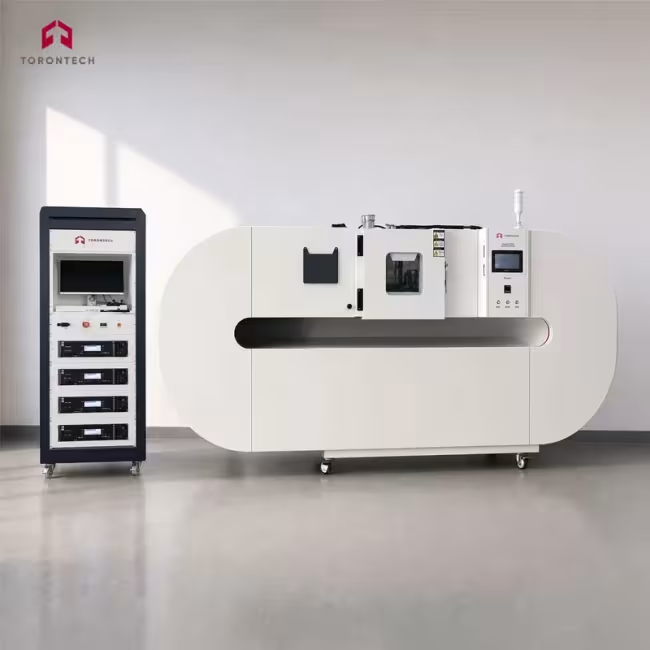
Smoke Detector Test Tunnel - ToronFT™ SDT
ToronFT™ SDT Smoke Detector Test Tunnel measures the response threshold of point-type photoelectric smoke detectors and standalone smoke alarms in a controlled airflow. A closed-loop tunnel circulates a calibrated paraffin test aerosol past the detector while an optical densitometer tracks smoke concentration, capturing the smoke density at the moment the device alarms. The tunnel covers response threshold, repeatability, orientation, airflow, ambient light, and high-temperature checks in one enclosure.
The ToronFT™ SDT generates smoke automatically and holds the smoke-rise rate under closed-loop control, so each measurement starts from a clean, repeatable baseline. A servo-driven lifting plate rotates the detector through its test orientations, and six circulating fans set airflow at the 0.2, 0.8, and 1.0 m/s velocities the standard specifies. The control software records wind speed, temperature, smoke concentration, and smoke-rise rate for every run and exports the data to an Excel report. This automation reduces operator variation and shortens the time needed for a full type-test sequence.
The base ToronFT™ SDT targets laboratories that certify photoelectric and optical smoke detectors against European fire-alarm standards. Manufacturers use it during product development and production-control sampling, while test houses use it to verify imported detectors before market entry
Smoke Detector Test Tunnel - ToronFT™ SDT Applications
The ToronFT™ SDT supports the laboratories, manufacturers, and test houses that develop and certify point-type smoke detection devices.
- Photoelectric Smoke Detector Certification: response-threshold and sensitivity testing of scattered-light and transmitted-light detectors
- Standalone Smoke Alarm Testing: sensitivity and air-movement testing of independent domestic smoke alarms
- Fire Detector Manufacturing: production-control sampling of detector batches to confirm consistent response across units
- Research and Product Development: evaluation of new optical sensor designs and alarm algorithms under repeatable aerosol conditions
- Third-Party Test Houses: independent verification of detector performance for certification bodies and notified labs
- Import and Distribution Quality Control: confirmation that detectors meet declared sensitivity before market entry
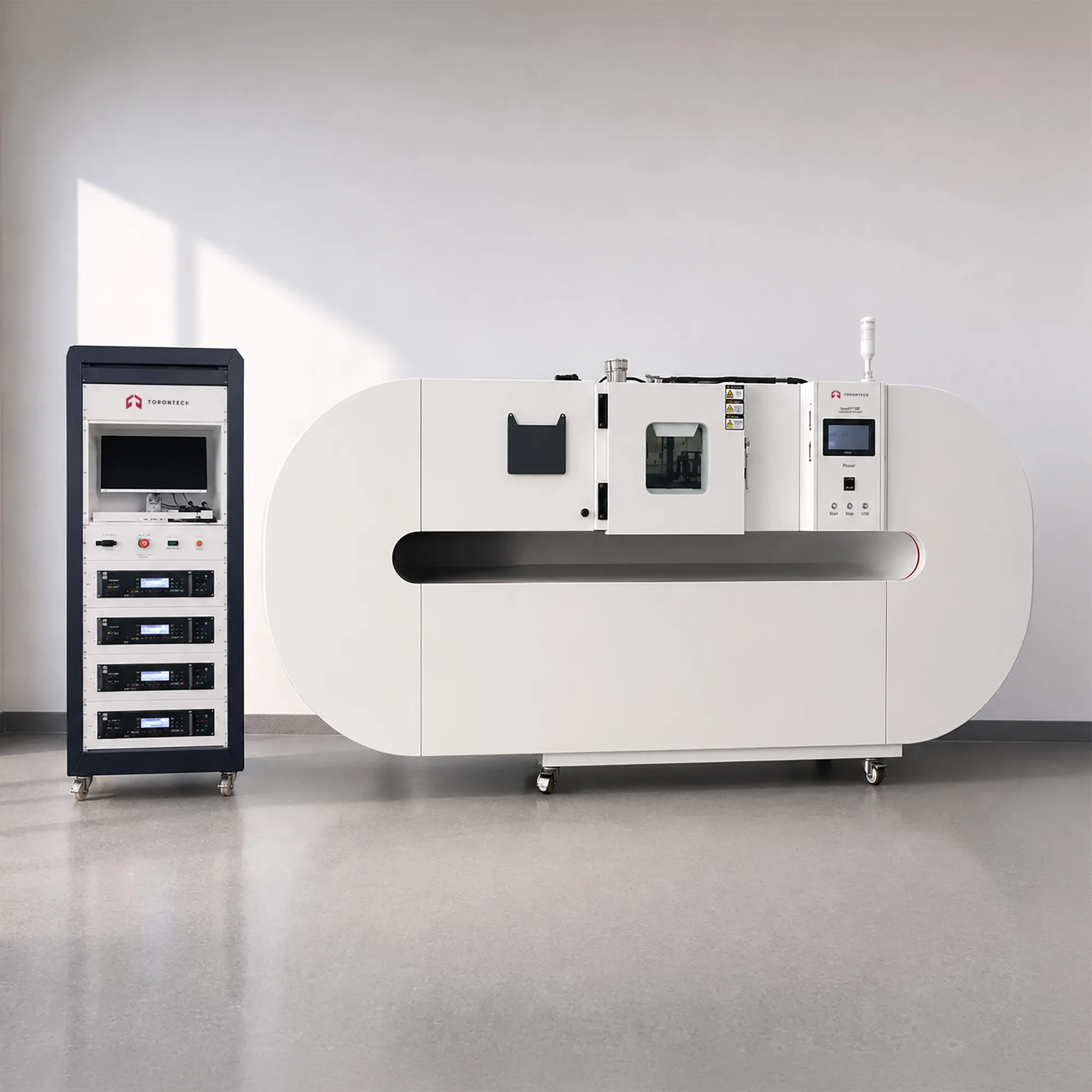
Smoke Detector Test Tunnel - ToronFT™ SDT Key Features
The SDT combines optical measurement, automated smoke control, and a conditioned test section in one closed-loop tunnel.
- Optical Response-Threshold Measurement: reflective densitometer reads the m value from 0.001 to 1.1 dB/m at 0.001 dB/m resolution for direct threshold reporting
- Fast Optical Response: T90 response time of 3 seconds or less tracks rapidly rising smoke without lag
- Automatic Zero Correction: densitometer rezeros against clean air before each run and corrects for smoke-pollution drift, holding baseline error within 0.02 dB/m
- Closed-Loop Smoke Generation: liquid-paraffin generator holds the smoke-rise rate under feedback control for reproducible test aerosol
- Stable Particle Size: aerosol particles span 0.2 to 1.0 µm, with over 90% in range, matching the optical profile of real smoke
- Constant-Smoke Mode: locks concentration to within ±0.01 dB/m for fixed-density studies
- Multi-Velocity Airflow: six PWM-controlled fans set the 0.2, 0.8, and 1.0 m/s velocities required for air-movement testing
- Servo Orientation Control: motorized lifting plate rotates the detector to each test angle automatically, removing manual repositioning
- Integrated High-Temperature Testing: SCR-controlled heater reaches 70°C at under 1°C per minute with 0.2°C cross-section uniformity
- Ambient-Light Dazzle Enclosure: fluorescent-lined chamber confirms immunity to bright light from all directions
- Modular Annular Box: pre-drilled sensor ports and a reserved frame interface leave room for upgrades and added test functions
- One-Key Automated Sequence: software runs alarm identification, angle rotation, cold and hot threshold tests, recording, and reset from a single start command
- Data Logging and Reporting: stores up to 10,000 records per item and exports concentration, smoke-rise, and temperature curves to Excel
- Filtered Air Intake: multi-layer filter keeps the recirculated air clean between runs
Theory and Method
A point smoke detector alarms when the smoke around it reaches a certain optical density. The SDT measures that density with the light-obscuration method: an infrared beam crosses the test section, and a photodetector reads how much the smoke attenuates it. The optical density m, in decibels per meter, follows m = (10 / d) log (P0 / P), where d is the optical path length, P0 is the light received in clean air, and P is the light received through smoke. The instrument records the m value present when the detector alarms, and that figure becomes the response threshold.
Repeatable smoke keeps the threshold meaningful. The ToronFT™ SDT uses a liquid-paraffin aerosol generator that produces particles between 0.2 and 1.0 micrometers, the size range that represents real combustion smoke for optical detectors. The control host raises concentration along a preset smoke-rise rate and corrects it in a closed loop, holding the rate between 0.015 and 0.1 dB/m per minute. A constant-smoke mode then locks concentration to within ±0.01 dB/m so the laboratory can study detector behavior at a fixed density.
Airflow and detector orientation change how smoke enters the sensing chamber, so the standard checks response across set velocities and angles. Six circulating fans under PWM control set the airflow, a two-layer mixing board evens out the smoke distribution, and a servo-driven plate rotates the detector to each test angle. For the high-temperature sequence, an SCR-controlled heating element raises the chamber to 70°C at under 1°C per minute while holding cross-section uniformity within 0.2°C. A separate dazzle enclosure surrounds the detector with fluorescent lamps to confirm that bright ambient light does not trigger a false alarm.
Smoke Detector Test Tunnel - ToronFT™ SDT Technical Specifications
| Parameter | Specification |
|---|---|
| Detector Types | Point-type photoelectric smoke detectors, standalone smoke alarms |
| Test Area Dimensions | 425 × 425 × 1100 mm |
| Box Structure | Closed-loop hermetic, three-layer (aluminum-foil inner, rubber-plastic insulation, electrostatic baking-paint shell) |
| Airflow Velocities | 0.2 m/s ±0.04, 0.8 m/s ±0.1, 1.0 m/s ±0.2 |
| Aerosol Type | Liquid-paraffin aerosol generator |
| Aerosol Particle Size | 0.2 to 1.0 μm (over 90% of particles) |
| Smoke-Rise Rate (m value) | 0.015 to 0.1 dB/m per minute |
| Constant-Smoke Stability | ≤ ±0.01 dB/m |
| Response-Threshold Method | Optical light obscuration, m = (10/d) log (P0/P) |
| Optical Measurement Length | ≤ 1.1 m |
| Light Source / Emitter | 800 to 950 nm infrared beam |
| Photodetector | Silicon photodiode (Hamamatsu) |
| Optical Response Time (T90) | ≤ 3 s |
| Measurement Range | 0.001 to 1.1 dB/m |
| Measurement Error | (m × 5% ± 0.02) dB/m |
| Resolution | 0.001 dB/m |
| Zero-Point Error | ≤ 0.02 dB/m |
| High-Temperature Range | Room temperature to 70°C |
| Heating Rate | < 1°C per minute |
| Heating Power | 3 kW |
| Temperature Uniformity | ≤ 0.2°C across test-area cross-section |
| Dazzle Lamp Power | 30 W per lamp, 4 lamps |
| Dazzle Lamp Color Temperature | 3200 K to 4200 K |
| Dazzle Lamp Diameter | ~380 mm |
| Dazzle Enclosure Dimensions | 380 × 380 × 380 mm |
| Control System | Touch screen plus PC control (acquisition card, temperature and AD modules) |
| Data Storage | Up to 10,000 records per item, Excel export |
| Recorded Curves | Smoke concentration, smoke-rise rate, temperature |
| Chassis / Box Material | Steel plate with electrostatic baking paint; SUS304 stainless test box with 10 mm insulation |
| Overall Dimensions | 2600 × 820 × 1640 mm (L × W × H) |
| Height Adjustment | 150 mm overall lift; casters with brakes |
| Voltage | AC 220 V, 3.5 kW total (110V is also available) |
| Operating Temperature | 13°C to 35°C |
| Operating Humidity | 55% ±20% RH |
| Certification | CE |