
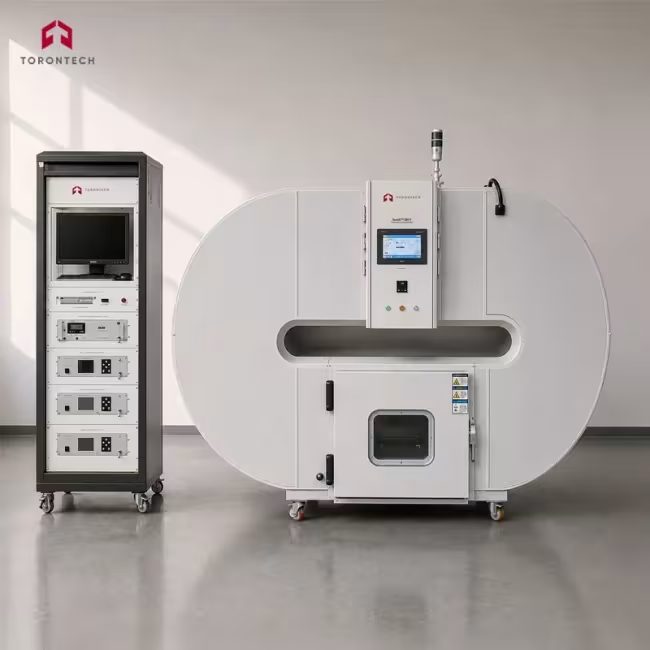
Smoke Detector Test Tunnel (Pro)
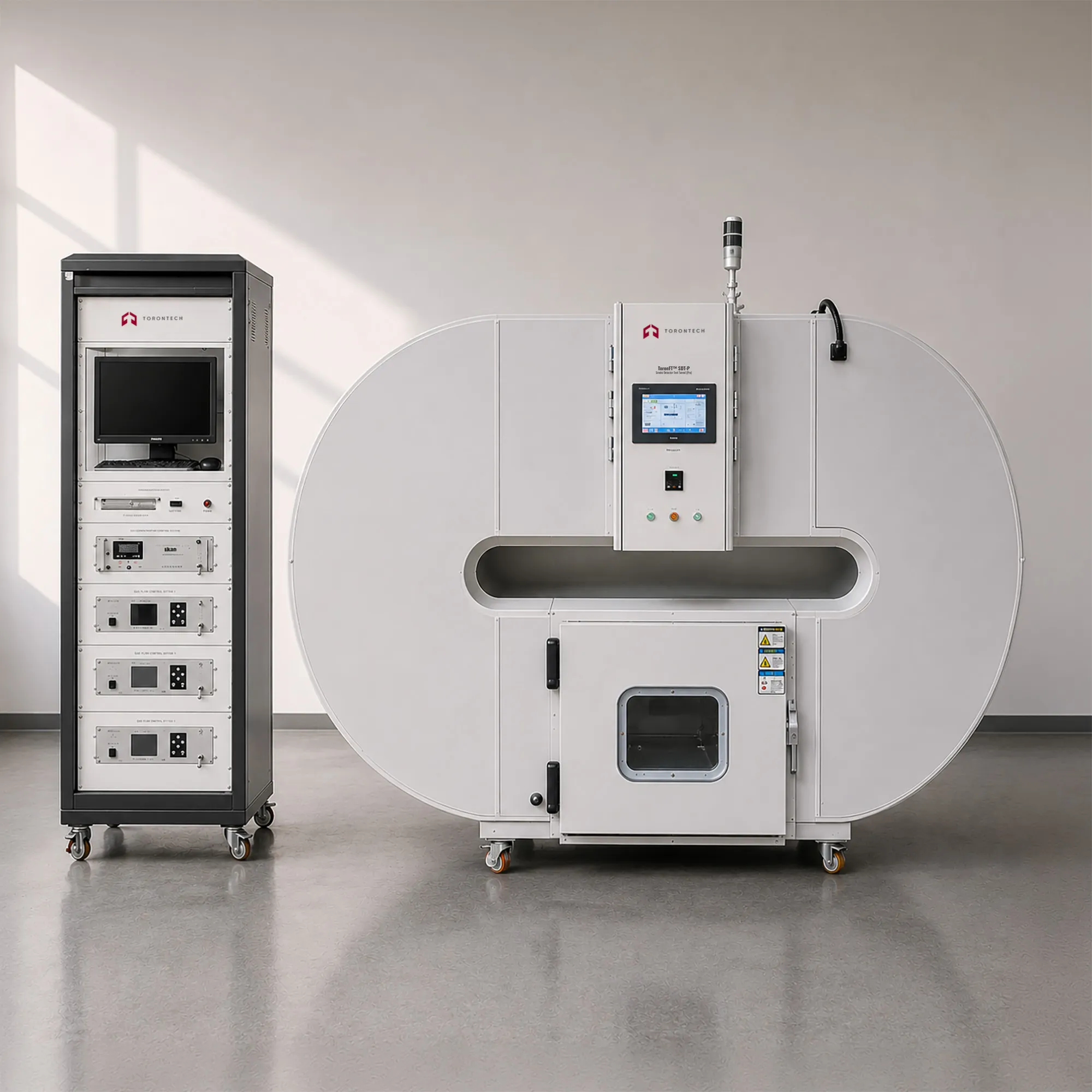
Smoke Detector Test Tunnel (Pro) - ToronFT™ SDT-P
ToronFT™ SDT-P Smoke Detector Test Tunnel gives fire-detection manufacturers and certification laboratories a controlled space for measuring how point-type smoke detectors respond. A closed-loop wind tunnel conditions airflow, temperature, and humidity around the detector, then introduces a calibrated test aerosol to find the point at which the device alarms. Qualitest supplies the SDT-P (Pro) build for type-approval and production-control testing to EN 54-7, UL 268, and ISO 7240-7. The tunnel reports the response threshold value directly, letting operators compare each result against the limits in the applicable standard.
Manufacturers use the SDT-P to verify that a detector reacts within specification regardless of airflow direction or the orientation of the unit. The Pro configuration adds the conditioning range needed for high-temperature and low-temperature response checks, along with the humidity control required for damp-heat sequences. Operators set airflow velocity, temperature, and aerosol concentration from the control software, which records each run for the test report. This combination supports the development of new detector models and the routine quality control of production batches.
Repeatable conditions keep the data defensible. The SDT-P holds aerosol concentration and airflow steady through each measurement, so results from one run match the next and hold up to audit during certification.
Smoke Detector Test Tunnel (Pro) - ToronFT™ SDT-P Applications
The ToronFT™ SDT-P serves laboratories and manufacturers that develop, certify, and quality-check point-type fire detectors.
- Fire Detector Manufacturing: response-threshold and repeatability testing of photoelectric, ionization, and dual-sensor smoke detectors during production-control checks
- Certification and Type-Approval Laboratories: measurement of detector sensitivity against EN 54-7, UL 268, and ISO 7240-7 limits for product approval
- Research and Product Development: evaluation of new sensor designs and alarm algorithms under controlled airflow and aerosol conditions
- Smoke Alarm (EN 14604) Testing: sensitivity and air-movement testing of standalone domestic smoke alarms
- Heat Detector Evaluation: temperature-ramp testing of point heat detectors using the same conditioned tunnel per EN 54-5 and ISO 7240-5
- Third-Party Test Houses: independent verification of detector performance for importers, distributors, and regulatory submissions
Standards
The ToronFT™ SDT-P supports the response and environmental test methods defined in the recognized standards for point-type smoke detectors.
- EN 54-7 - Fire detection and fire alarm systems: Part 7: Point smoke detectors using scattered light, transmitted light or ionization
- ISO 7240-7 - Fire detection and alarm systems: Part 7: Point-type smoke detectors using scattered light, transmitted light or ionization
- UL 268 - Standard for Smoke Detectors for Fire Alarm Systems
- EN 14604 - Smoke alarm devices
- EN 54-5 - Fire detection and fire alarm systems: Part 5: Heat detectors: Point heat detectors
- ISO 7240-5 - Fire detection and alarm systems: Part 5: Point-type heat detectors
Smoke Detector Test Tunnel (Pro) - ToronFT™ SDT-P Key Features
The Pro configuration combines conditioning hardware, flow management, and software control in one closed-loop tunnel.
- Closed-Loop Wind Tunnel: recirculating airflow path reaches test conditions quickly and holds a stable velocity profile across the detector mount
- Variable Airflow Control: fan adjustable from 0 to 6.5 m/s covers the 0.2, 0.8, and 1.0 m/s velocities called out in the smoke detector test methods
- Flow Straightening: rectifier grid and guide vanes deliver uniform, low-turbulence air to the test section for repeatable aerosol entry
- Integrated Heating: heater spans 35°C to 75°C at a controlled 0.8°C to 1°C per minute ramp for high-temperature response checks
- Sub-Ambient Conditioning: evaporator reaches down to −40°C at a controlled cool-down rate for low-temperature testing
- Humidity Control: humidifier holds 90% to 96% relative humidity for damp-heat sequences
- Precision Sensing: temperature sensor reads to ±0.5°C and the humidity sensor to ±0.5% RH, both at 0.1 resolution, for traceable conditioning data
- Calibrated Anemometer: airflow measurement from 0.2 to 10 m/s within ±5% confirms velocity at the test point
- Software-Driven Operation: control software sets parameters, runs the test sequence, and logs results for the certification report
- Aerosol Management: dedicated aerosol inlet and concentration measurement feed the response-threshold calculation
Theory and Method
A point smoke detector alarms when the aerosol concentration in the air reaches its response threshold. The SDT-P measures that threshold by passing the detector and the reference instruments through one controlled airflow while a generator feeds test aerosol into the loop at a steady rate. As concentration climbs, an optical density meter tracks light obscuration in decibels per meter (the m value) while a measuring ionization chamber tracks the y value. When the detector alarms, the system records the concentration at that instant as the response threshold value.
Airflow direction and speed change how aerosol enters a detector's sensing chamber, so the standards require sensitivity to stay stable across orientations and across a range of air velocities. The SDT-P sets velocity with a variable-speed fan and straightens the flow through a rectifier grid before it reaches the test section. Guide vanes and a rectangular closed-loop path hold a uniform velocity profile across the detector mount. Operators rotate the detector through defined orientations and repeat the measurement to confirm the response stays within the allowed ratio.
Environmental conditioning extends the same principle to temperature and humidity. The heater, evaporator, and humidifier bring the loop to a set point before aerosol enters, which lets the laboratory measure response at high and low operating temperatures and under damp-heat conditions. Because the tunnel recirculates its air, it reaches and holds these set points quickly and purges aerosol between runs for a clean baseline. Continuous monitoring of velocity, temperature, and humidity keeps every measurement traceable to the conditions recorded in the report.
Smoke Detector Test Tunnel (Pro) - ToronFT™ SDT-P Technical Specifications
| Parameter | Specification |
|---|---|
| Airflow Velocity Range | 0 to 6.5 m/s, continuously adjustable |
| Heating Temperature Range | 35°C to 75°C, continuously adjustable |
| Heating Rate | 0.8°C to 1°C per minute |
| Humidity Range | 90% to 96% RH, continuously adjustable |
| Humidification Rate | 4.5% to 5% per minute |
| Cooling Temperature Range | 0°C to -40°C, continuously adjustable |
| Cooling Rate | 0.8°C to 1°C per minute |
| Temperature Sensor Accuracy | ≤ ±0.5°C |
| Temperature Sensor Resolution | ≤ 0.1°C |
| Humidity Sensor Accuracy | ≤ ±0.5% RH |
| Humidity Sensor Resolution | ≤ 0.1% RH |
| Anemometer Measurement Range | 0.2 to 10 m/s |
| Anemometer Accuracy | ≤ ±5% |
| Anemometer Resolution | ≤ 0.1 m/s |
| System Composition | Test chamber, control cabinet, control software |
| Test Chamber Components | Closed-loop wind tunnel, turbine fan, drive motor, guide vanes, rectifier grid, air inlet door, exhaust door, detector test rack, aerosol inlet, concentration measurement, anemometer |