
Single Tube Distillation Apparatus
Single Tube Distillation Apparatus - TT-86
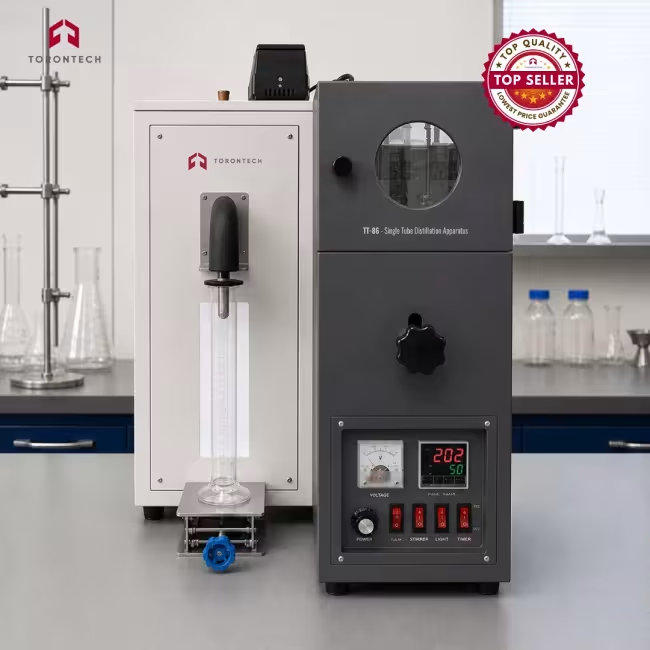
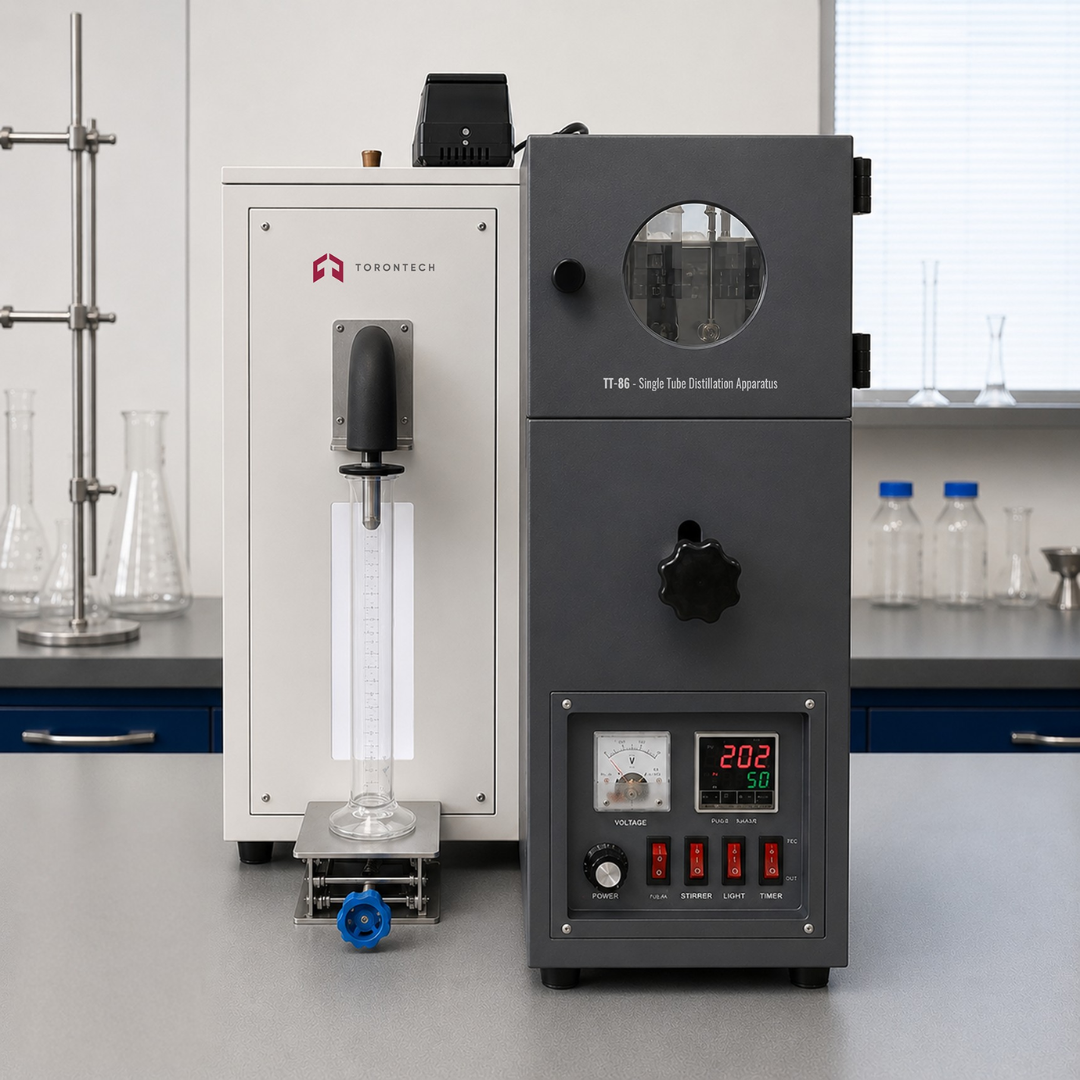
The Single Tube Distillation Apparatus TT-86 determines the boiling range characteristics of light and middle petroleum distillates for refinery, terminal, and quality control laboratories. The instrument distills a 100 mL specimen at ambient pressure under the conditions defined by ASTM D86. Operators record vapor temperatures against recovered condensate volume to build a complete distillation curve. Torontech supplies the TT-86 as the single tube member of its D86 range, sized for laboratories running moderate daily sample loads.
Sample coverage spans automotive spark ignition fuels with and without oxygenates, aviation gasolines, and aviation turbine fuels. The method also applies to diesel fuels, biodiesel blends up to 20 percent, marine fuels, naphthas, white spirits, kerosines, and Grades 1 and 2 burner fuels. A quartz tube furnace heats the flask. A stainless steel bath holds the condenser coolant at a controlled temperature. Manual power adjustment from 0 to 1000 W gives the analyst direct authority over heating rate at every stage of the run.
Construction details support long service in a working fuel laboratory. Stainless steel forms the condenser bath, the flask support stand, and the briquette. A quartz glass inspection window and LED auxiliary lighting keep the flask neck and the first drop visible throughout the test. A digital voltmeter reports the applied heating voltage, so the operator can reproduce a known ramp on repeat samples. The TT-86 accepts standard 125 mL distillation flasks and 100 mL graduated cylinders.
Single Tube Distillation Apparatus - TT-86 Applications
The TT-86 serves any laboratory that specifies, blends, or verifies volatile petroleum products against a published boiling range.
- Refinery Quality Control: verifies that gasoline, kerosine, and diesel streams meet the distillation limits written into product specifications before blending or release
- Fuel Terminals and Custody Transfer: confirms boiling range on receipt and dispatch to detect contamination, cross-blending, or off-specification product
- Aviation Fuel Testing: measures the distillation profile of aviation gasolines and aviation turbine fuels against Jet A and Jet A-1 requirements
- Diesel and Biodiesel Laboratories: checks the T90 and final boiling point of diesel fuels and biodiesel blends up to B20 to predict combustion behavior and deposit formation
- Marine Fuel Analysis: profiles distillate marine fuels to confirm volatility and support bunker quality disputes
- Solvent and Naphtha Production: establishes the boiling range of white spirits, special petroleum spirits, and naphthas used as process feedstocks or industrial solvents
- Third-Party Testing and Certification Laboratories: provides ASTM D86 distillation data for commercial certificates of analysis and regulatory reporting
Standards
The TT-86 follows the apparatus, procedure, and condition group requirements of the recognized atmospheric distillation test method for petroleum products.
- ASTM D86 - Standard Test Method for Distillation of Petroleum Products and Liquid Fuels at Atmospheric Pressure
Single Tube Distillation Apparatus - TT-86 Key Features
The feature set targets the two things that decide D86 data quality: controlled heat input and a stable condenser bath.
- Stepless Heating Control: a continuously adjustable 0 to 1000 W supply lets the operator match the heating rate to the sample condition group without stepped increments
- Quartz Tube Furnace: delivers even radiant heat to the flask bottom and reaches working temperature quickly for short cycle times
- Temperature-Controlled Condenser Bath: holds coolant from 0°C to 60°C within ±0.5°C so condensation conditions stay correct for both light and heavy samples
- Motor-Driven Bath Agitation: circulates the coolant continuously to remove temperature gradients across the condenser tube
- Stainless Steel Construction: bath, flask support stand, and briquette resist fuel exposure and repeated cleaning across long service life
- Quartz Glass Inspection Window: gives a clear view of the flask during heating so the analyst can watch for boiling onset and irregular behavior
- LED Auxiliary Lighting: illuminates the condenser outlet and cylinder graduations for reliable first-drop detection and volume reading
- Digital Voltmeter Display: shows applied heating voltage as a numeric value, making a validated ramp easy to repeat on later samples
- Silicone Sealing Plugs: locate the thermometer and secure the distillation flask joint to keep vapor losses low
- Insulated Receiving Cylinder Bath: maintains the graduated cylinder at the specified receiver temperature during collection
- Manual Furnace Positioning: allows the operator to set and adjust the flask position directly, useful for teaching laboratories and low-throughput work
Theory and Method
Distillation separates a fuel by boiling point. Every component in a petroleum mixture exerts a vapor pressure that rises with temperature, and the liquid boils once that vapor pressure reaches the surrounding atmospheric pressure. Lighter components reach that balance first and leave the flask as vapor, so the temperature measured at the flask neck tracks the composition of whatever fraction is evaporating at that moment. As the light ends deplete, the remaining liquid grows heavier and the vapor temperature climbs.
ASTM D86 turns that behavior into a repeatable measurement. The method charges 100 mL of sample into a 125 mL flask and condenses the vapor in a tube cooled by a temperature-regulated bath. Condensate collects in a 100 mL graduated cylinder. The analyst pairs each vapor temperature with the recovered volume at that instant, producing the initial boiling point, the percentage recovered points, the final boiling point, and the recovery, residue, and loss figures. The prescribed geometry delivers roughly one theoretical plate of fractionation.
Heating rate governs accuracy more than any other variable. Too fast a ramp carries heavier material over before it should. Too slow a ramp flattens the front end of the curve. The TT-86 addresses this with a stepless voltage regulator driving a quartz tube furnace, letting the operator hold the time to initial boiling point and the recovery rate inside the windows ASTM D86 sets for each condition group. Motor stirring keeps the bath uniform, so condensation temperature stays stable throughout.
Single Tube Distillation Apparatus - TT-86 Technical Specifications
| Parameter | Specification |
|---|---|
| Test Method | ASTM D86 (atmospheric distillation) |
| Configuration | Single tube |
| Sample Volume | 100 mL |
| Distillation Flask | 125 mL |
| Graduated Cylinder | 100 mL |
| Heating Power | 0 to 1000 W, continuously adjustable |
| Heating Element | Quartz tube furnace |
| Voltage Regulation | Stepless (SSVR) |
| Condenser Bath Temperature Range | 0°C to 60°C |
| Temperature Control Accuracy | ±0.5°C |
| Bath Agitation | Motor-driven stirring |
| Furnace Body Control | Manual |
| Display | Digital voltmeter |
| Illumination | LED auxiliary lighting |
| Inspection Window | Quartz glass |
| Bath and Fixture Material | Stainless steel |
| Power Supply | AC 220 V ±10%, 50 Hz |
| Ambient Temperature | 10°C to 40°C |
| Ambient Humidity | ≤85% |
Configuration and Included Components
| Item | Description |
|---|---|
| Quartz Tube Furnace | Radiant heating element for the distillation flask |
| Stainless Steel Condenser Bath | Temperature-controlled coolant bath with motor stirring |
| Stainless Steel Flask Support Stand | Positions and supports the distillation flask over the furnace |
| Stainless Steel Briquette | Heat-distributing plate beneath the distillation flask |
| Receiving Cylinder Insulation Bath | Holds the graduated cylinder at the specified receiver temperature |
| Cylinder Plug | Seals the graduated cylinder during collection to limit evaporative loss |
| Cylinder Support Stand | Stainless steel stand locating the graduated cylinder under the condenser outlet |
| Silicone Plugs | Secure the thermometer and the distillation flask joint |
| Quartz Glass Inspection Window | Viewing port into the heating chamber |
| LED Lighting Unit | Auxiliary illumination for first-drop and volume observation |
| Digital Voltmeter | Numeric readout of applied heating voltage |