
Half Sine, Sawtooth, and Trapezoidal Shock Test System for 30 to 1,000 kg Payloads
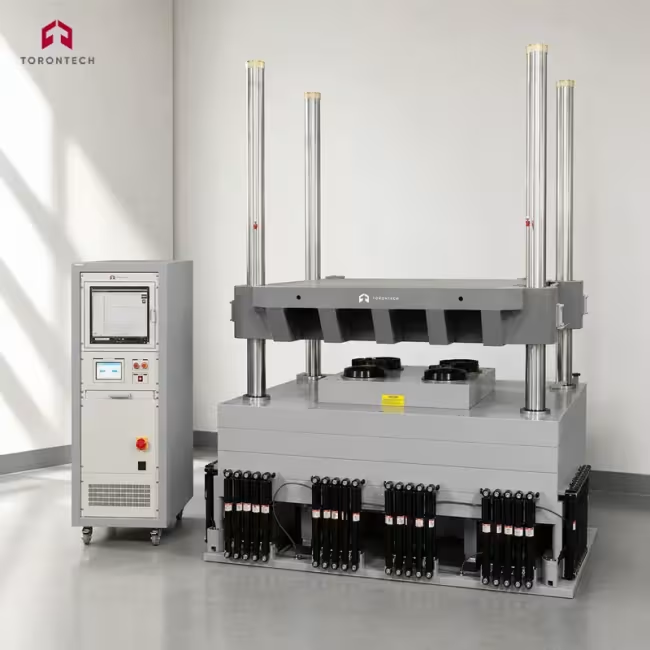
A shock test system reproduces the impact, drop, and handling events a product meets during transport and service, so structural weaknesses surface in the laboratory rather than at the customer. The ToronSTS™ Series accelerates a table carrying the specimen into a programmer that shapes the pulse, producing half sine, sawtooth, and trapezoidal profiles. Seven models cover payloads up to 1,000 kg (2,205 lb). Peak acceleration reaches 600 G, with half sine durations as short as 1 ms.
Table area scales with payload, starting at 400 x 400 mm on the ToronSTS™ 30 and reaching 2,000 x 2,000 mm on the ToronSTS™ 1000. The larger tables carry palletized loads, appliances, and complete cabinets without overhang. Pneumatic boost supplements the gravity drop, so a target acceleration can be reached at a lower machine height. Air spring isolation with hydraulic damping keeps the reaction load off the building, and no foundation pit or anchor block is required.
Waveform selection determines what a test proves. Half sine profiles cover general handling and transport shock. Sawtooth pulses deliver the clean velocity change used for fragility and cushion evaluation. Trapezoidal pulses hold acceleration near constant across the event, which suits equipment and enclosure qualification. Operators fit the matching programmer, set drop height and boost pressure at the touchscreen, and repeat the shot until the recorded pulse falls inside tolerance.
Shock Test System - ToronSTS™ Series Applications
- Packaging and distribution: Establishes the damage boundary of a packed product and validates cushion designs, so protective material can be matched to the shock levels a shipping lane actually delivers.
- Consumer appliances and white goods: Subjects refrigerators, washers, and their internal mounts to handling shock at full unit weight, exposing bracket fatigue and compressor mount failures before field returns start.
- Consumer electronics and displays: Checks panel assemblies, chassis, and connector retention on televisions, monitors, and laptops against the impacts of parcel and pallet transport.
- Automotive components: Verifies that instrument clusters, control modules, lighting assemblies, and battery mounts stay functional and mechanically intact after transient acceleration loading.
- Energy storage: Tests cells, modules, and complete packs for enclosure integrity, terminal security, and electrical isolation after shock, at weights the smaller shock machines cannot carry.
- Aerospace and defense: Qualifies avionics boxes, ground support hardware, and shipping containers against half sine and sawtooth pulses defined in customer test specifications.
- Industrial and medical equipment: Confirms that imaging units, analyzers, and machine assemblies arrive aligned and operational after the handling shocks of crated shipment.
Shock Test System - ToronSTS™ Series Key Features
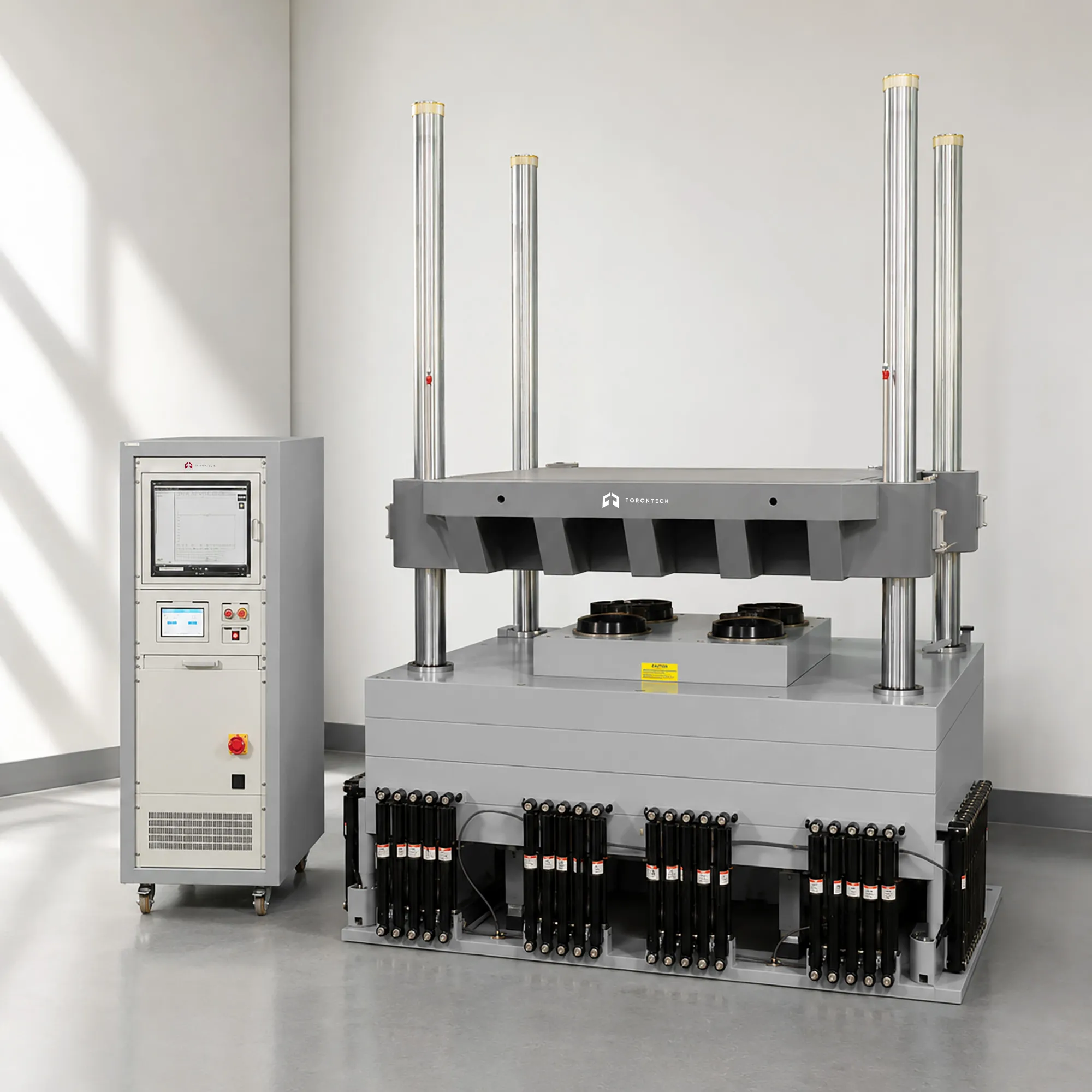
- Three pulse shapes on one platform, so half sine handling shock, sawtooth fragility work, and trapezoidal qualification runs share a single machine and a single fixturing approach.
- Payload range of 30 to 1,000 kg across seven models, covering component-level work and full palletized units without forcing a laboratory into two separate machines.
- Table sizes to 2,000 x 2,000 mm, large enough to mount appliances, cabinets, and crated assemblies with the center of gravity kept over the table.
- Combined pneumatic and hydraulic boost and braking that arrests the table after first contact and prevents multiple-impact contamination of the recorded pulse.
- Air spring isolation with hydraulic damping, allowing installation on a standard laboratory floor without a foundation pit, isolation mass, or structural anchoring.
- Touchscreen control of drop height and boost pressure, with stored settings that let a technician repeat a qualified pulse without re-tuning.
- Interlocked guarding and a full safety protection circuit covering table release, travel, and braking.
- Optional dual-mass shock amplifier for accelerations above the standard capability of the machine.
- Interchangeable programmer and waveform generator sets, so pulse capability can be extended after installation as test requirements change.
Theory and Method
Drop-table shock testing converts a controlled velocity change into a measured acceleration pulse. The table and specimen are raised to a set height, released, and accelerated down guide rails by gravity and pneumatic boost. Contact with a programmer mounted on the seismic base decelerates the assembly over a few milliseconds. Programmer stiffness, programmer travel, and impact velocity together set the peak acceleration and the duration. An accelerometer on the table records the waveform for evaluation against the target pulse.
Each pulse shape comes from a different programmer. Elastomeric programmers give the half sine profile, where resisting force rises and falls with deflection. Gas and crushable programmers hold force closer to constant through the stroke, which produces the trapezoidal and sawtooth profiles. Changing the pulse shape means changing hardware on the base rather than editing a screen setting. The waveform generator set supplied with a machine determines which profiles a laboratory can run.
Peak acceleration and pulse duration are not set independently. Raising the drop height increases impact velocity, which raises peak G and shortens the pulse for a given programmer. Adding boost pressure produces the same effect without a taller machine. Braking engages after first contact so the table cannot rebound into the programmer, which would apply an unrecorded second shock and invalidate the run.
A typical sequence starts with a trial pulse on a dummy mass matched to the specimen weight. Drop height, boost pressure, and programmer are tuned against the recorded trace until peak acceleration and duration sit inside the required tolerance band. The specimen is then secured to the table, with fixturing kept as rigid as the part allows, because a compliant mount filters the pulse and understates what the specimen experiences. Shots are repeated on each axis called for by the test plan.
Shock Test System - ToronSTS™ Series Technical Specifications
| Specification | ToronSTS™ 30 | ToronSTS™ 75 | ToronSTS™ 100 | ToronSTS™ 200 | ToronSTS™ 300 | ToronSTS™ 600 | ToronSTS™ 1000 |
|---|---|---|---|---|---|---|---|
| Table size | 400 x 400 mm (15.7 x 15.7 in) | 500 x 600 mm (19.7 x 23.6 in) | 700 x 800 mm (27.6 x 31.5 in) | 1,000 x 1,000 mm (39.4 x 39.4 in) | 1,200 x 1,200 mm (47.2 x 47.2 in) | 1,500 x 1,500 mm (59.1 x 59.1 in) | 1,500 x 1,500 mm (59.1 x 59.1 in) |
| Max. specimen weight | 30 kg (66 lb) | 75 kg (165 lb) | 100 kg (220 lb) | 200 kg (441 lb) | 300 kg (661 lb) | 600 kg (1,323 lb) | 1,000 kg (2,205 lb) |
| Max. acceleration, half sine | 600 G | 500 G | 500 G | 300 G | 300 G | ||
| Max. acceleration, sawtooth | 100 G | ||||||
| Max. acceleration, trapezoidal | 100 G | 60 G | 50 G | 50 G | 50 G | ||
| Pulse duration, half sine | 1 to 60 ms | 1 to 60 ms | 2 to 60 ms | 3 to 60 ms | 3 to 60 ms | 3 to 60 ms | 3 to 60 ms |
| Pulse duration, sawtooth | 6 to 18 ms | ||||||
| Pulse duration, trapezoidal | 6 to 12 ms | ||||||
| Optional devices | Dual-mass shock amplifier, waveform generator | ||||||