
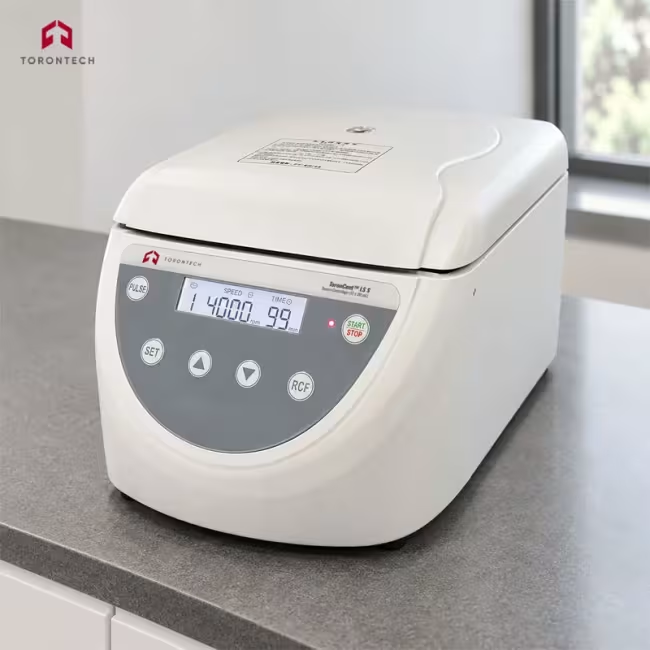
Serum Centrifuge (12 x 20 mL) - ToronCent™ LS S
ToronCent™ LS S serum centrifuge spins 12 x 20 mL or up to 24 blood collection tubes at 4,000 rpm and 2,200 x g, in a 12 kg housing drawing 100 W. Hospital laboratories, physician offices, veterinary clinics, and teaching labs use it as a dedicated serum and plasma station. Three of its four rotors take 5 mL and 7 mL blood collection adapters, the format most chemistry and serology panels arrive in. Noise stays at or below 62 dB(A).
Four angle rotors cover the working formats. The 12 x 20 mL rotor handles larger draw volumes, the 18 x 10 mL and 24 x 10 mL rotors raise tube count per run, and a 4 x 50 mL rotor takes conical tubes for pooled or concentrated samples. All four share the same 4,000 rpm and 2,200 x g rating, so switching rotors changes throughput without changing the separation the protocol was validated against. Rotor swaps therefore need no revalidation of the spin conditions.
A touch panel and LCD display drive setup, and a microprocessor holds speed within ±30 rpm. An electronic door lock blocks operation when the lid is open and holds the lid shut while the rotor turns. The housing is molded as one piece, which leaves no seams to trap spilled sample and makes wipe-down between runs straightforward. A damping structure keeps a light instrument steady on the bench.
Serum Centrifuge (12 x 20 mL) - ToronCent™ LS S Applications
The ToronCent™ LS S covers the tube formats and separation window that routine serum and plasma work calls for.
- Clinical Chemistry: serum separation ahead of analyzer runs for metabolic, lipid, liver, and renal panels
- Gel Separator Tube Processing: spinning SST and equivalent tubes so the gel forms a stable barrier between serum and the cellular fraction
- Serology and Immunoassay Preparation: clarified serum for antibody, hormone, and infectious disease testing
- Plasma Preparation: processing anticoagulated tubes for coagulation and specialty chemistry panels
- Physician Office and Point-of-Care Laboratories: a 12 kg unit sized for a collection room or satellite site rather than a central bench
- Veterinary Clinics: small-batch serum and plasma work on the same tube formats used in human diagnostics
- Blood Collection Sites: on-site separation ahead of transport, with a footprint that suits a mobile or temporary setup
- Urinalysis: sediment concentration in 10 mL tubes before microscopic examination
- Teaching Laboratories: a quiet, low draw instrument for student benches and demonstration work
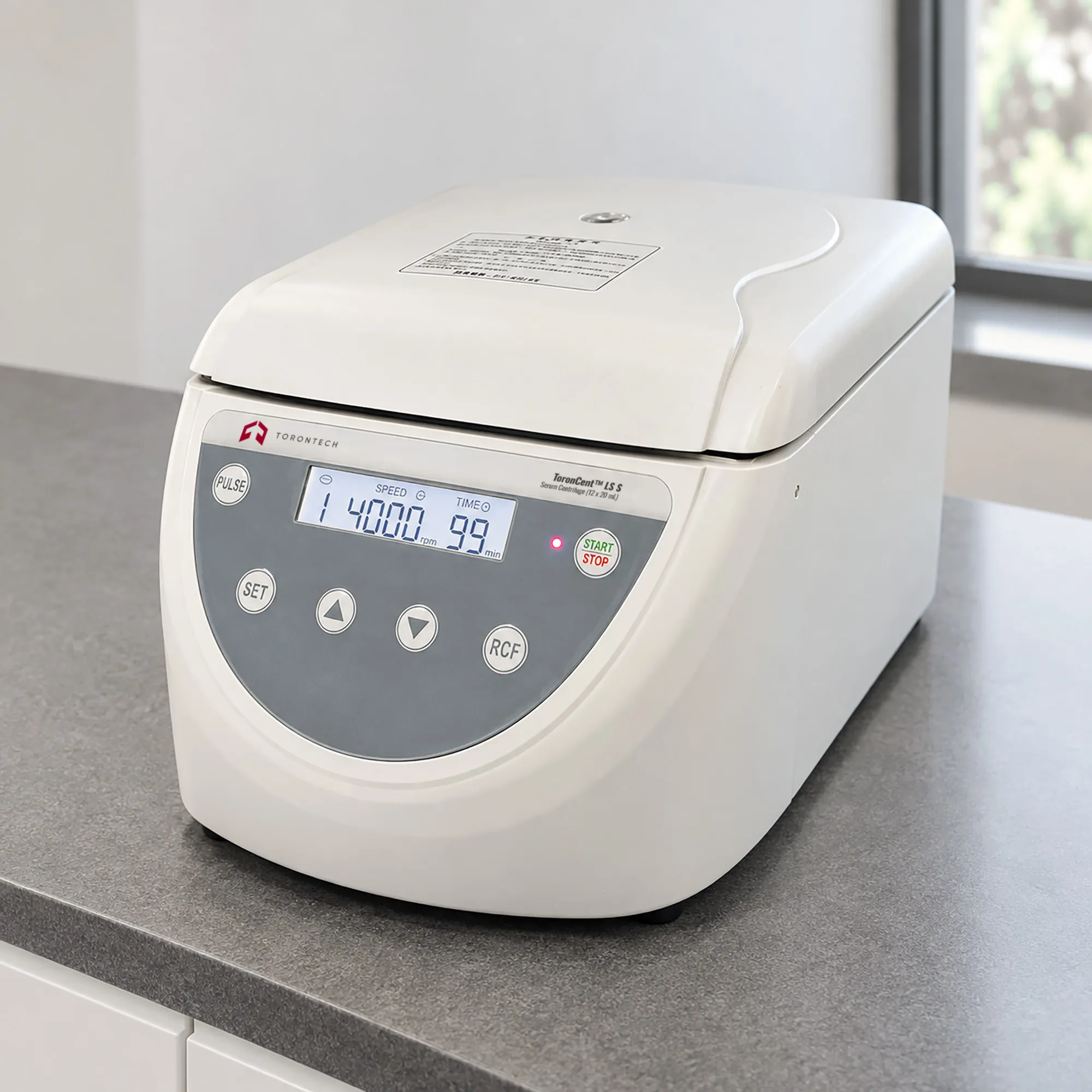
Serum Centrifuge (12 x 20 mL) - ToronCent™ LS S Key Features
The rotor set, control panel, and mechanical build target laboratories running blood tubes in volume rather than mixed sample types.
- Four Angle Rotors: 12 x 20 mL, 18 x 10 mL, 24 x 10 mL, and 4 x 50 mL, all rated to the same speed and g-force so throughput changes without altering the separation
- 24 Tube Maximum: the highest tube count in the range, sized for batch processing of collection tubes
- 5 mL and 7 mL Blood Collection Adapters: fit three of the four rotors, matching the tube formats most chemistry and serology panels use
- 2,200 x g Ceiling: sits inside the window routine serum protocols call for, keeping hemolysis risk low
- 12 kg and 100 W: the lightest and lowest draw unit across the low speed range, which suits a collection room, a satellite site, or a mobile setup
- Noise at or Below 62 dB(A): the quietest figure in the family, workable in a room where staff and patients are present
- Electronic Door Lock: blocks the run when the lid is open and holds the lid shut while the rotor turns
- One-Piece Molded Housing: leaves no seams to trap spilled sample, so wipe-down between runs is quick
- Touch Panel and LCD Display: shows speed and time on one screen with direct key entry
- DC Brushless Motor: runs without carbon brushes, leaving no carbon dust in the chamber and no brush replacement over the service life
- Microprocessor Speed Control: holds set speed within ±30 rpm
- Vibration Damping Structure: absorbs residual rotor imbalance so a light instrument stays put on the bench
- Second-Resolution Countdown: displays remaining time in seconds once a run drops under a minute
Theory and Method
Serum separation starts with a process the centrifuge does not perform. Blood drawn into a plain or gel tube clots as fibrin polymerizes into a network that traps the cellular fraction, and that clot retracts over roughly half an hour, squeezing serum out. Centrifugation then completes the job by driving the retracted clot and any remaining cells to the bottom of the tube. Serum, being the least dense component, rises and forms a clear layer that the analyzer or the pipette can reach.
Gel separator tubes exploit a density that sits between the two fractions. At rest the gel is a viscous plug at the tube bottom, dense enough to stay put under gravity. Under load it thins and flows, and because its density falls between the serum above and the packed cells below, it migrates to that boundary and stops. The gel firms up again as the rotor slows, leaving a barrier that stops cells leaking analytes back into the serum during storage.
The separation window matters more than raw speed. Excessive force ruptures red cells and releases hemoglobin, potassium, and enzymes into the serum, which corrupts the very panels the sample was drawn for. A ceiling of 2,200 x g sits comfortably inside the range routine serum protocols specify. The fixed angle geometry suits this work because tubes sit close to the spindle at a short radius, keeping the instrument compact while the sedimentation path stays short enough for a fast run.
Serum Centrifuge (12 x 20 mL) - ToronCent™ LS S Technical Specifications
| Parameter | Specification |
|---|---|
| Maximum Speed | 4,000 rpm |
| Maximum RCF | 2,200 x g |
| Maximum Capacity | 12 x 20 mL |
| Speed Accuracy | ±30 rpm |
| Time Setting Range | 1 min to 99 min |
| Motor | DC brushless |
| Control | Microprocessor, touch panel, LCD display |
| Housing | One-piece molded |
| Door Lock | Electronic interlock |
| Noise Level | ≤62 dB(A) |
| Voltage | AC 220 V ±22 V, 50/60 Hz (110V is also available) |
| Power Consumption | 100 W |
| Dimensions (W x D x H) | 456 x 330 x 266 mm |
| Packing Dimensions (W x D x H) | 568 x 423 x 300 mm |
| Net Weight | 12 kg |
Rotor Range
| Rotor | Type | Maximum Capacity | Maximum Speed | Maximum RCF | Adapters |
|---|---|---|---|---|---|
| Rotor 1 | Fixed angle | 12 x 20 mL | 4,000 rpm | 2,200 x g | 5 mL and 7 mL blood collection tube |
| Rotor 2 | Fixed angle | 18 x 10 mL | 4,000 rpm | 2,200 x g | 5 mL and 7 mL blood collection tube |
| Rotor 3 | Fixed angle | 24 x 10 mL | 4,000 rpm | 2,200 x g | 5 mL and 7 mL blood collection tube |
| Rotor 4 | Fixed angle | 4 x 50 mL | 4,000 rpm | 2,200 x g |