

Salinity Digital Refractometer – ToronDR™ Salt
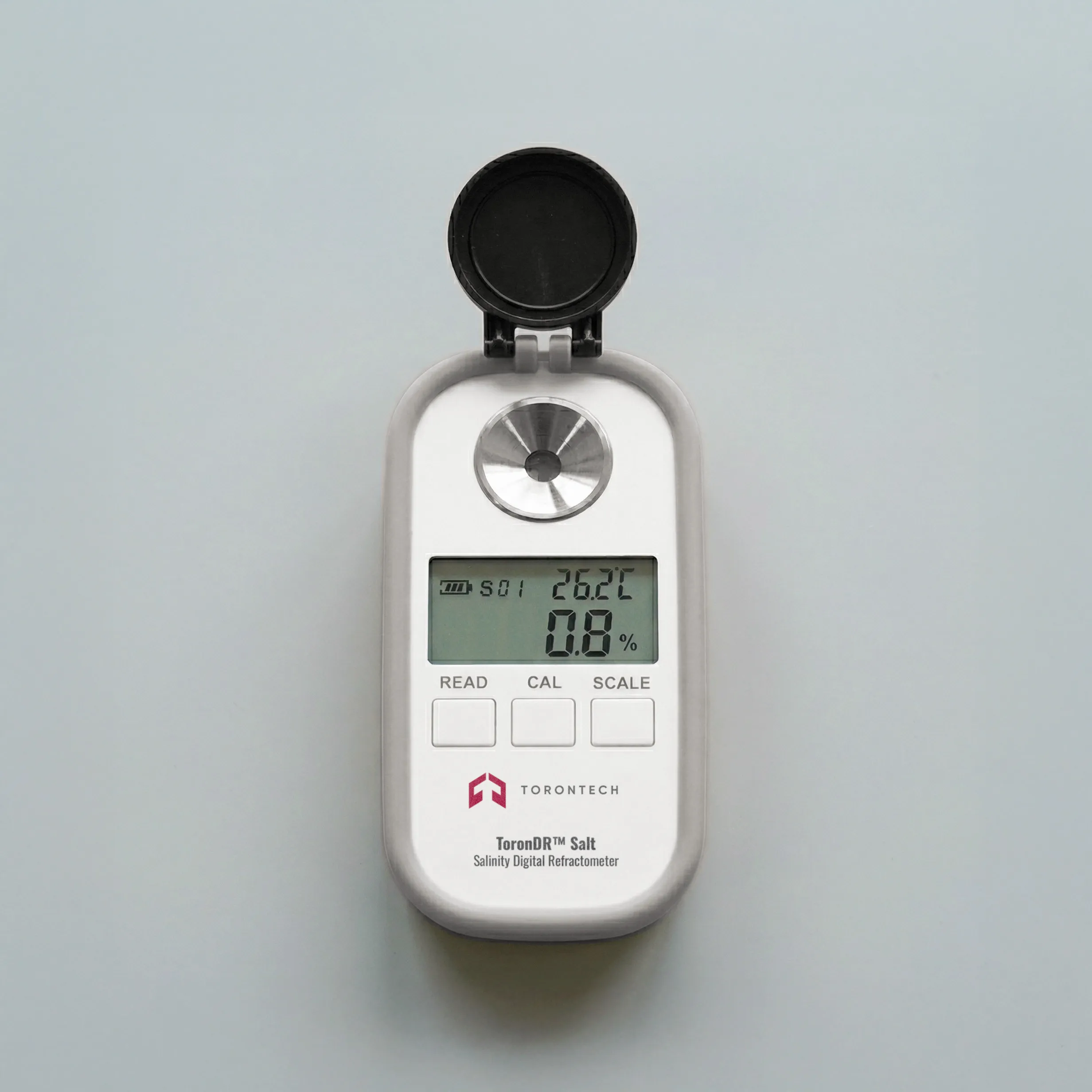
A Digital Refractometer in the ToronDR™ Salt line is designed for fast salinity measurement with direct digital readout instead of a manual optical scale. Based on the listed ToronDR™ Salt 201 and ToronDR™ Salt 202 models, this product family is built for salinity, specific gravity, and refractive index testing, with one model focused on sodium chloride brine and the other focused on seawater salinity and chlorinity.
The ToronDR™ Salt 201 with 0.0–28.0% sodium chloride salinity, 0–280‰ salinity, 1.000–1.217 specific gravity, and 1.3330–1.3900 nD, while ToronDR™ Salt 202 is configured for 0–100‰ sea-water salinity, 0–57‰ chlorinity, 1.000–1.070 specific gravity, and 1.3330–1.3530 nD.
This makes ToronDR™ Salt suitable for brine preparation, marine monitoring, aquarium systems, salt-water process control, and general laboratory salinity screening. Compared with a manual Salinity Refractometer, the digital format offers a quicker numerical result and reduces operator reading error from light/dark boundary interpretation.
ToronDR™ Salt is a handheld Digital Refractometer platform for salt-water and brine measurement. The family includes two application-specific models rather than one generic instrument. ToronDR™ Salt 201 is built for high-range sodium chloride salinity work, while ToronDR™ Salt 202 is tailored to seawater-style measurement with salinity, chlorinity, specific gravity, and refractive-index scales more suited to marine systems.
This category is different from a manual optical salinity refractometer because the result is shown digitally and the model structure is application-specific. One unit is better for concentrated salt solutions and industrial brine, while the other is better for seawater and marine monitoring where chlorinity and lower-range specific gravity matter more.
Salinity Digital Refractometer – ToronDR™ Salt Application
- Brine concentration control: ToronDR™ Salt 201 is the better fit for sodium chloride brine and higher salt concentration checks because its range extends to 28.0% NaCl salinity and 280‰ salinity. This is useful for salt solution preparation, industrial brine handling, food-process salt solutions, and other higher-concentration applications where a seawater-range instrument would be too limited.
- Seawater and marine monitoring: ToronDR™ Salt 202 is designed for seawater-style measurement with 0–100‰ sea-water salinity, 0–57‰ chlorinity, and 1.000–1.070 specific gravity. This makes it more suitable for aquariums, aquaculture, marine research, seawater preparation, and related quality-control work.
- Aquarium and aquaculture use: a digital Salinity Refractometer is useful in aquarium and aquaculture settings because it provides a quick reading of seawater salinity and specific gravity without requiring manual interpretation. The ToronDR™ Salt 202 model is especially relevant here because its measurement layout is aligned with marine-water conditions rather than concentrated industrial brine.
- Laboratory and process quality control: both models also fit laboratory and process environments where operators need a compact digital instrument for incoming checks, batch comparison, or routine liquid monitoring. The addition of refractive index and specific gravity scales broadens the usefulness of the platform beyond a single salinity number.
Salinity Digital Refractometer – ToronDR™ Salt Key Features
- Handheld Digital Refractometer design for direct salinity-related numeric readout.
- Two application-focused models: one for high-range sodium chloride brine and one for seawater salinity and chlorinity.
- DR-201 covers 0.0–28.0% sodium chloride salinity, 0–280‰ salinity, 1.000–1.217 specific gravity, and 1.3330–1.3900 nD.
- DR-202 covers 0–100‰ sea-water salinity, 0–57‰ chlorinity, 1.000–1.070 specific gravity, and 1.3330–1.3530 nD.
- Digital workflow is easier to read than a manual optical Salinity Refractometer during repeated testing.
- Multi-parameter structure improves usefulness across marine, brine, aquarium, and lab environments.
Theory and Method
A Digital Refractometer measures how light changes as it passes through a liquid sample, then converts that optical response into a digital value. In the ToronDR™ Salt family, this allows the instrument to display salinity, specific gravity, chlorinity, or refractive index depending on the model. The ToronDR™ Salt 201 and ToronDR™ Salt 202 show this clearly by pairing refractive index with salt-related interpretation scales in one handheld digital unit.
This digital method reduces manual reading error and makes repeated checks easier during routine work. That is especially helpful when operators need to compare multiple samples quickly in production, marine monitoring, or laboratory screening tasks.
Salinity Digital Refractometer – ToronDR™ Salt Technical Specification
| Specification | ToronDR™ Salt 201 | ToronDR™ Salt 202 |
|---|---|---|
| Product positioning | High-range sodium chloride salinity digital refractometer | Seawater salinity / chlorinity digital refractometer |
| Salinity range | 0.0–28.0% sodium chloride salinity; 0–280‰ salinity | 0–100‰ sea-water salinity |
| Chlorinity range | — | 0–57‰ chlorinity |
| Specific gravity range | 1.000–1.217 | 1.000–1.070 |
| Refractive index range | 1.3330–1.3900 nD | 1.3330–1.3530 nD |
| Best-fit use case | Brine preparation, concentrated salt solution checks, industrial processes | Seawater preparation, marine monitoring, aquariums, aquaculture |