

Rock Wool Heat Insulation Tester - ToronFT™ RWH
ToronFT™ RWH Rock Wool Heat Insulation Tester measures the thermal conductivity of rock wool, mineral wool, and other flat insulation materials using the guarded hot plate method. Two matched specimens sit on either side of a heated metering plate, and the instrument records the power, temperature difference, and thickness needed to calculate the material's thermal conductivity at steady state. Torontech supplies the ToronFT™ RWH for laboratories that test to ASTM C177 and the equivalent ISO and EN guarded-hot-plate standards. Results report directly in watts per meter-kelvin, the figure used to rate insulation performance and document energy-efficiency compliance.
The guarded hot plate is the reference method for low-conductivity materials because it measures heat flow without a calibration sample. A guard ring around the metering plate holds the same temperature as the center, which forces heat to travel straight through the specimen rather than sideways. The ToronFT™ RWH controls the hot and cold plate temperatures, waits for the readings to stabilize, and computes conductivity once steady state is reached. A microcomputer system displays the temperature and power curves in real time and generates the test report.
Insulation manufacturers, construction-material laboratories, and research groups use the ToronFT™ RWH to verify product performance and support certification. The instrument handles boards, blankets, foams, and other homogeneous flat materials within its specimen size and conductivity range.
Rock Wool Heat Insulation Tester - ToronFT™ RWH Applications
The ToronFT™ RWH serves laboratories that measure and certify the thermal performance of insulation and building materials.
- Rock and Mineral Wool Production: thermal conductivity testing of rock wool, glass wool, and mineral wool boards and blankets for quality control
- Building Insulation Certification: measurement of lambda and R-values to document energy-efficiency compliance for construction products
- Foam and Board Insulation: conductivity testing of EPS, XPS, polyurethane, and phenolic foam panels
- Construction Material Laboratories: evaluation of gypsum board, calcium silicate, and composite panels for thermal transmission
- Research and Product Development: comparison of new insulation formulations under controlled steady-state conditions
- Refractory and Industrial Insulation: assessment of ceramic fiber and high-temperature insulation within the apparatus range
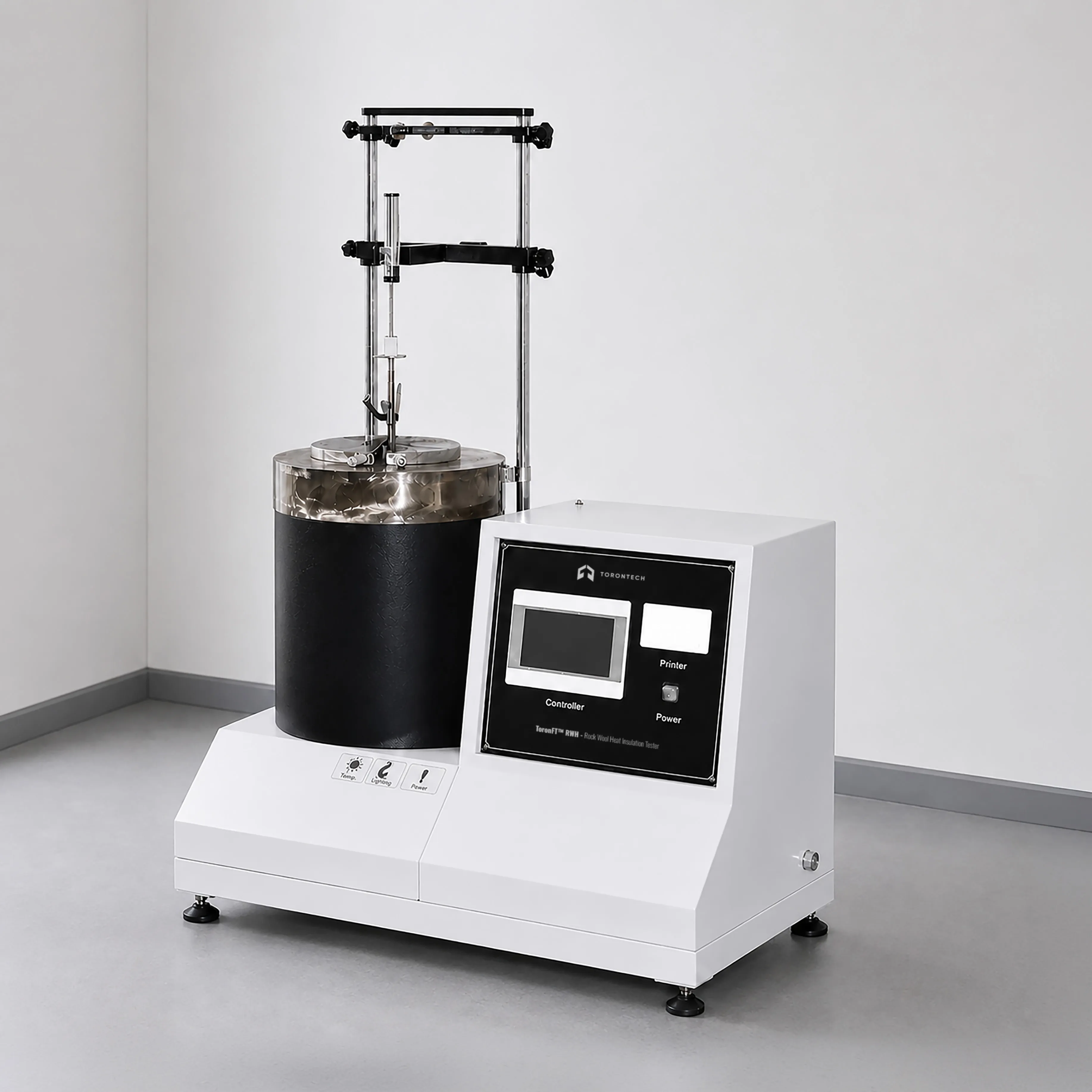
Rock Wool Heat Insulation Tester - ToronFT™ RWH Key Features
The ToronFT™ RWH combines guarded-plate accuracy with automated temperature control and reporting.
- Guarded Hot Plate Design: central metering plate with a matched guard ring drives one-dimensional heat flow for absolute conductivity measurement
- Dual-Specimen Configuration: two matched specimens above and below the hot plate balance the heat path and double the metered area
- Direct Conductivity Readout: results report in watts per meter-kelvin without a calibration sample
- Automated Temperature Control: independent hot and cold plate control reaches and holds the set gradient with a stable, fast response
- Real-Time Monitoring: a large display shows hot-plate, cold-plate, and heat-flux readings as the test runs toward steady state
- Fixed-Thickness Clamping: an adjustable holder sets and holds specimen thickness so compressible materials are measured at a known dimension
- Computer Data System: software logs temperature curves, computes conductivity and resistance, and generates a printable report
- Broad Material Range: handles rock wool, glass wool, foams, boards, and composite panels within the specimen and conductivity limits
Theory and Method
Heat conduction through a flat material follows Fourier's law: the heat flow equals the thermal conductivity times the area and temperature difference, divided by the thickness. Rearranged, conductivity is k = (Q × d) / (A × ΔT), where Q is the heat flow through the metered area A, d is the specimen thickness, and ΔT is the temperature difference across it. The guarded hot plate measures each of those quantities directly, which is why it is treated as an absolute method that needs no reference material. The result is the steady-state thermal conductivity in watts per meter-kelvin.
The challenge in the measurement is making sure all the metered heat actually passes through the specimen. The ToronFT™ RWH surrounds the central metering plate with a guard heater held at the same temperature, so no heat escapes sideways from the metered zone. Two identical specimens are clamped symmetrically above and below the hot plate, with cold plates on their outer faces, which doubles the metered area and balances the heat path. Thermocouples track the plate surface temperatures while the system holds the gradient steady.
A reading is only valid once the system reaches steady state, meaning the temperatures and power stop drifting. The ToronFT™ RWH monitors the plate temperatures and heater power until they settle, then records the values and computes conductivity over the metered area and measured thickness. Because rock wool and similar materials compress, the instrument fixes the specimen thickness during the test so the calculation uses the true tested dimension. The software stores the data and produces a report with the conductivity, resistance, and test conditions.
Rock Wool Heat Insulation Tester - ToronFT™ RWH Technical Specifications
| Parameter | Specification |
|---|---|
| Test Method | Guarded hot plate (absolute) |
| Thermal Conductivity Range | 0.010 to 5.000 W/(m·K) |
| Measurement Accuracy | Better than ±3% |
| Specimen Size | 300 × 300 mm |
| Specimen Thickness | 5 to 50 mm |
| Hot Plate Temperature | Room temperature to 80°C |
| Temperature Control | Independent hot and cold plate control |
| Data System | Microcomputer control with real-time curve display and report output |
| Voltage | AC 220 V (110V is also available) |
| Power Consumption | < 4.5 kW |