
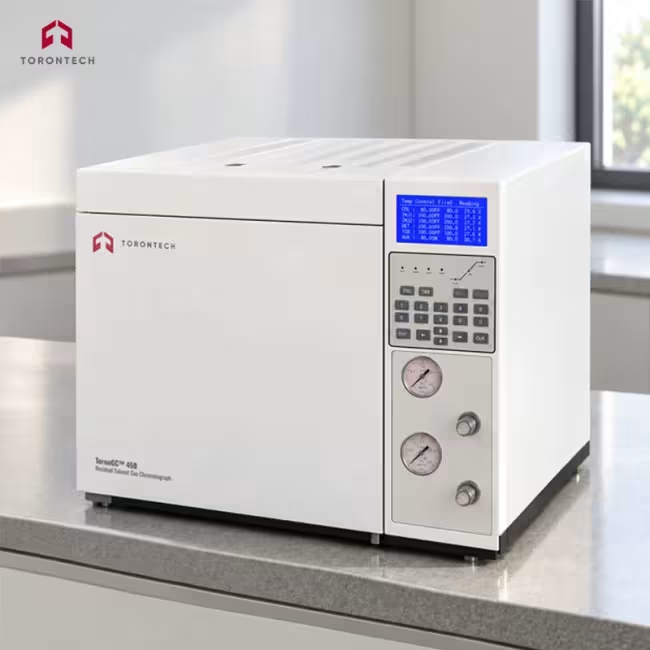
Residual Solvent Gas Chromatograph
Residual Solvent Gas Chromatograph - ToronGC™ 450
Gas Chromatograph for Solvent Residue in Flexible Packaging
ToronGC™ 450 is a residual solvent gas chromatograph that measures organic solvent residue on printed films, laminated films, extrusion films, and drug-use films and sheets. The instrument uses gas chromatography with flame ionization detection to separate and quantify individual solvents, and it also measures the water content of organic solvents for purity checks. It suits food and pharmaceutical packaging QC, quality inspection departments, and R&D labs.
Dual FID detectors with dual gas circuits give high sensitivity to organic solvents, and automatic ignition and self-diagnosis simplify daily operation. Constant and 9-stage programmed temperature control, with ramp rates of 1 to 50°C per minute, resolve solvents across a range of volatilities in one run. A zero-dead-volume capillary column and tight temperature accuracy keep peaks sharp and retention times repeatable.
A variable-frequency cooling system returns the oven near room temperature quickly between methods, and the instrument records parameters automatically even through a power interruption. An optional headspace injection device runs the standard headspace method for packaging solvent residue. The bundled chromatography workstation handles method setup, data acquisition, and reporting, so the ToronGC™ 450 works as a complete residual-solvent analysis system.
Residual Solvent Gas Chromatograph - ToronGC™ 450 Applications
The ToronGC™ 450 measures solvent residue and solvent purity across packaging manufacturing and quality control.
- Flexible Packaging Solvent Residue: measures residual solvent on printed, laminated, and extrusion films used in food and consumer packaging.
- Printing Ink and Lamination QC: checks solvent residue left by solvent-based inks and adhesives after printing and lamination.
- Food Packaging Compliance: supports residual solvent testing of food-contact films to meet safety requirements.
- Pharmaceutical Packaging: tests solvent residue on drug-use films and sheets for medicine packaging.
- Benzene and Aromatic Solvent Screening: quantifies benzene, toluene, and other aromatic solvent residues of concern in packaging.
- Solvent Purity and Water Content: measures the water content of organic solvents for incoming-material QC.
- Converting and Coating Lines: monitors solvent residue during film conversion and coating operations.
- R&D and Quality Inspection Labs: supports method development and routine solvent-residue inspection.
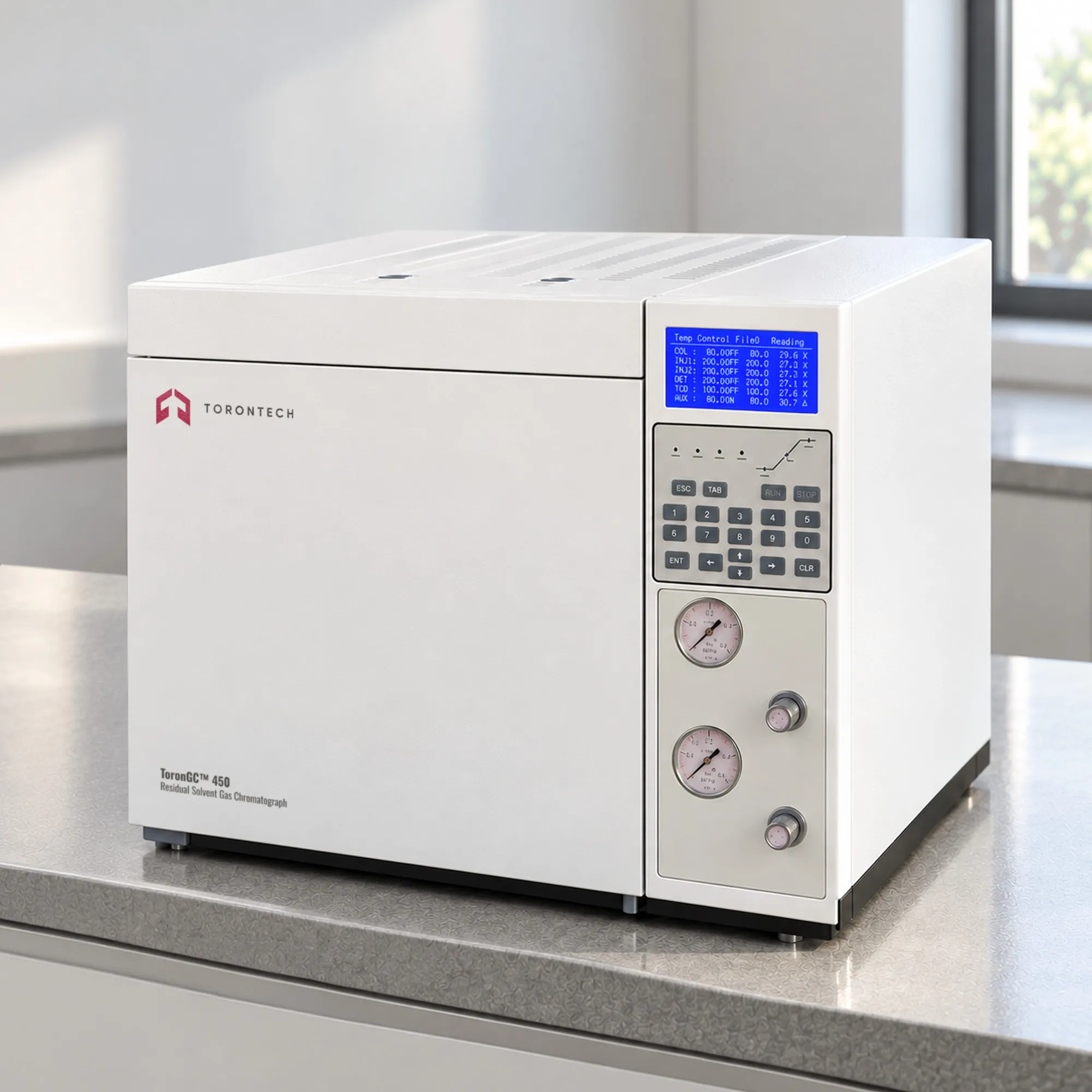
Residual Solvent Gas Chromatograph - ToronGC™ 450 Key Features
The ToronGC™ 450 combines dual-FID gas chromatography with programmed temperature control for reliable residual-solvent analysis.
- Residual Solvent and Solvent Purity in One: measures organic solvent residue on films and the water content of organic solvents on a single instrument.
- Dual FID Detectors: two flame ionization detectors with dual gas circuits support parallel or comparative analysis with high sensitivity to organic solvents.
- Automatic Ignition: the flame ionization detector lights automatically at the start of a run.
- Programmed Temperature Control: constant and 9-stage programmed control, with ramp rates of 1 to 50°C per minute and per-stage dwell times to 300 minutes.
- Tight Temperature Accuracy: temperature control holds better than 0.1°C for repeatable retention times and quantitation.
- High-Efficiency Capillary Column: a zero-dead-volume capillary column with fast temperature rise gives sharp peaks and short run times.
- Variable-Frequency Cooling: a variable-frequency cooling system brings the oven near room temperature quickly for low-temperature methods.
- Dual-CPU Design: two CPUs and electromagnetic-interference protection give stable, reliable operation.
- Carrier-Gas Flow Monitoring: flow monitoring protects the detector and column from damage.
- Over-Temperature Protection: built-in protection guards the oven and detectors.
- Power-Loss Parameter Retention: the instrument records method parameters automatically, even through a power interruption.
- Self-Diagnosis: onboard diagnostics flag faults for quick troubleshooting.
- Chromatography Workstation: the bundled workstation software handles method setup, acquisition, and reporting.
- Optional Headspace Injection: an optional headspace autosampler runs the standard headspace method for residual solvent in packaging.
Theory and Method
Residual solvent testing measures the volatile organic solvents left in a printed or laminated film after ink and adhesive drying. A film sample is sealed in a vial and heated so the residual solvents evaporate into the headspace above the sample. A measured volume of that headspace gas is injected into the gas chromatograph, which separates the individual solvents.
Inside the chromatograph, a carrier gas sweeps the sample through a capillary column held at a controlled temperature. Each solvent travels through the column at a rate set by its interaction with the column coating, so the solvents separate and leave the column at different times. A flame ionization detector burns each solvent as it elutes and produces a signal proportional to its amount.
The resulting chromatogram identifies each solvent by its retention time and quantifies it from its peak area against a calibration. Programmed temperature control resolves solvents with a wide range of volatilities in one run, and the flame ionization detector gives high sensitivity to organic compounds. The same platform also measures the water content of organic solvents for purity checks.
Residual Solvent Gas Chromatograph - ToronGC™ 450 Technical Specifications
| Parameter | Specification |
|---|---|
| Injector Temperature | Room temperature +5°C to 450°C, ±0.1°C (at 200°C) |
| Detector Temperature | Room temperature +5°C to 450°C, ±0.1°C (at 200°C) |
| Column Oven Temperature | Room temperature +5°C to 420°C, ±0.1°C (at 200°C) |
| Programmed Temperature Stages | 9 grades (customization available) |
| Ramp Rate | 1°C to 50°C per minute |
| Dwell Time per Stage | 0 to 300 min |
| Detection Limit | ≤ 5×10⁻¹² g/s |
| Baseline Noise | ≤ 0.01 mv |
| Baseline Drift | ≤ 0.1 mv |
| Linearity | 10⁶ |
| Signal Stabilization Time | < 20 min |
| Ignition | Automatic |
| Dimensions | 280 mm × 280 mm × 250 mm |
Standard Delivery
| Item | Description |
|---|---|
| Main Unit | Gas chromatograph with flame ionization detection |
| FID Detector | Flame ionization detector for organic solvent analysis |
| Capillary Column | High-efficiency capillary column for solvent separation |
| Chromatography Workstation | Method setup, data acquisition, and reporting software |
Optional Accessories
| Item | Description |
|---|---|
| Headspace Injection Device | Headspace autosampler for the standard residual-solvent method |
| Air Generator | Supplies combustion air for the flame ionization detector |
| Hydrogen Generator | Supplies fuel gas for the flame ionization detector |
| Nitrogen Generator | Supplies carrier gas for the chromatograph |