
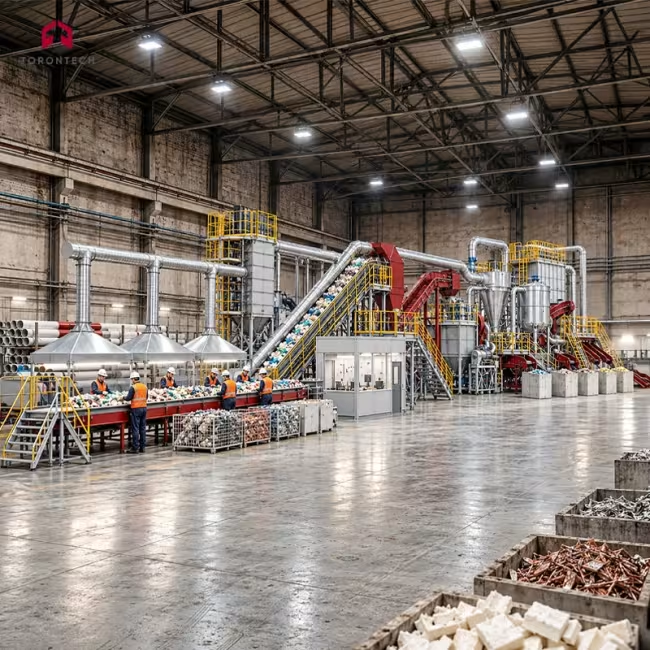
Refrigerator Recycling Line - ToronEWR™ Refri
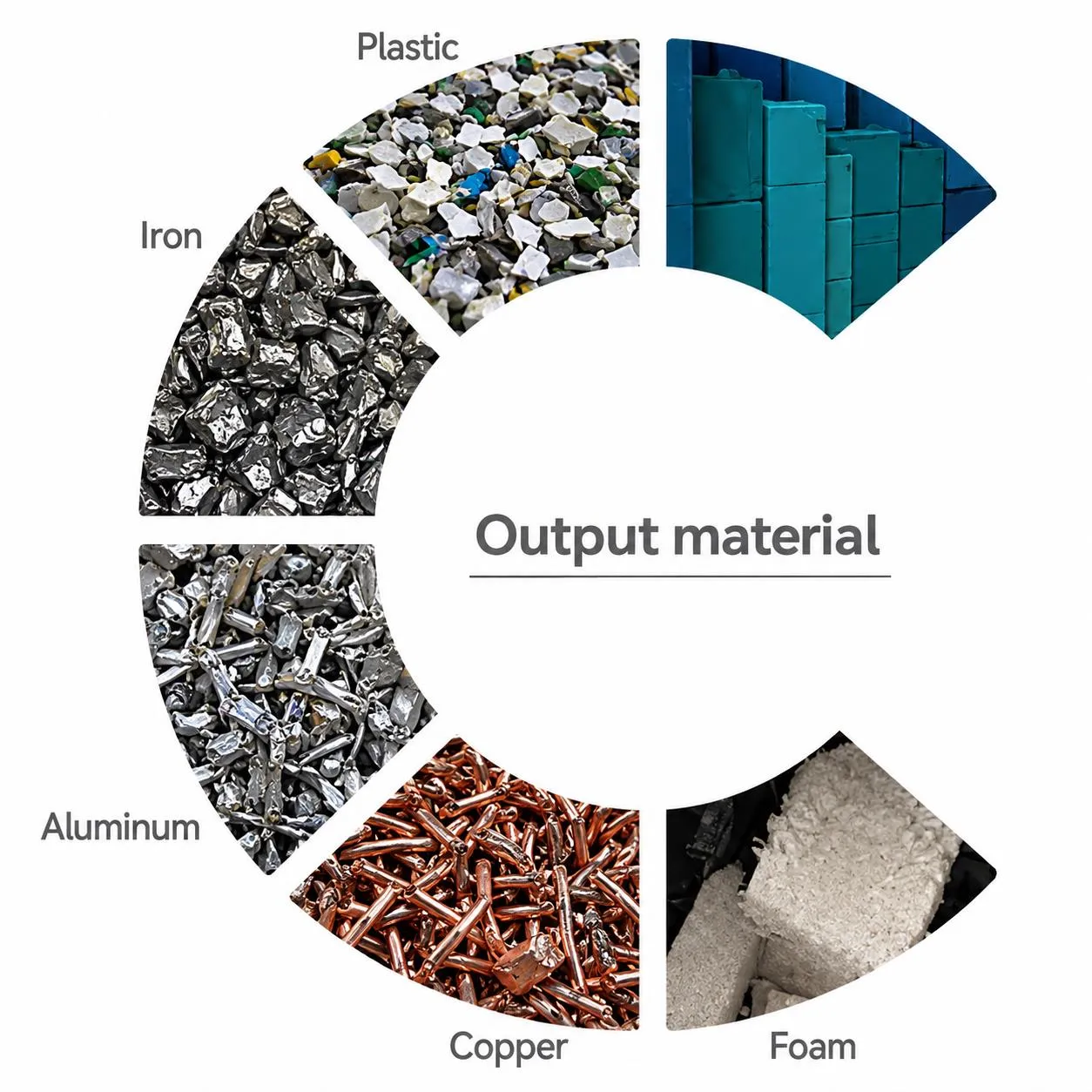
ToronEWR™ Refri refrigerator recycling line shreds, separates, and recovers material from end-of-life refrigerators and freezers at 50 to 120 units per hour. Five output streams leave the process: iron, aluminum, copper, plastic, and compacted polyurethane foam. Metal separation runs above 98 percent and plastic separation above 97 percent according to supplier data. Appliance recyclers, scrap processors, and WEEE contractors use the line to convert bulky whole units into graded, saleable fractions.
Refrigerant and compressor removal happen before material reaches this line. Units arrive already degassed and stripped of the compressor, which is how appliance recycling is sequenced under most regulatory regimes. What remains is the cabinet: sheet steel, plastic liner, aluminum and copper tubing, cable, and the polyurethane foam insulation bonded between shell and liner. Separating that foam cleanly from the metal and plastic around it is the work the line performs.
Foam handling shapes the entire design. Polyurethane insulation holds a flammable blowing agent, so the shredding stage operates under nitrogen to keep oxygen below the level that supports ignition. Foam also occupies enormous volume relative to its weight, which is why the line compacts it hydraulically at a ratio of 1 to 8. Hydraulic pressure works slowly and generates no frictional heat, removing a fire path that mechanical compaction would introduce.
Refrigerator Recycling Line - ToronEWR™ Refri Applications
The ToronEWR™ Refri line serves operators processing cooling appliances as a dedicated volume stream rather than as mixed scrap.
- Appliance Recycling Facilities: processes collected refrigerators and freezers into graded metal, plastic, and foam fractions for onward sale
- WEEE Treatment Operators: handles the temperature exchange equipment category, which regulators treat separately from other electrical waste
- Municipal Collection Programs: converts bulky white goods gathered through curbside and drop-off schemes into recoverable material
- Scrap Metal Processors: adds cooling appliance capability so whole units become accepted feedstock rather than a rejected input
- Retailer Takeback Programs: processes units returned through trade-in and delivery exchange schemes at volume
- Commercial Refrigeration Recovery: treats display cases, chest freezers, and other large-capacity units the line is configured to handle
- Ferrous Scrap Recovery: produces iron with a bulk density at or above 0.8 tons per cubic meter, suitable for melt shop feed
- Non-Ferrous Metal Recovery: recovers aluminum and copper from evaporator tubing, condenser coils, and wiring
- Plastic Recycling Operations: supplies separated cabinet and liner plastic carrying foam content at or below 1.5 percent
- Polyurethane Foam Recovery: delivers compacted foam blocks for downstream blowing agent recovery or thermal treatment
- Cable and Wire Recovery: separates most insulated cable automatically during processing rather than through manual picking
- Waste Management Contractors: brings appliance processing in house instead of routing units to third-party treatment
Refrigerator Recycling Line - ToronEWR™ Refri Key Features
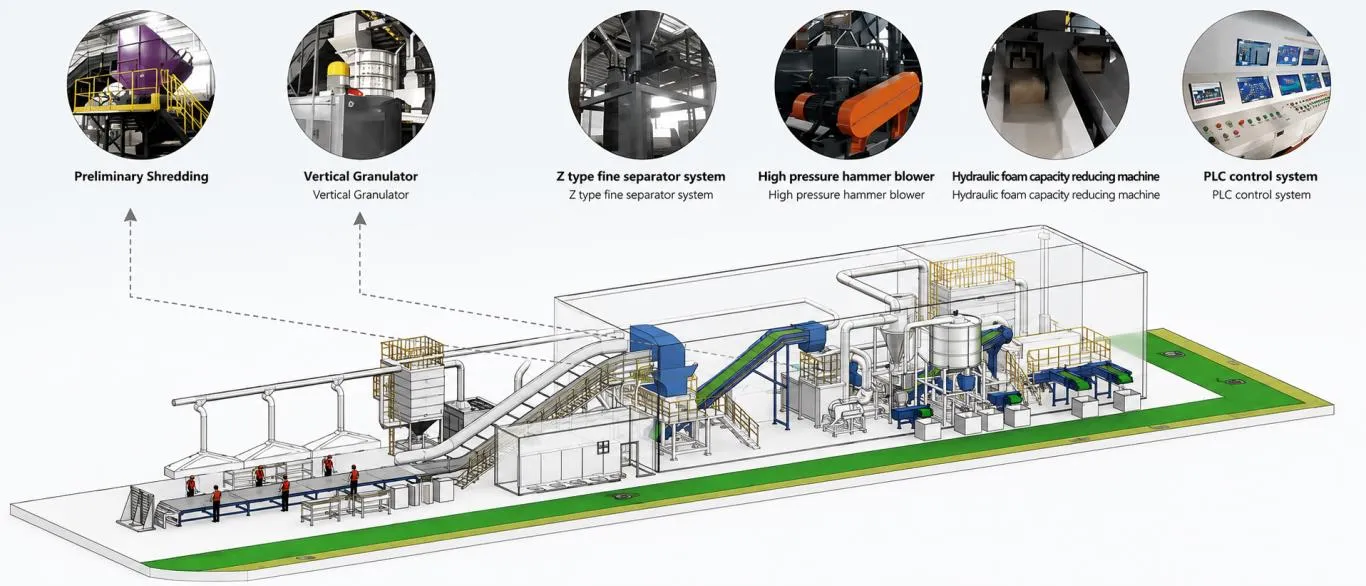
The ToronEWR™ Refri line pairs staged size reduction with air-based density separation and dedicated foam handling, backed by a layered safety system.
- Metal Separation Above 98 Percent: supplier data reports better than 98 percent of metal content recovered into the metal fractions
- Plastic Separation Above 97 Percent: supplier data reports better than 97 percent plastic recovery, with foam content held at or below 1.5 percent
- Low Foam Contamination: plastic content in the recovered foam fraction stays at or below 3 percent, protecting downstream foam processing
- Nitrogen Inerting at the Shredder: a nitrogen generator displaces oxygen inside the twin-shaft shredder, holding down the flash explosion risk that released blowing agent creates
- Layered Fire Protection: flammable gas detection, fire alarm, spray suppression, and automatic shutdown operate together rather than as a single safeguard
- Independent Extraction System: a dedicated ventilation system handles dust and exhaust air separately from the process stream
- Hydraulic Foam Compaction at 1:8: hydraulic pressure reduces foam volume eightfold without generating the frictional heat that creates a fire path
- High-Pressure Hammer Blower: one machine collects and crushes foam at the same time, which improves foam reduction and lowers energy consumption across the line
- Low-Speed High-Torque Preliminary Shredder: horizontal twin-shaft tearing opens cabinets quietly and without the heat that faster cutters generate
- Vertical Granulator with Full Peeling: secondary crushing strips material apart to the particle size the fine separator needs, producing iron at 0.8 tons per cubic meter or better
- Uniform Output Particle Size: consistent granulation across the stream is what allows the density separator to work accurately
- Automatic Cable Separation: the process pulls most insulated cable out without manual picking
- Large-Capacity Unit Handling: the line is configured for oversized refrigerators and chest freezers rather than domestic units alone
- Siemens PLC Control: real-time monitoring covers the full process, with remote monitoring available on request
- Convenient Maintenance Access: the crushing chamber allows straightforward removal of foreign objects, and wear parts are designed for extended service
Theory and Method
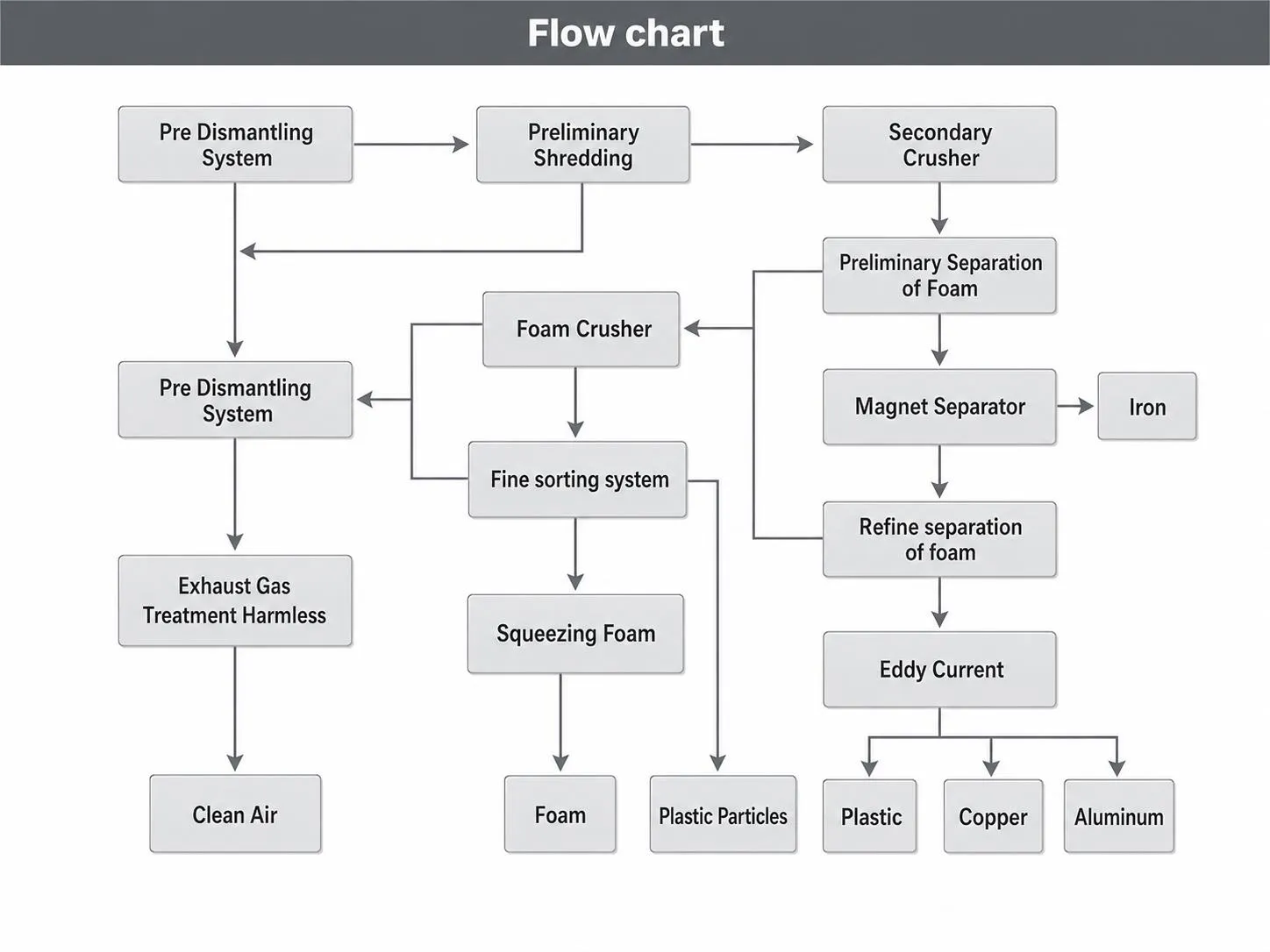
A refrigerator cabinet is a bonded sandwich. Polyurethane foam is injected between the outer steel shell and the inner plastic liner, where it cures and adheres to both surfaces. That bond is what makes recovery difficult: no sorting method reaches the foam until the sandwich is broken open and the three materials travel as separate particles. Shredding and granulation exist to liberate them, and every separation stage downstream depends on how completely that liberation happened.
The blowing agent trapped in the foam cells drives the safety design. Cutting the foam releases that gas into the shredder enclosure, where it would otherwise build toward a flammable concentration. A nitrogen generator displaces oxygen inside the twin-shaft shredder, holding the atmosphere below the level combustion requires. Gas detection, fire alarm, spray suppression, and automatic shutdown sit behind that as layered protection, and an independent extraction system draws dust and released gas away from the process.
Separation then exploits an unusually wide density spread. Polyurethane foam sits near 0.03 grams per cubic centimeter, cabinet plastics fall between 0.9 and 1.4, and metals run from 2.7 for aluminum up to 8.9 for copper. The Z-type separator uses air as its medium, so airflow lifts the light fraction while gravity carries dense particles down. A second pass through the separator pulls thin plastic film out of the foam stream, which raises plastic recovery and lowers the foam content left in the plastic fraction.
Refrigerator Recycling Line - ToronEWR™ Refri Technical Specifications
System Overview
| Parameter | Specification |
|---|---|
| System Type | Shredding, separation, and foam recovery line for cooling appliances |
| Production Capacity | 50 to 60 units/hour, or 80 to 120 units/hour depending on configuration |
| Processable Feedstock | End-of-life refrigerators and freezers with refrigerant and compressor already removed |
| Output Materials | Iron, aluminum, copper, plastic, compacted polyurethane foam |
| Metal Separation Rate | Above 98 percent (supplier stated) |
| Plastic Separation Rate | Above 97 percent (supplier stated) |
| Foam Content in Plastic | 1.5 percent or below |
| Plastic Content in Foam | 3 percent or below |
| Recovered Iron Bulk Density | 0.8 t/m³ or above |
| Foam Volume Reduction Ratio | 1:8 by hydraulic compaction |
| Atmosphere Control | Nitrogen generator serving the twin-shaft shredder |
| Safety Systems | Flammable gas detection, fire alarm, spray suppression, automatic shutdown |
| Dust and Exhaust Handling | Independent ventilation and extraction system |
| Control System | Siemens PLC with real-time process monitoring |
| Remote Monitoring | Available on request |
| Cable Handling | Most insulated cable separated automatically |
Machine Line-Up
The line is assembled from the modules below. Each stage is described with its function, working method, and available parameters.
1. Feeding System
Degassed cabinets are loaded onto the infeed conveyor and carried into the preliminary shredder at a controlled rate. Metered feeding keeps the shredder within its working load and prevents the surge that dropping several units at once would cause.
| Parameter | Specification |
|---|---|
| Function | Meters whole cabinets into the preliminary shredder |
| Feed Material | Refrigerators and freezers, refrigerant and compressor removed |
| Feed Method | Loader or manual charging onto infeed conveyor |
| Configuration | Sized to unit dimensions and hourly throughput target |
2. Preliminary Shredder
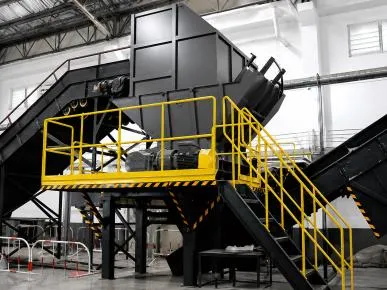 | The preliminary shredder performs first-stage horizontal tearing on pre-dismantled cabinets. Slow shaft rotation combined with high torque opens the steel and plastic sandwich without stalling, and the low-speed action keeps noise levels down. This is the stage where foam is first cut open, which is why the nitrogen system serves it directly. |
| Parameter | Specification |
|---|---|
| Function | First-stage tearing of whole refrigerator cabinets |
| Configuration | Horizontal twin-shaft shredder |
| Operating Speed | Low speed |
| Torque Characteristic | High torque across the working range |
| Noise Profile | Low noise operation |
| Atmosphere | Served by the nitrogen inerting system |
| Output | Torn cabinet fragments for secondary granulation |
3. Nitrogen Inerting System
A nitrogen generator supplies inert gas to the twin-shaft shredder enclosure. Displacing oxygen at the point where foam cells are first opened keeps the released blowing agent below the concentration at which a flash explosion becomes possible.
| Parameter | Specification |
|---|---|
| Function | Oxygen displacement at the primary shredding stage |
| Gas Supply | On-site nitrogen generator |
| Coverage | Twin-shaft shredder enclosure |
| Hazard Addressed | Flammable blowing agent released from foam cells |
| Process Purpose | Holds atmosphere below the level that supports combustion |
4. Vertical Granulator
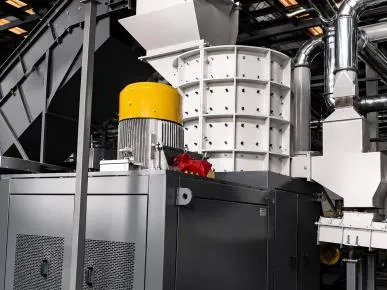 | The granulator carries out secondary crushing and full peeling. Material is worked until the discharge size meets what the fine separator requires, and the peeling action strips foam away from the metal and plastic surfaces it bonded to. Recovered iron leaves this stage at a bulk density of 0.8 tons per cubic meter or better. |
| Parameter | Specification |
|---|---|
| Function | Secondary crushing and peeling of shredded material |
| Output Size | Set to the requirement of the fine separation stage |
| Peeling Action | Strips foam from bonded metal and plastic surfaces |
| Iron Bulk Density | 0.8 t/m³ or above |
| Particle Consistency | Uniform output size across the discharge stream |
| Maintenance | Crushing chamber allows convenient removal of foreign objects |
5. Z-Type Fine Separator System
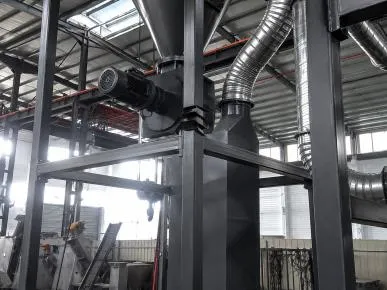 | The fine separator uses air as its separation medium. Airflow and gravity act together on the material so particles divide according to density, splitting light foam from heavier plastic and metal. A second separation pass works on the foam stream specifically, pulling thin plastic out to raise plastic recovery. |
| Parameter | Specification |
| Function | Density-based separation of foam, plastic, and metal fractions |
| Separation Medium | Air |
| Working Principle | Combined airflow and gravitational action |
| Second Pass | Applied to the foam stream to recover thin plastic |
| Process Benefit | Raises plastic recovery and lowers foam content in plastic |
6. High-Pressure Hammer Blower
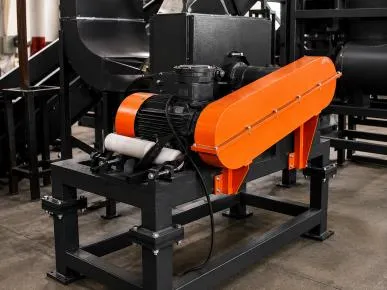 | The hammer blower collects and crushes foam in a single operation. Handling both functions in one machine improves foam reduction and prepares the material for the second separation of plastic from foam. This unit accounts for much of the line's energy efficiency. |
| Parameter | Specification |
|---|---|
| Function | Simultaneous collection and crushing of polyurethane foam |
| Working Principle | High-pressure hammer action with integrated air conveying |
| Process Benefit | Improves foam reduction and supports plastic and foam separation |
| Energy Profile | Contributes to low power consumption across the line |
7. Hydraulic Foam Compaction Machine
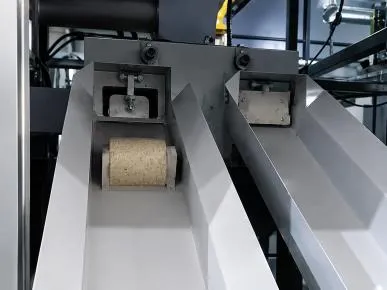 | Recovered foam is compressed into blocks for transport and storage. Hydraulic pressure achieves a volume reduction ratio of 1 to 8, and because the compression is slow and static, the foam does not heat during the operation. That absence of frictional heat removes a fire path that faster mechanical compaction would create. |
| Parameter | Specification |
|---|---|
| Function | Volume reduction of recovered foam into compacted blocks |
| Compression Method | Hydraulic pressure |
| Volume Reduction Ratio | 1:8 |
| Thermal Behavior | No heat generation during compression |
| Safety Benefit | Removes the ignition path associated with frictional heating |
| Output | Compacted foam blocks for storage, transport, or onward treatment |
8. Dust and Exhaust Extraction System
An independent ventilation system handles dust and exhaust air separately from the material process. Drawing released gas and airborne particulate away from the line supports both workplace conditions and the emission requirements the site operates under.
| Parameter | Specification |
|---|---|
| Function | Extraction and treatment of dust and process exhaust air |
| Configuration | Independent system, separate from material handling |
| Coverage | Shredding, granulation, and separation stages |
| Process Benefit | Supports workplace air quality and site emission compliance |
9. Gas Detection and Fire Safety System
Safety instrumentation runs across the process as a layered system. Flammable gas detectors monitor concentration continuously, and detection triggers alarm, spray suppression, and automatic shutdown rather than relying on operator response.
| Parameter | Specification |
|---|---|
| Function | Detection of flammable gas and automated fire response |
| Detection | Flammable gas detectors on the process line |
| Alarm | Fire detection alarm |
| Suppression | Spray suppression system |
| Automated Response | Automatic equipment shutdown on detection |
10. PLC Control System
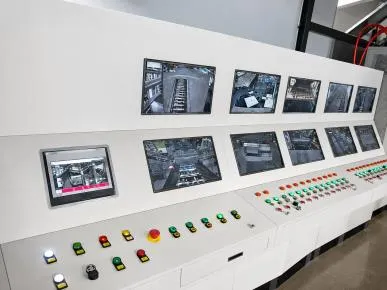 | A Siemens PLC governs the production line and provides real-time monitoring across the full process. Centralized control keeps operation consistent and straightforward, and remote monitoring can be configured where a site requires it. |
| Parameter | Specification |
|---|---|
| Function | Process control and real-time monitoring |
| Controller | Siemens PLC |
| Monitoring | Real-time across the full production line |
| Remote Access | Remote monitoring available on request |
| Operation | Centralized control with straightforward operator interface |