
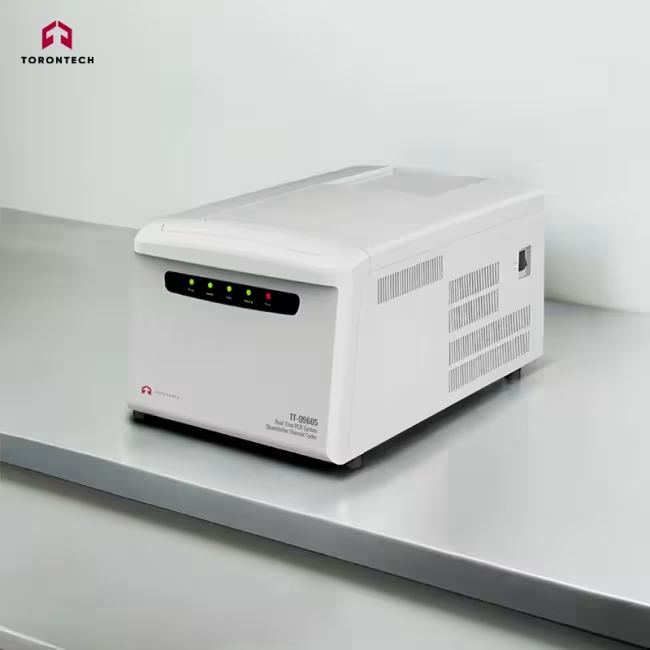
96-Well Real-Time PCR System
96-Well Real-Time PCR System - ToronPCR™ 9605
The ToronPCR™ 9605 is a 96-well real-time PCR system built for research labs that run full plates of gene expression, genotyping, and pathogen detection assays. It reads five fluorescence channels through a CMOS camera, so each well can quantify up to five targets in one run. Dual optical fibers under every well carry light to and from the sample, which raises detection efficiency and signal-to-noise ratio. Six independent Peltier temperature zones support gradient runs and multiple thermal profiles on one plate.
The 9605 accepts 96-well plates, 8-well strip tubes, and single transparent tubes with reaction volumes from 10 to 120 µL. Edge temperature compensation and precision sensors hold ±0.15°C accuracy and ±0.25°C uniformity across the block. That control reduces well-to-well variation and keeps Ct values consistent from edge to center. Detection reaches a single target copy, and the linear dynamic range spans 10 logs.
Researchers use this quantitative thermal cycler for multiplex expression profiling, SNP analysis, mutation screening, and molecular cloning checks. Software automates baseline and threshold setting and exports data in multiple formats for downstream analysis. The ToronPCR™ 9605 is intended for research use only and is not for diagnostic procedures.
Applications
The ToronPCR™ 9605 supports high-throughput qPCR workflows across life science research, agri-food testing, and animal health studies. Its five-channel optics and gradient block suit both routine runs and assay development.
- DNA and RNA Quantification: measures nucleic acid copy number in extracts for sequencing prep, cloning, and assay setup
- Gene Expression Analysis: tracks relative expression changes with reference-gene normalization across full plates
- Multiplex Gene Expression Profiling: quantifies up to five targets per well to compare pathways in a single run
- Pathogen Detection Research: identifies bacterial and viral targets in research samples with probe-based assays
- Genotyping and SNP Analysis: separates alleles with dual-probe assays read in separate fluorescence channels
- Mutation Screening: flags sequence variants in research models and candidate gene panels
- Molecular Cloning: confirms insert presence and estimates plasmid copy number in transformed clones
- Agri-Food Safety Testing: screens food, feed, and crop samples for microbial contaminants and GMO material
- Veterinary Testing: detects animal pathogens in livestock and companion animal research samples
Key Features
The ToronPCR™ 9605 combines dual-fiber optics, a six-zone Peltier block, and automated analysis software in one high-throughput platform. Each feature supports accurate quantification across full 96-well runs.
- Five-Channel Fluorescence Detection: runs up to five targets per well, which cuts reagent cost and sample consumption
- Dual Optical Fibers per Well: raise detection efficiency and signal-to-noise ratio for cleaner amplification curves
- CMOS Camera Detection: images the plate across five channels to capture consistent signal from every well
- Six Independent Temperature Zones: run gradient PCR or several thermal profiles on one plate to speed up optimization
- Peltier Heating and Cooling: deliver fast, uniform transitions at up to 5°C/sec heating and 4°C/sec cooling
- Edge Temperature Compensation: reduces well-to-well thermal variation for repeatable Ct values across the block
- Single-Copy Sensitivity: detects very low target levels and resolves 1.5-fold differences in singleplex reactions
- Automated Baseline and Threshold Setting: removes manual curve adjustment and speeds up data review
- Dedicated Analysis Modes: cover multiplex expression profiling, pathogen detection, and SNP analysis
- Multi-Format Data Export: moves results into statistics packages, LIMS, or reports without retyping
- Flexible Consumables: accepts 96-well plates, 8-well strips, and single tubes with 10 to 120 µL volumes
Theory and Method
Real-time PCR (qPCR) tracks DNA amplification cycle by cycle instead of measuring the product only at the end. Each cycle denatures double-stranded DNA near 95°C, anneals primers at a lower temperature, and extends new strands with a thermostable polymerase. A fluorescent reporter, either an intercalating dye such as SYBR Green or a sequence-specific probe, emits light in proportion to the product formed. During the exponential phase, the signal roughly doubles every cycle.
The instrument records the quantification cycle (Cq or Ct), where fluorescence crosses a set threshold. Samples with more starting template reach that threshold sooner. Ct falls linearly as the log of the initial copy number rises, so a standard curve converts Ct values into absolute quantities. The ΔΔCt method compares a target with a reference gene for relative quantification. The 9605 supports both approaches across 10 logs of linear range.
The 9605 uses a halogen lamp to excite the wells between 475 and 670 nm and a CMOS camera to capture emission from 515 to 680 nm. Five filter channels separate distinct dyes, so one well can carry an internal control plus four targets. Peltier modules drive heating and cooling, and six independent zones let users test several annealing temperatures on one plate during assay optimization.
Technical Specifications
Parameter | Specification |
Model | ToronPCR™ 9605 |
Description | 96-well real-time PCR instrument with 5 dye channel filters |
Sample Capacity | 96 wells, 0.2 mL plate |
Compatible Consumables | 96-well plates, 8-well strip tubes, single tubes (transparent) |
Reaction Volume | 10 to 120 µL |
Excitation Source | Halogen lamp |
Excitation Range | 475 to 670 nm |
Detection Method | CMOS camera |
Detection Range | 515 to 680 nm |
Detection Channels | 5 |
Temperature Range | 4 to 100°C |
Average Heating / Cooling Rate | 3.0°C/sec / 3.0°C/sec |
Maximum Heating / Cooling Rate | 5.0°C/sec / 4.0°C/sec |
Temperature Uniformity | ±0.25°C |
Temperature Accuracy | ±0.15°C |
Gradient | 6 independent temperature zones |
Detection Sensitivity | 1 copy |
Fold-Change Resolution | Detects 1.5-fold differences in target quantity (singleplex) |
Linear Dynamic Range | 10 logs |
Dimensions (W × D × H) | 600 × 390 × 320 mm |
Weight | 23 kg |
Intended Use | Research use only, not for diagnostic procedures |