
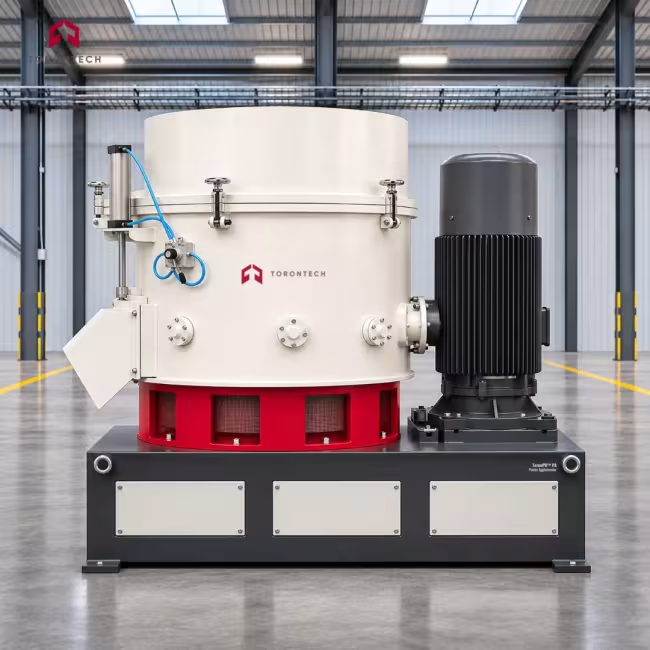
Plastic Agglomerator
Plastic Agglomerator - ToronPR™ PA Series
Plastic Film Agglomerator for PE, PP, PVC Film and Chemical Fiber Waste
The plastic agglomerator turns light, bulky film, bags, and fiber waste into dense, free-flowing granules that feed an extruder easily. Recyclers, film converters, and fiber producers use it to recover soft scrap that would otherwise bridge in a hopper or float through an extrusion line. The ToronPR™ PA cuts, heats, and compacts material in a single drum using a high-speed rotor against fixed blades. Six models cover drum volumes of 100 L through 800 L.
Loose film has a very low bulk density, which makes it slow and uneven to pelletize directly. Agglomerating first increases bulk density, so the extruder receives a steady, compact feed and runs at higher, more stable output. The machine handles PVC, LDPE, HDPE, LLDPE, and PP film, along with bags, filament, strapping, sheet, and degradable film. It also processes chemical fiber waste such as polyester, acrylic, and polypropylene fiber and waste filament.
A stainless steel 304 inner drum resists corrosion and keeps material contact surfaces clean. Operators load material by hand, and a pneumatic discharge door releases the finished granules at the end of each cycle. Rotor speeds of 750 to 1,050 rpm give the friction needed to soften material quickly. Torontech matches each drum size to the material type and the output a plant needs.
Plastic Agglomerator - ToronPR™ PA Series Applications
This film agglomerator suits operations that need to densify soft, light plastic or fiber scrap before reprocessing.
- Film Production Scrap: agglomerating edge trim, start-up waste, and rejected rolls from blown and cast film lines
- Bag and Packaging Converting: recovering bag, pouch, and sheet scrap from converting plants
- Post-Consumer Film Recycling: densifying washed and dried LDPE, LLDPE, and PP film before pelletizing
- PVC Film and Sheet Recovery: compacting PVC film and sheet trim for reprocessing
- Strapping and Raffia Recycling: processing PP strapping, belts, and raffia tape waste
- Synthetic Fiber Recovery: agglomerating polyester, acrylic, and PP fiber waste and waste silk from spinning and nonwoven plants
- Degradable Film Reprocessing: recovering degradable film offcuts and corners for reuse
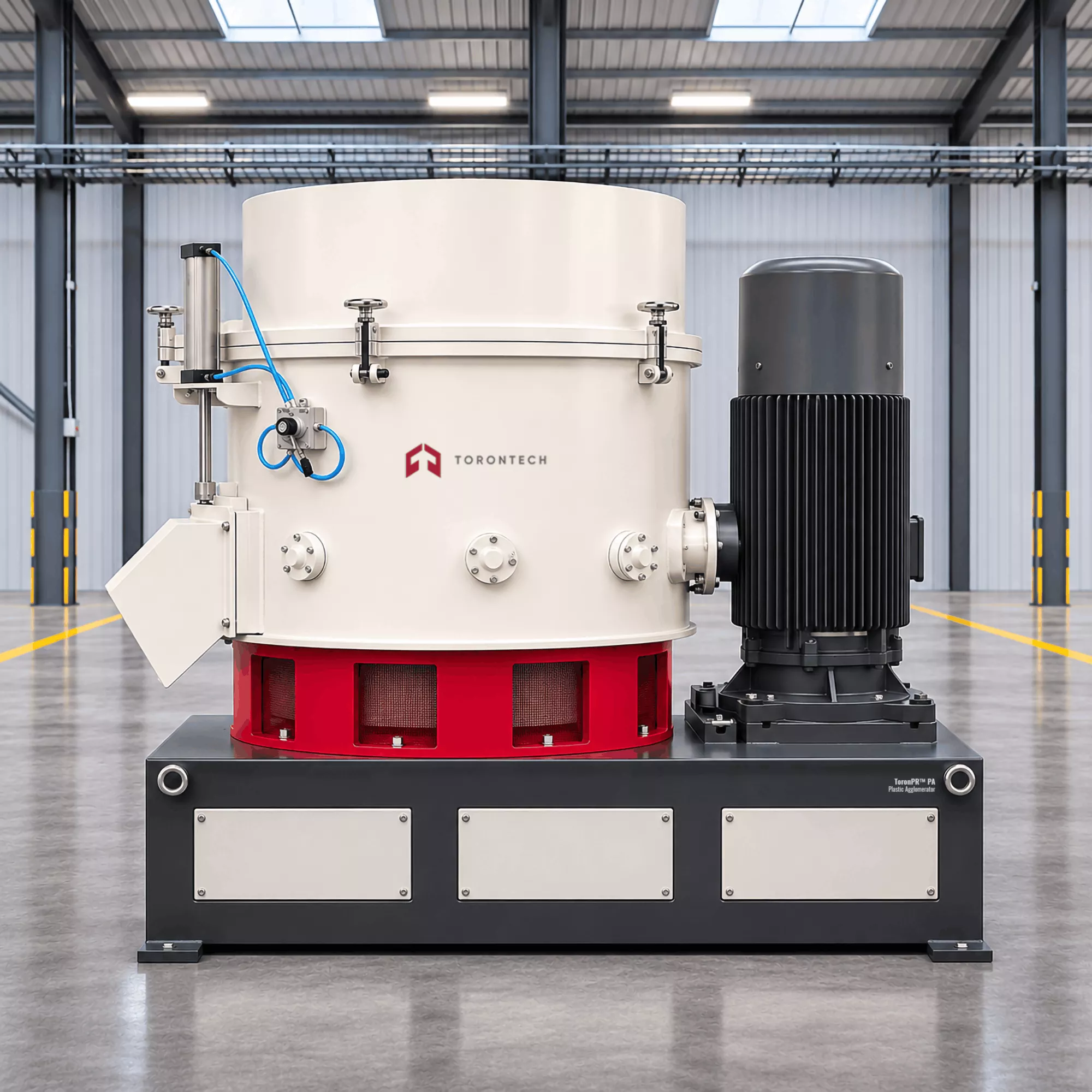
Plastic Agglomerator - ToronPR™ PA Series Key Features
The agglomerator combines cutting and densifying in one compact batch machine for soft plastic and fiber waste.
- Cut, Heat, and Densify in One Drum: a single machine turns loose film and fiber into dense granules without separate shredding
- High-Speed Rotor: main shaft speeds of 750 to 1,050 rpm generate the friction needed to soften material quickly
- Stainless Steel 304 Drum: a corrosion-resistant inner pot keeps material contact surfaces clean
- Hardened Alloy Steel Blades: rotary and fixed blades are made from hardened alloy tool steel for long cutting life
- Pneumatic Discharge: a pneumatically operated door releases finished granules quickly at the end of each batch
- Simple Manual Loading: operators load material directly into the drum without additional feeding equipment
- Wide Material Range: processes PVC, LDPE, HDPE, LLDPE, and PP film plus polyester, acrylic, and PP fiber waste
- Six Drum Sizes: total volumes of 100 L through 800 L, with motor power up to 132 kW
Theory and Method
Agglomeration combines cutting, frictional heating, and compaction in one drum. A rotor with blades spins at high speed at the bottom of the drum, throwing material against fixed blades mounted on the drum wall. The blades cut film and fiber into small pieces while the intense motion generates friction. That friction raises the material temperature steadily throughout the batch.
As the temperature approaches the plastic's softening point, the pieces become tacky and begin to shrink. Softened particles stick to one another and fuse into small, dense lumps. Agglomerators of this type use a small, controlled shot of water at this stage to cool the surface suddenly. The quick temperature drop sets the lumps, and the rotor breaks them into hard, irregular granules.
The pneumatic discharge door then opens and the rotor throws the finished granules out of the drum. The result has many times the bulk density of loose film or fiber. Dense granules flow freely from a hopper and feed an extruder screw consistently. Operators then reload the drum, so the machine works in repeated batches.
Plastic Agglomerator - ToronPR™ PA Series Technical Specifications
Models 100 to 300
| Parameter | ToronPR™ PA 100 | ToronPR™ PA 200 | ToronPR™ PA 300 |
|---|---|---|---|
| Total Volume | 100 L | 200 L | 300 L |
| Effective Volume | 75 L | 150 L | 225 L |
| Main Shaft Speed | 1,050 rpm | 1,000 rpm | 950 rpm |
| Capacity | 100 kg/h | 150 kg/h | 200 kg/h |
| Motor Power | 37 kW | 45 kW | 55 kW |
| Rotary Blades | 2 pcs | 2 pcs | 2 pcs |
| Fixed Blades | 6 pcs | 6 pcs | 8 pcs |
| Inner Drum Material | Stainless steel 304 | Stainless steel 304 | Stainless steel 304 |
| Feeding Method | Manual | Manual | Manual |
| Discharge Method | Pneumatic | Pneumatic | Pneumatic |
| Weight | 1,000 kg | 1,200 kg | 1,800 kg |
| Dimensions (L × W × H) | 1,700 × 750 × 1,500 mm | 1,700 × 850 × 1,500 mm | 2,000 × 850 × 1,600 mm |
Models 500 to 800
| Parameter | ToronPR™ PA 500 | ToronPR™ PA 600 | ToronPR™ PA 800 |
|---|---|---|---|
| Total Volume | 500 L | 600 L | 800 L |
| Effective Volume | 375 L | 450 L | 600 L |
| Main Shaft Speed | 750 rpm | 750 rpm | 750 rpm |
| Capacity | 300 kg/h | 400 kg/h | 550 kg/h |
| Motor Power | 75 kW | 90-110 kW | 132 kW |
| Rotary Blades | 4 pcs | 4 pcs | 4 pcs |
| Fixed Blades | 8 pcs | 8 pcs | 8 pcs |
| Inner Drum Material | Stainless steel 304 | Stainless steel 304 | Stainless steel 304 |
| Feeding Method | Manual | Manual | Manual |
| Discharge Method | Pneumatic | Pneumatic | Pneumatic |
| Weight | 2,500 kg | 3,500 kg | 3,800 kg |
| Dimensions (L × W × H) | 2,300 × 950 × 1,700 mm | 2,300 × 1,100 × 1,750 mm | 2,500 × 1,250 × 1,800 mm |
Parameters are for reference only and may change according to the final configuration.
Common Specifications
| Item | Description |
|---|---|
| Process Type | Batch agglomeration (cutting, frictional heating, and compaction) |
| Blade Material | Hardened alloy tool steel |
| Suitable Materials | PVC, LDPE, HDPE, LLDPE, and PP film, bags, filament, strapping, sheet, degradable film, polyester, acrylic, and PP chemical fiber, waste silk |